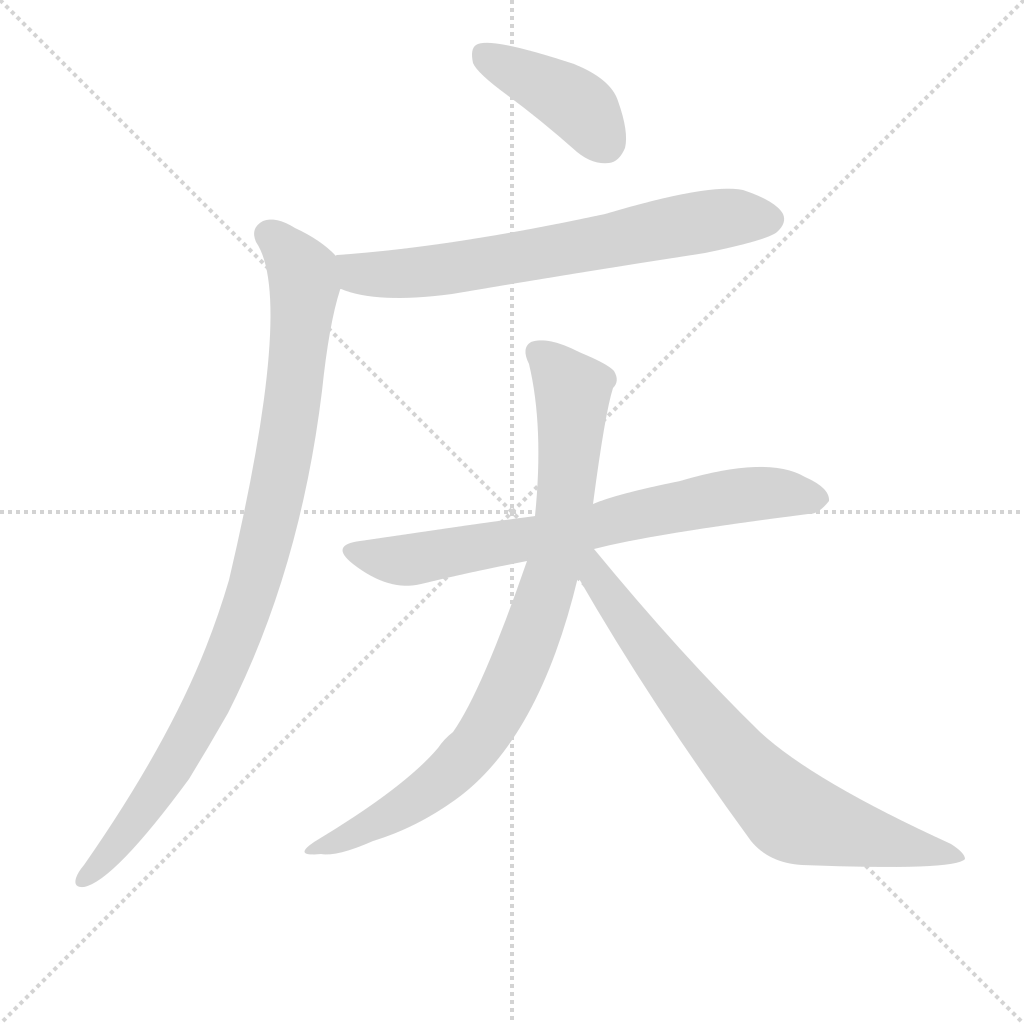
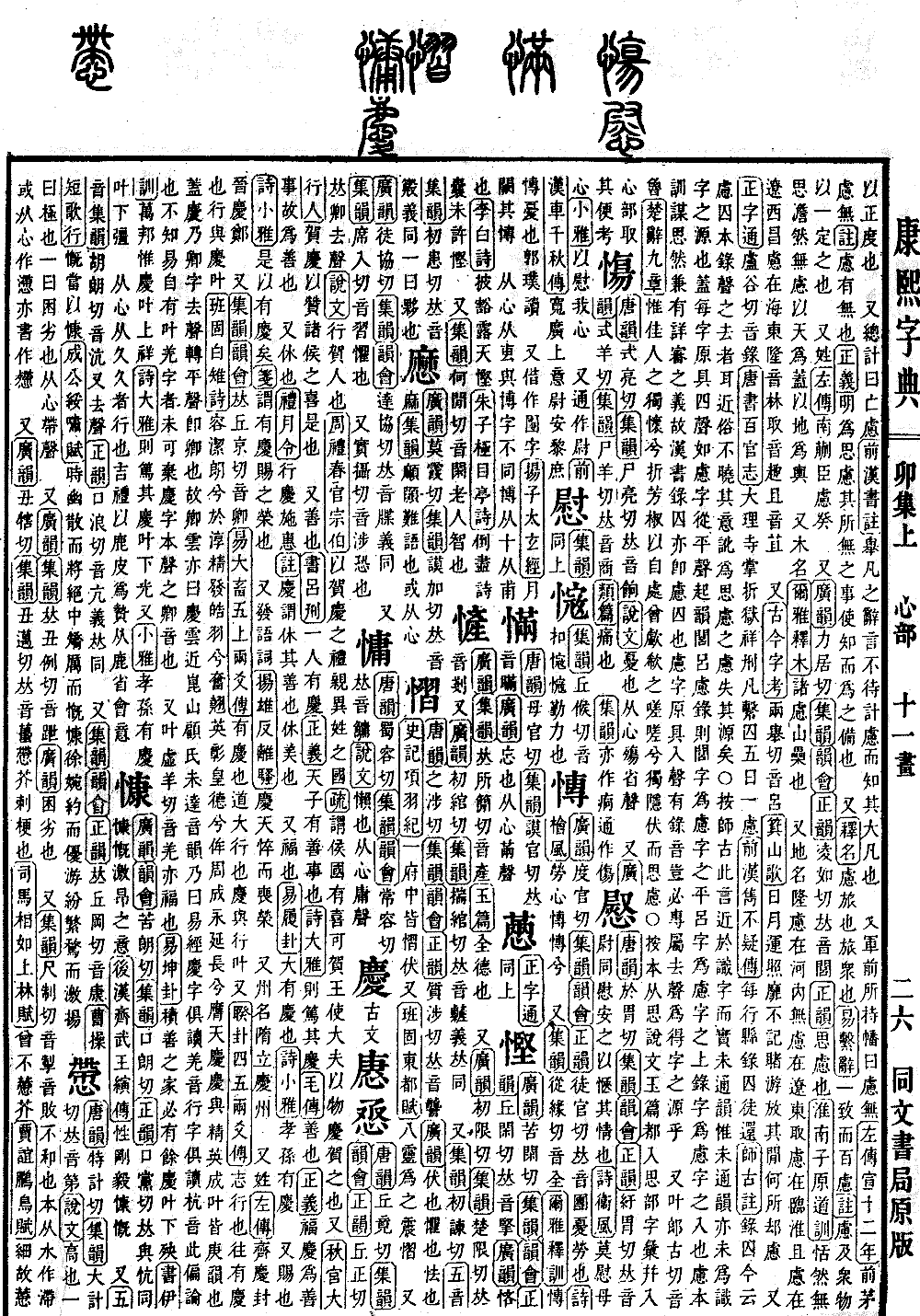
Mao Collection, Upper Volume
Radical: Heart (xīn)
Kangxi Strokes: 15
Page 400, Entry 01
Ancient character. According to the Tangyun (a rhyme dictionary), the pronunciation is qing (departing tone). According to the Jiyun (a rhyme dictionary), the Yunhui (a collection of rhymes), and the Zhengyun (a correction of rhymes), the pronunciation is also qing (departing tone). It is read like the word qing (minister) in the departing tone. According to the Shuowen Jiezi (a dictionary of characters), it refers to a person who goes to offer congratulations. According to the Book of Rites (Zhouli), Spring Offices, Minister of Rites (Zongbo): use the ceremonies of celebration and congratulation to draw closer to feudal states of different surnames. The commentary explains: this means when feudal states have happy events worthy of celebration, the Son of Heaven sends high officials bearing gifts to congratulate them. Also, according to the Autumn Offices, Great Minister of Protocol (Da Xingren): to assist in the happy events of feudal lords through celebration and congratulation, this is the meaning.
It also denotes goodness or virtue. According to the Book of Documents (Shujing), Counsels of Lu (Lü Xing): the Son of Heaven alone has good conduct. The commentary explains: this refers to the Son of Heaven having good fortune. According to the Book of Odes (Shijing), Greater Odes (Daya): thus favoring those with good conduct. The Mao commentary states: it means good. The commentary explains: blessings and celebrations are good things, hence it is interpreted as good.
It also refers to beauty or auspiciousness. According to the Book of Rites (Liji), Monthly Ordinances (Yueling): implement auspicious celebrations and bestow favors. The commentary states: celebration refers to praising good conduct. Xiu (rest/repose) means beauty.
It also refers to good fortune. According to the Book of Changes (I Ching), Treading Hexagram (Lü): has great good fortune and celebration. According to the Book of Odes (Shijing), Lesser Odes (Xiaoya): filial descendants have good fortune and celebration.
It also refers to rewards. According to the Book of Odes (Shijing), Lesser Odes (Xiaoya): therefore there were rewards. The Jian commentary states: this refers to the honor of receiving rewards.
It is also an initial particle. Yang Xiong, Anti-Li Sao: The heavens are withered and have lost their glory.
It is also the name of a prefecture. Established during the Sui Dynasty as Qing Prefecture.
It is also a surname. According to the Zuo Commentary (Zuo Zhuan), there was Qing Feng of the state of Qi, and Qing Zheng of the state of Jin.
According to the Jiyun and the Yunhui, it is pronounced qing (level tone), the same sound as qing (minister). According to the commentary on the fifth and top lines of the Great Livestock Hexagram (Da Chu) in the Book of Changes (I Ching): there is celebration, the righteous path is being greatly practiced. The character for celebration rhymes with the character for practice. Also, according to the commentary on the fourth and fifth lines of the Opposition Hexagram (Kui): the aspiration can be realized, to proceed will bring auspicious celebration. The character for practice rhymes with the character for celebration. According to Ban Gu, Poem on the White Pheasant: The appearance is clean and bright, lying in purity and sincerity, shining with white feathers, and rising with spirit. Displaying the virtue of the Emperor, comparable to King Cheng of Zhou, extending eternally, bearing the blessings and celebrations of Heaven. The character for celebration rhymes with words like qing (pure), ying (heroic), and cheng (complete), all belonging to the Geng rhyme category. It is likely that the character for celebration is the departing tone of the character for minister, and when transformed into the level tone, it becomes minister. Therefore, the clouds of ministers are also called celebration clouds. Recently, the Gu family of Kunshan, not understanding phonology, actually claimed that the characters for celebration in the Book of Changes (I Ching) should all be read with the sound qiang, and the characters for practice should be read with the sound hang. This is a one-sided view, not knowing that the Book of Changes (I Ching) itself has instances of rhyming with the character qiang. One cannot abandon the original ministerial pronunciation of the character for celebration.
It is also pronounced qiang when rhyming, also meaning good fortune. According to the Book of Changes (I Ching), Earth Hexagram (Kun): a family that accumulates goodness will certainly have abundant blessings and celebrations. It rhymes with the character for disaster (yang) in the following text. According to the Book of Documents (Shujing), Instructions of Yi (Yi Xun): all nations have therefore attained auspicious celebration. It rhymes with the character for auspicious (xiang) in the preceding text. According to the Book of Odes (Shijing), Greater Odes (Daya): thus favoring those with good conduct. It rhymes with the character for light (guang) in the following text. Also, in the Lesser Odes (Xiaoya): filial descendants have good fortune and celebration. It rhymes with the character for strong (qiang) in the following text.
The character form is composed of heart and long. Long means to walk. In auspicious rituals, deer skin is used as a formal gift, so the character form adopts an abbreviated version of the character for deer, making it a compound ideograph.