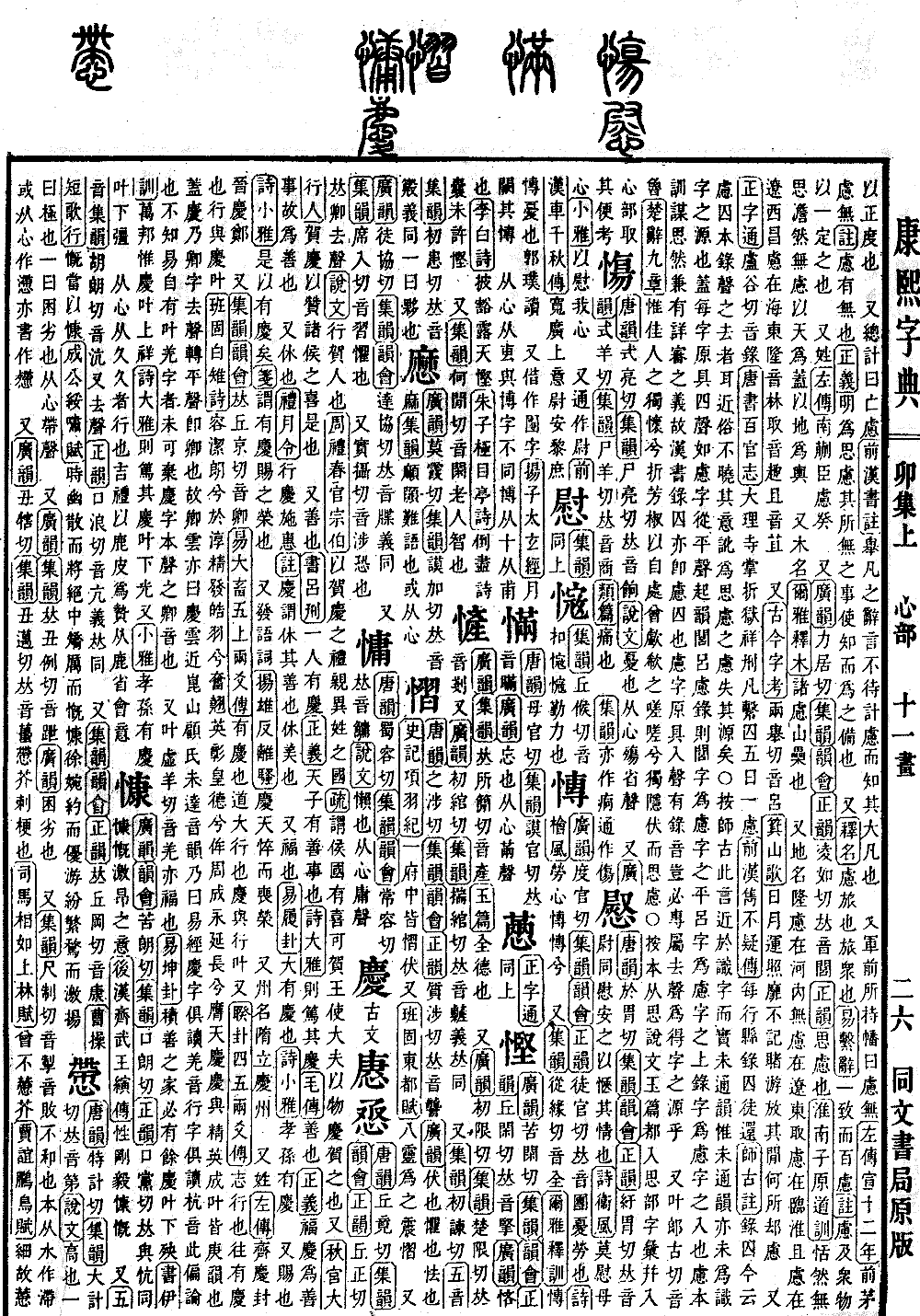
Mao Collection, Upper Volume
Radical: Heart (xīn)
Kangxi Strokes: 15
Page 400, Entry 13
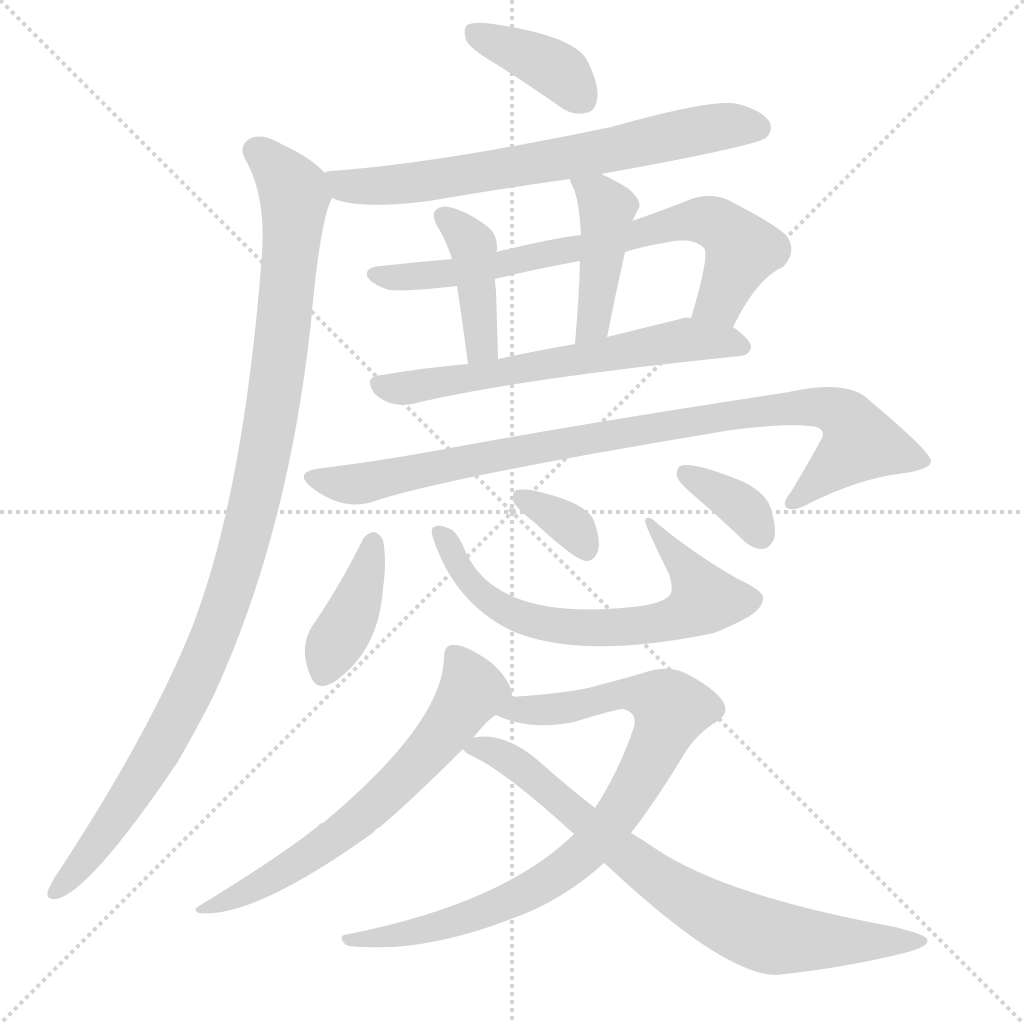
Ancient characters. Pronounced qìng (falling tone).
From the Shuowen Jiezi (Explanation of Simple and Compound Characters): refers to going to congratulate others.
Book of Rites (Zhouli), Spring Offices, Minister of Religion: Use the rituals of congratulation and celebration to draw near to the vassal states of different surnames. Commentary: This means that when a vassal state has a joyful event worthy of celebration, the King of Zhou sends an officer with gifts to offer congratulations.
Also, Autumn Offices, Minister of Ceremonies: To assist the joyful events of the vassal states through congratulation and celebration, this is the meaning.
Also refers to goodness or virtue.
Book of Documents (Shujing), Counsels of Yu: The Son of Heaven has one good deed.
Correct Meaning (Zhengyi): Refers to the Son of Heaven having good conduct.
Book of Odes (Shijing), Greater Odes: Thereupon favor that good deed.
Mao Commentary: Meaning goodness.
Correct Meaning: Good fortune and celebration are both auspicious, thus it is explained as goodness.
Also refers to beauty or excellence.
Book of Rites (Liji), Monthly Ordinances: Implement commendations and bestow favors.
Annotation: To celebrate is to commend his good deeds. Xiu (rest/repose) means beauty.
Also refers to good fortune.
Book of Changes (Yijing), Lu Hexagram: There is great good fortune.
Book of Odes (Shijing), Lesser Odes: Filial descendants have good fortune.
Also refers to rewards.
Book of Odes (Shijing), Lesser Odes: Therefore there are rewards.
箋 (Jian Annotation): Refers to the honor of having received rewards.
Also used as a sentence-initial particle.
Yang Xiong, Anti-Li Sao: Celebrating the heavens' withering and the loss of glory.
Also refers to a prefecture name. Established during the Sui Dynasty as Qing Prefecture.
Also a surname.
Zuo Commentary (Zuozhuan): Qing Feng of the State of Qi, Qing Zheng of the State of Jin.
Also pronounced qīng.
Book of Changes (Yijing), Greater Accumulation Hexagram, Five and Six爻 (Yao/Line) Commentary: Having good fortune and celebrations, the proper path is able to be widely practiced. Qing rhymes with Xing (practice).
Also, Opposition Hexagram, Four and Five爻 (Yao/Line) Commentary: Ambitions are able to be realized, proceeding will bring good fortune and celebrations. Xing rhymes with Qing.
Ban Gu, Poem on the White Pheasant: The countenance is pure and bright, rooted in purity and sincerity; spreading the white feathers, rising with a lofty posture. Manifesting the Emperor's virtue, equal to King Cheng of Zhou; lasting forever and ever, inheriting the good fortune of Heaven. Qing rhymes with words such as Jing (essence), Ying (hero), and Cheng (success), all belonging to the Geng rhyme group.
Generally, the character Qing is the falling tone of the character Qing; if transformed into the level tone, it is Qing. Thus, Qingyun (auspicious clouds) is also called Qingyun. Recently, the Gu family of Kunshan (Gu Yanwu) did not master phonology and actually claimed that all instances of the character Qing in the Book of Changes should be pronounced Qiang, and the character Xing should be pronounced Hang. This is a one-sided view and they were unaware that the Book of Changes originally contains rhymes with the character Qiang. One must not abandon the original Qing pronunciation of the character Qing.
Also rhymed as qiāng. Also signifies good fortune.
Book of Changes (Yijing), Kun Hexagram: A family that accumulates goodness will surely have surplus good fortune and celebration. Rhymes with Yang (calamity) below.
Book of Documents (Shujing), Instructions of Yi: All states under Heaven celebrate for this. Rhymes with Xiang (auspiciousness) above.
Book of Odes (Shijing), Greater Odes: Thereupon favor that good fortune and celebration. Rhymes with Guang (light) below.
Also, Lesser Odes: Filial descendants have good fortune and celebration. Rhymes with Qiang (strength) below.
The character structure is composed of Heart and Jiu. Jiu means to walk. In auspicious rituals, deer skin is used as a formal gift; the character shape is an abbreviated form of Deer, belonging to the category of compound ideographs.