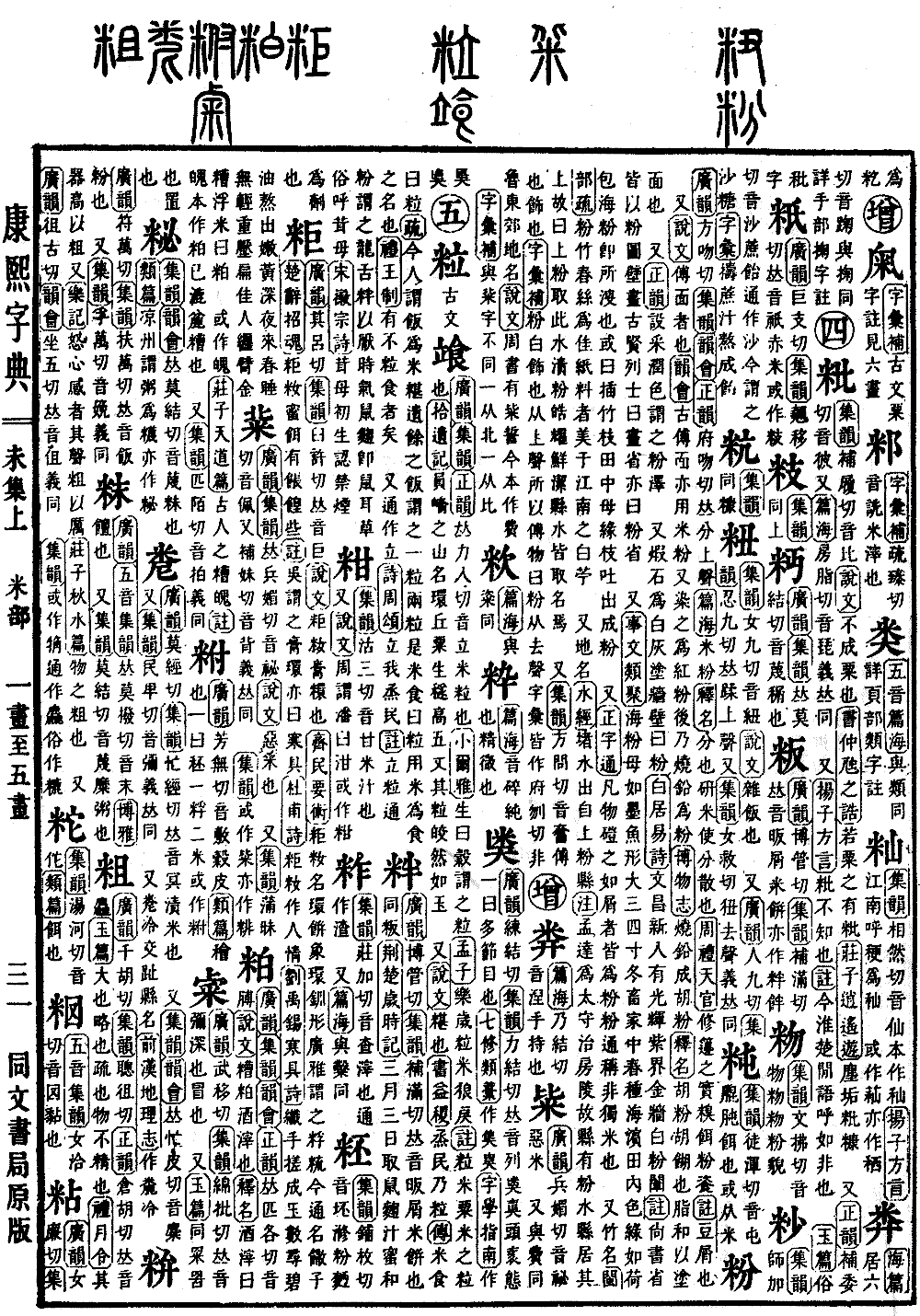
Wei Collection, Upper Volume
Radical: Rice (mǐ)
Kangxi stroke count: 19
Page 907, Entry 03
Five Sounds Collection of Characters (Wuyin Pianhai): Same as the character category. Refer to the detailed note under the Radical: Head (yè) for the character category.
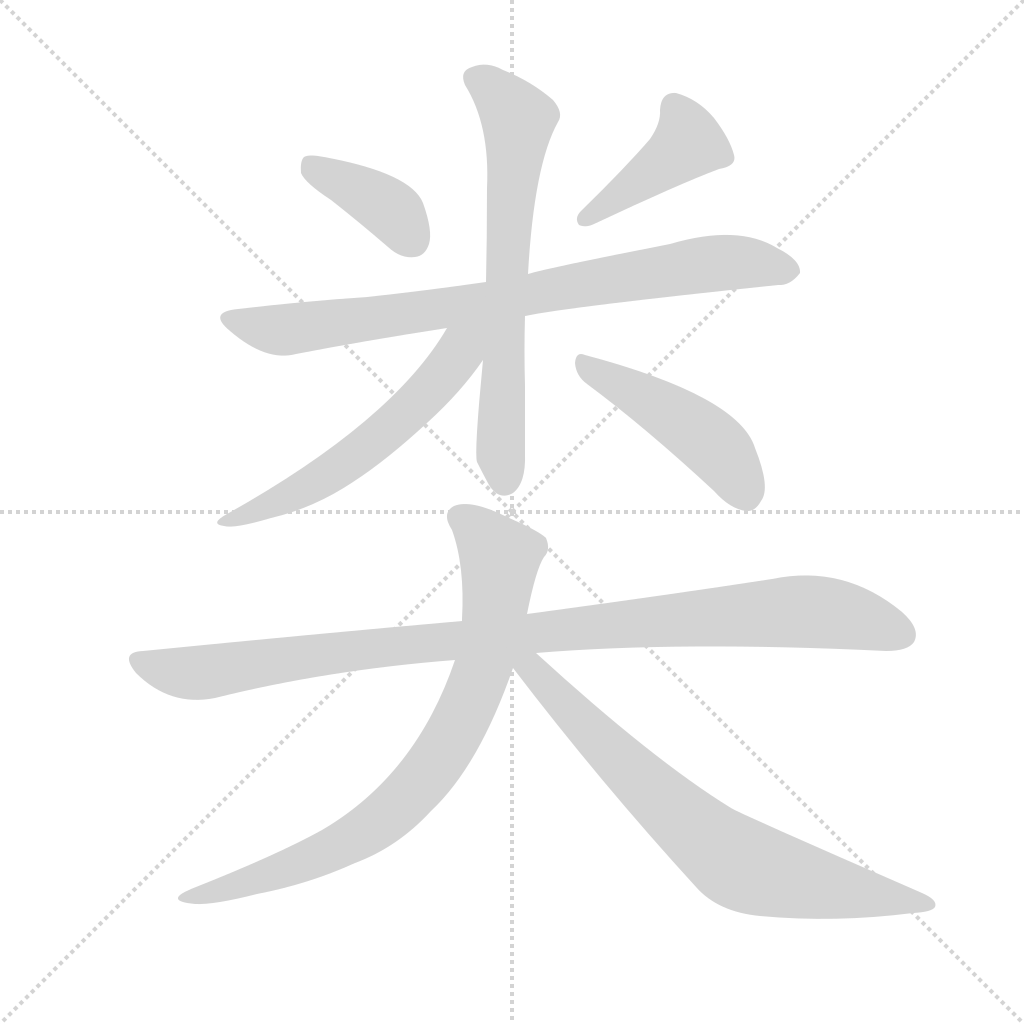
Class
Tang Rhyme (Tang Yun), Collection of Rhymes (Jiyun), Rhyme Gathering (Yunhui), Correct Rhymes (Zhengyun): Pronounced li (falling tone).
Book of Etymology (Erya), Explanation of Ancient Words (Shigu): Good.
Book of Odes (Shijing), Great Odes (Daya): To be able to be bright, to be able to be good.
Commentary (Jian): Class means good. Diligent in bestowing without selfishness is called class.
Also: Filial sons are not exhausted; may they be given such goodness forever.
Tradition (Zhuan): Class means good.
Also, Jade Chapters (Yupian): A category or kind.
Book of Changes (Yijing), Qian Hexagram: Then each follows its own kind.
Also: Great Treatise (Xici): Things are gathered by their kind.
Also: To compare.
Book of Rites (Liji), Record on the Subject of Education (Xueji): To know categories and be enlightened.
Note: Knowing the comparison of affairs and justice.
Also: Black Robes (Ziyi): The Master said: If a subordinate serves a superior, but the body is not upright and words are not sincere, then justice is not unified, and conduct has no standard.
Note: Class refers to a model for comparison.
Sub-commentary (Shu): It means that if speech and conduct have no consistency, they cannot be compared.
Also: Zuo Tradition (Zuo Zhuan), Ninth Year of Duke Xiang: The Duke of Jin employed each according to his ability.
Note: According to what they are capable of.
Also: To resemble.
Book of Rites (Liji), Summary of the Rules of Propriety (Quli): When feudal lords have finished the funeral and see the Son of Heaven, it is called a representative meeting.
Note: Acting on behalf of the father to receive the state. Class is like resembling. Holding leather and silk, it represents the ceremony of a feudal lord meeting.
Also: Name of a sacrifice.
Book of Documents (Shujing), Canon of Shun: Then he performed the class sacrifice to the Supreme Deity.
Book of Odes (Shijing), Great Odes (Daya): It is the class sacrifice, it is the military sacrifice.
Rites of Zhou (Zhouli), Spring Offices (Chunguan), Director of Rituals (Sishi): The class sacrifice is made to the Supreme Deity.
Zheng Note: The class sacrifice is a rite performed in imitation of the suburban sacrifice.
Also: Book of Etymology (Erya), Explanation of Fishes: When a tortoise leans left, it is not in its proper class.
Sub-commentary (Shu): Ni means low. It does not make a sound. It refers to the state when it walks with its head leaning to the left side.
Also: Classic of Mountains and Seas (Shanhaijing): On Mount Danyuan, there is a beast. Its form is like a wildcat but with a mane. Its name is called Lei. It is both male and female to itself. Those who eat it will not be jealous.
Also: Wings of the Book of Etymology (Eryayi): It records two types: the class and the strange class, which are creatures that are both male and female within the same body. Same as the word for sacrificial fat.
Also: Name of a state.
History of the Later Han (Hou Hanshu), Record of the Western Regions: There is the Pulei State.
Also: A surname.
Records of the Grand Historian (Shiji), Hereditary House of Prince Xiao of Liang: Lei Han revolted.
Compendium of Correct Characters (Zhengzitong): Song Dynasty official Lei Yan, an adjutant in Ningde, Fuzhou.
Also: Collection of Rhymes (Jiyun): Pronounced lei (falling tone). Partial or biased.
Zuo Tradition (Zuo Zhuan), Sixteenth Year of Duke Zhao: [His conduct] was rather partial.
Also: Collection of Rhymes (Jiyun): Pronounced lu (level tone). Resembling.
Cao Zhi, Seven Exhortations (Qi Qi): Beautiful plants are planted together, of unusual kinds and strange categories. Green leaves and red flowers, brightening the sky and facing the sun.
Analytical Dictionary of Characters (Shuowen): Categories of kinds being similar, especially the dog. Derived from radical dog, with the phonetic lei.