Wei Collection, Middle Volume
Radical: Sheep (yáng)
Kangxi stroke count: 19
Page 954, Entry 25
Pronounced geng.
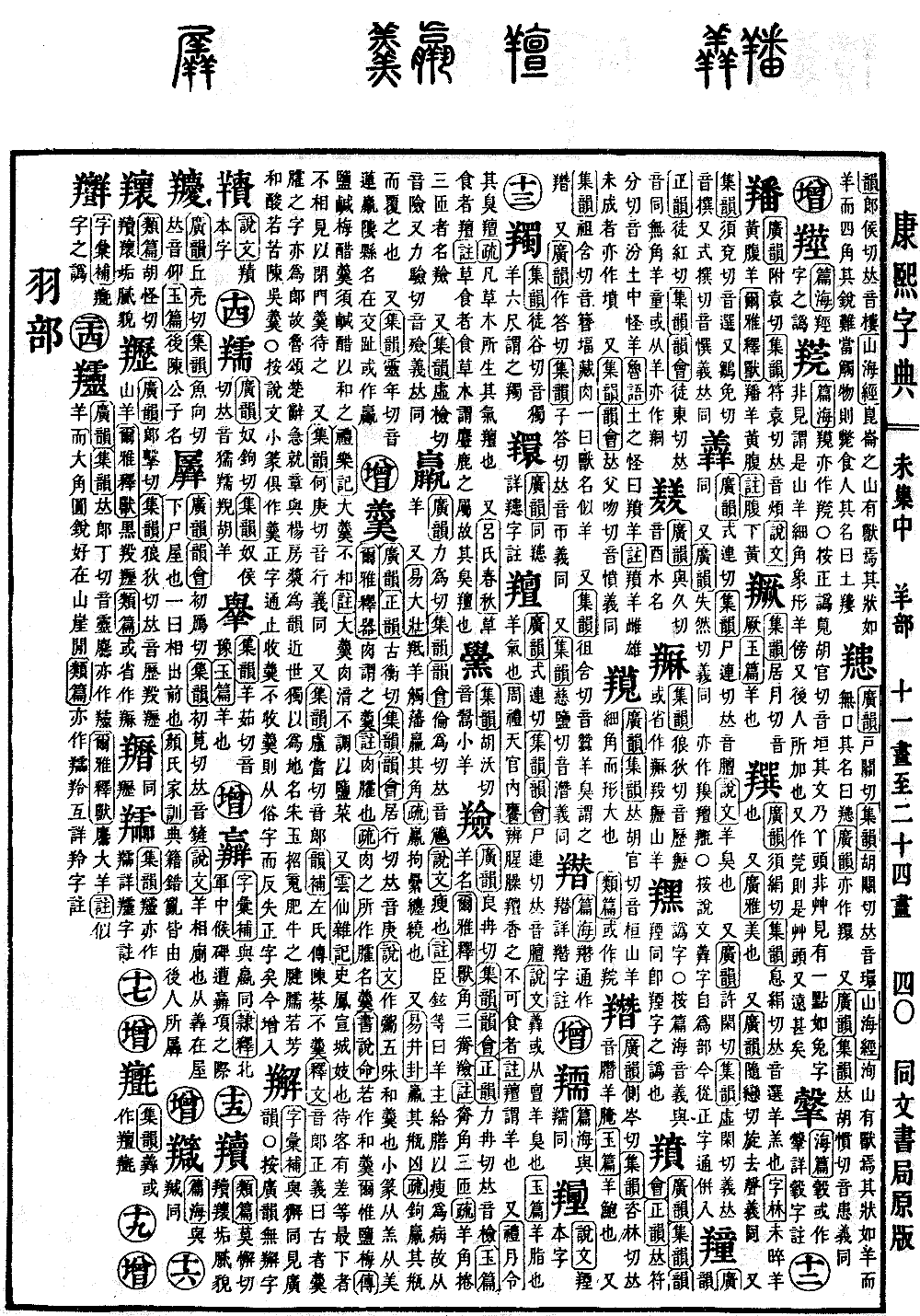
In the Shuowen Jiezi (Explaining Graphs and Analyzing Characters), it is written as a compound. It refers to a meat broth seasoned with five flavors. The small seal script character form is composed of sheep and beautiful.
In the Erya (Approaching Elegance), it is stated that broth made from meat is called geng. The commentary notes that this refers specifically to meat broth. The sub-commentary states that thick soup made from meat is called geng.
In the Book of Documents (Shujing), it is written: Like preparing a well-seasoned broth, you are the salt and the plum. The commentary explains that salt provides a salty flavor and plums provide a sour flavor; broth requires both to be properly seasoned.
In the Book of Rites (Liji), it is written: Great broth (da geng) has no added seasoning. The commentary explains that great broth is pure meat juice without the addition of salt or vegetables.
Furthermore, in the Yunxian Zaji (Miscellaneous Records of Floating Immortals), it is recorded that Shi Feng was a courtesan in Xuancheng. She had a hierarchical system for receiving guests; she would not meet the lowest-ranking guests, and would serve them closing-door broth (bi men geng) instead.
Also pronounced heng. The meaning is the same.
Also pronounced lang. In the Rhyme Supplement (Yunbu), it is noted that in the Zuo Tradition (Zuo Zhuan), there are places in Chen and Cai called Bugeng. The Explanation of Texts (Shiwen) records the pronunciation as lang. The Zheng Yi (Correct Meaning) states that in ancient times, the geng in geng huo was also written as lang, which is why it rhymes with yang, fang, and jiang in the Odes of Lu (Lu Song), the Songs of Chu (Chuci), and the Jijiuzhang (Quick-to-Learn Chapter). In later ages, this pronunciation was used only for place names.
Song Yu writes in the Summoning of the Soul (Zhao Hun): The sinews of fat oxen are stewed until tender and fragrant, seasoned with sour and bitter flavors, and offered as Wu-style broth.
Note: In the Shuowen Jiezi (Explaining Graphs and Analyzing Characters), the small seal script is written as geng. The Zhengzitong (Correction of Characters) only includes the variant form and omits the correct form, thereby following a vulgar usage and losing the original standard. It is added here. The variant is a common form of the character. See Wei Collection.