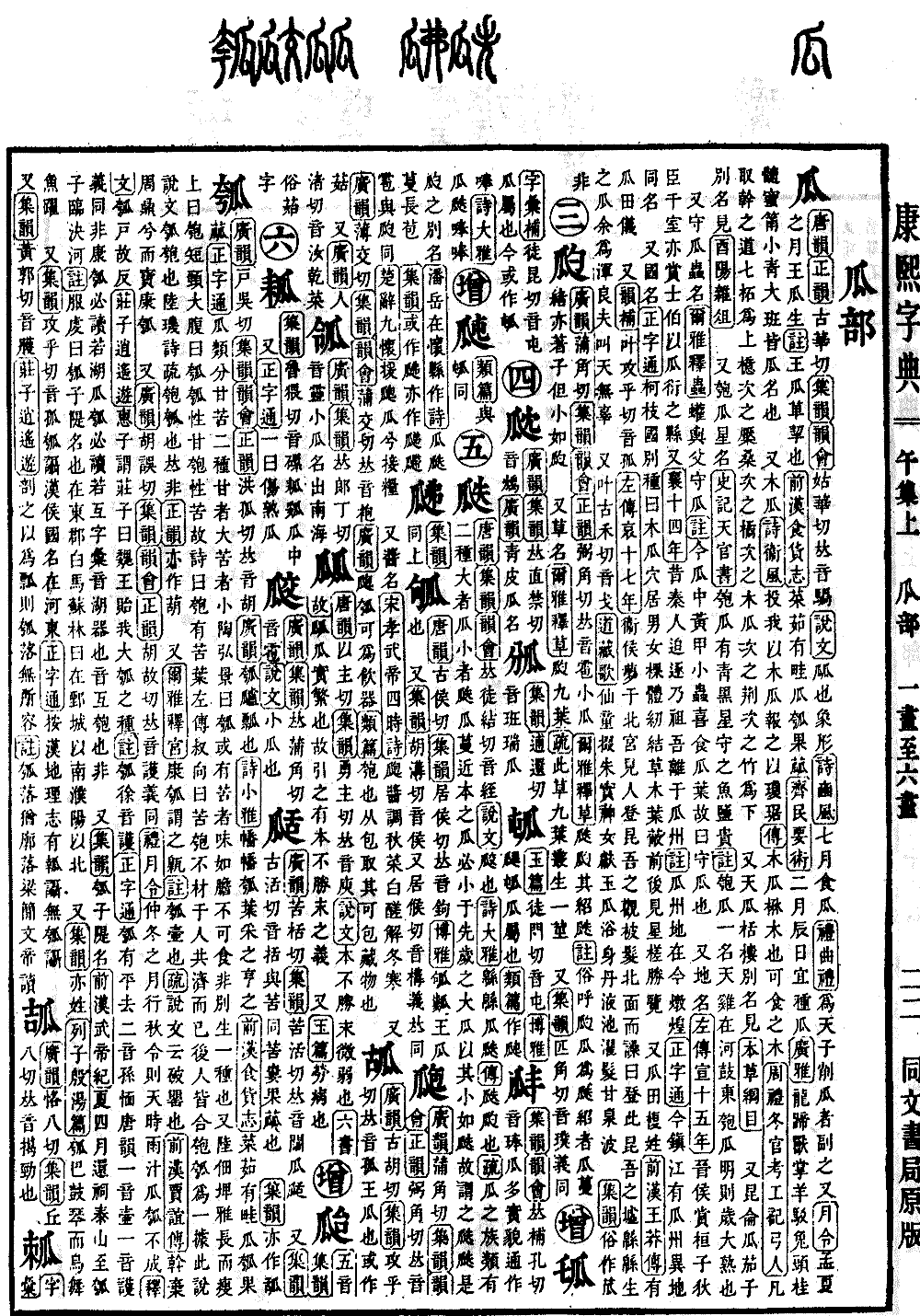
Wu Collection, Upper Volume
Radical: Melon (guā)
Kangxi Strokes: 11
Page 746, Entry 20
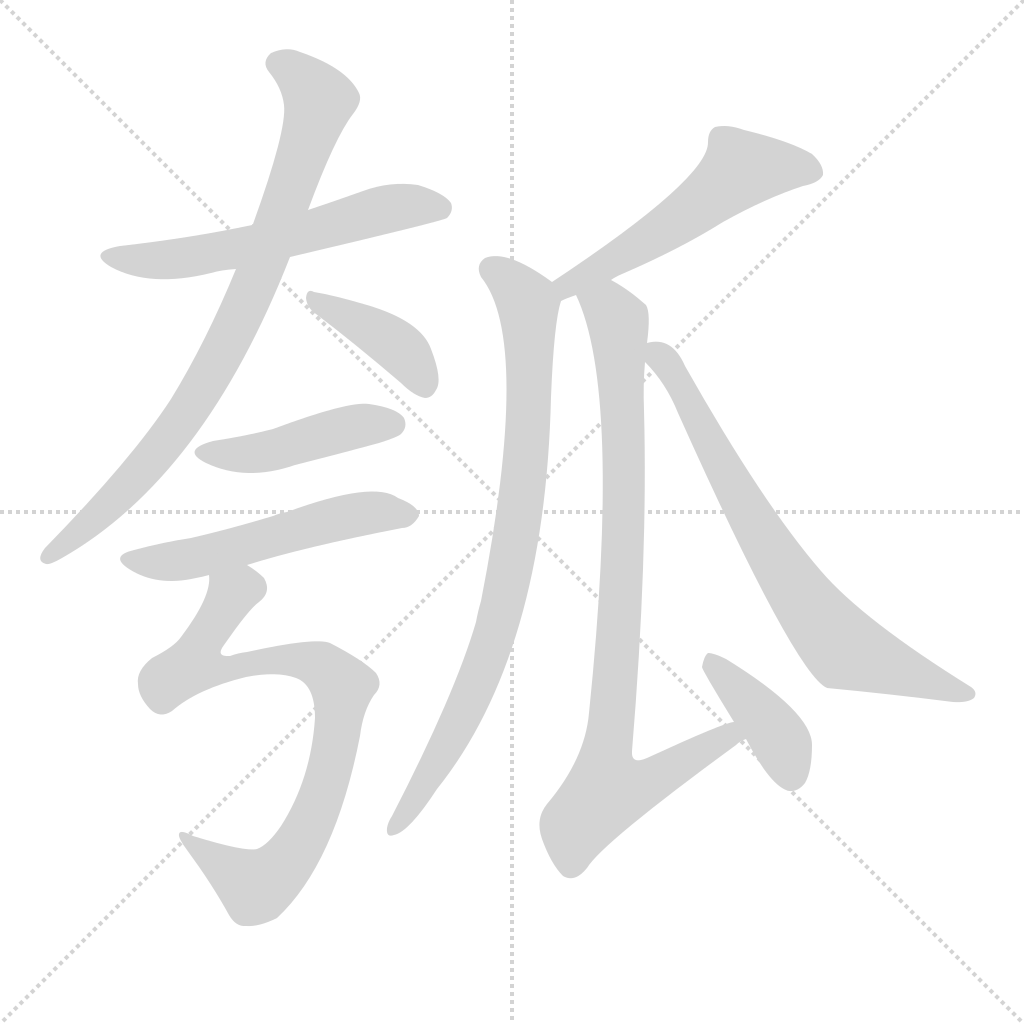
Pronounced hu. According to Guangyun, a gourd is a dipper. Book of Odes (Shijing), Lesser Odes: Plucking the leaves of the gourd to boil and eat. History of the Former Han Dynasty (Qianhan Shu), Treatise on Food and Money: In the vegetable gardens, there are melons and gourds. Orthography Compendium (Zhengzitong): Melons are divided into sweet and bitter varieties; the sweet ones are large, and the bitter ones are small. Tao Hongjing stated: Some gourds are bitter, tasting like bile, and are inedible, yet they are not a separate species. Lu Dian in his Expanded Observations (Piya) notes: Those that are long with thin necks are called pao, while those with short necks and large bellies are called hu. The hu is sweet, and the pao is bitter. Therefore, the Book of Odes mentions the bitter leaves of the pao. In the Zuo Tradition (Zuo Zhuan), Shuxiang states: A bitter gourd has no other use for man, serving only to help one cross a river. Later generations treated the pao and the hu as the same thing. Based on this, Explaining Graphs and Analyzing Characters (Shuowen Jiezi) says that the hu is the pao. Lu Ji, in his Commentary on the Plants, Trees, Birds, Animals, Insects, and Fish of the Mao Odes (Maoshi Caomu Niaoshou Chongyu Shu), says: The pao is the hu. This is incorrect. Correct Rhymes (Zhengyun) notes it is also written as a variant form (hú). Furthermore, in the Literary Expositor (Erya), Interpretation of Dwellings: A broken pottery vessel is called a xi. Commentary: A hu is a vessel. Sub-commentary: Explaining Graphs and Analyzing Characters (Shuowen Jiezi) says: A broken earthen pot. History of the Former Han Dynasty (Qianhan Shu), Biography of Jia Yi: Discarding the Zhou tripod yet treasuring a broken pottery vessel.
Pronounced hu (falling tone). The meaning is the same. Book of Rites (Liji), Monthly Ordinances: In the second month of winter, if the administrative orders of autumn are implemented, freezing rain will fall, and melons and gourds will not thrive. Commentary: Hu is read as hu (falling tone). Zhuangzi, Free and Easy Wandering: Huizi said to Zhuangzi: The King of Wei gave me seeds of a large gourd. Commentary: Hu, read by Xu Miao as hu (falling tone). Orthography Compendium (Zhengzitong): The character hu has both level tone and falling tone pronunciations. Sun Mian, in the Tang Rhymes (Tangyun), notes one pronunciation as hu and another as hu (falling tone), with the same meaning. It is not the case that a kang-hu (earthen vessel) must be read as hu (level tone), or that a gua-hu (melon/gourd) must be read as hu (falling tone). The Dictionary (Zihui) glosses the sound as hu (level tone) when referring to a vessel, and as hu (falling tone) when referring to a gourd. This is incorrect.
Additionally, according to Collection of Rhymes (Jiyun), Huzi is the name of a levee. History of the Former Han Dynasty (Qianhan Shu), Annals of Emperor Wu: In the fourth month of summer, upon returning from the sacrifice at Mount Tai, the Emperor inspected the breach in the Yellow River at the Huzi Levee. Commentary: Fu Qian stated: Huzi is the name of a levee in Baima County, Dong Commandery. Su Lin stated: It is south of Juancheng and north of Puyang.
Additionally, according to Collection of Rhymes (Jiyun), it is also a surname. Liezi, Tang Questions: Hubo played the zither, causing birds to dance and fish to leap.
Additionally, according to Collection of Rhymes (Jiyun), pronounced gu. Hu-nie is the name of a Han dynasty marquisate in Hedong Commandery. Orthography Compendium (Zhengzitong): According to the History of the Former Han Dynasty (Qianhan Shu), Geographical Treatise, it is written as nie, not hu-nie.
Additionally, according to Collection of Rhymes (Jiyun), pronounced huo. Zhuangzi, Free and Easy Wandering: If one cuts it open to use as a dipper, the dipper is too large to fit anywhere. Commentary: Hu-luo describes the state of being vast and empty. Emperor Wen of Liang used this reading.
Correction: In Liezi, Yin Tang Chapter, it has been corrected to the Tang Questions Chapter according to the original text.