Chen Collection, Middle Volume
Radical: Tree (mù)
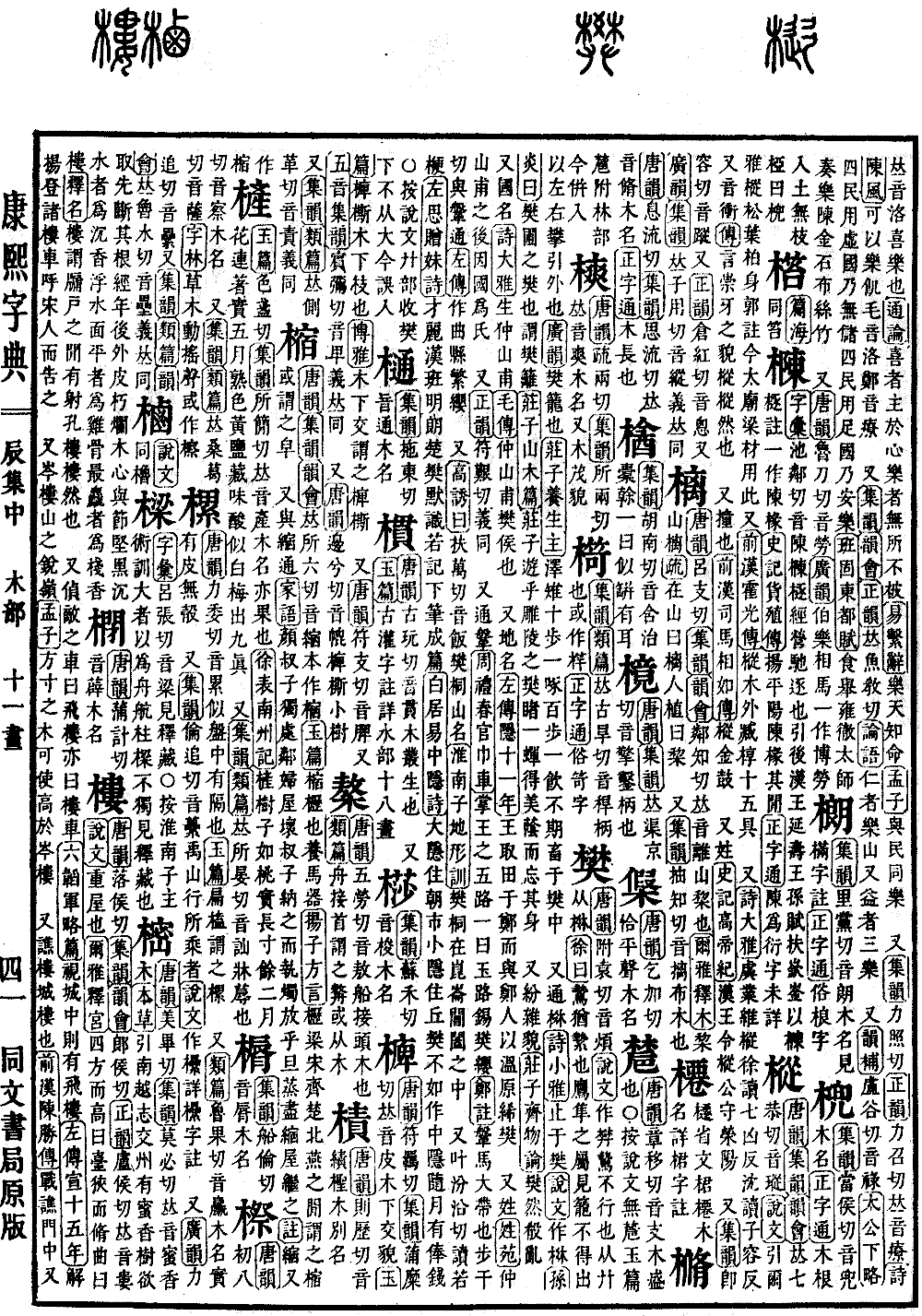
Fan
Kangxi strokes: 15
Page 549, Entry 15
Pronounced fan. According to the Tang Rhyme (Tangyun), the pronunciation is the same as that of fan.
According to the Explaining Graphs and Analyzing Characters (Shuowen Jiezi), it is written as a variant form, meaning a fierce bird that is restrained and unable to fly. The form is composed of a variant element and the character for a hedge. Xu Xuan explains that this means to be tethered. Raptors like eagles and falcons see a cage but cannot exit because their wings are pulled outward.
According to the Broad Rhyme (Guangyun), it refers to a cage.
In the Book of Master Zhuang (Zhuangzi), chapter Nurturing the Lord of Life (Yang Sheng Zhu): A wild pheasant in the marsh takes ten steps to peck a grain and a hundred steps to drink a gulp of water, not wishing to be kept in a cage.
Also functions as a variant of the character for a hedge. In the Book of Odes (Shijing), chapter Small Odes (Xiao Ya): Resting by the hedge. The Explaining Graphs and Analyzing Characters (Shuowen Jiezi) records it as a variant form. Sun Yan states this refers to the enclosure of a garden, meaning a fence. In the Book of Master Zhuang (Zhuangzi), chapter Mountain Tree (Shan Mu): Master Zhuang wandered within the hedge of Diao Ling, seeing a cicada that had found excellent shade but forgotten the danger to itself.
Also refers to a state of disorder or confusion. In the Book of Master Zhuang (Zhuangzi), chapter Discussion on Making All Things Equal (Qi Wu Lun): Appearing in a state of chaotic disorder.
Also the name of a state. In the Book of Odes (Shijing), chapter Greater Odes (Da Ya): Giving birth to Zhong Shanfu. The Mao Commentary (Mao Zhuan) states that Zhong Shanfu was a feudal lord of the State of Fan.
Also a place name. In the Zuo Tradition (Zuo Zhuan), the eleventh year of the Duke of Yin: The King of Zhou acquired fields from the State of Zheng and in turn granted the lands of Wen, Yuan, Chi, and Fan to the people of Zheng.
Also a surname. According to the Garden of Surnames (Xing Yuan), they are the descendants of Zhong Shanfu, taking their state as a surname.
According to the Correct Rhyme (Zhengyun), it is pronounced fan. The meaning is the same.
Also functions as a variant of a character for a horse accessory. In the Rites of Zhou (Zhou Li), section Spring Officials, Bureau of Carriages: Overseeing the five types of carriages of the ruler. The first is the Jade Carriage, equipped with a metal ornament on the horse's forehead, a horse belly band, and a breast collar. Zheng Xuan notes that this is pronounced like the word for a broad leather belt, referring to the belly band. The Explanation of Text (Shiwen) records the pronunciation as ban. The Zuo Tradition (Zuo Zhuan) writes it as a variant.
According to Gao You, it is pronounced fan. Fan Tong is the name of a mountain. According to the Huainan Masters (Huainanzi), section Explication of Topography (Dixing Xun): Mount Fantong is located within the Changhe Gate of the Kunlun Mountains.
According to the rhyming style of literary poetry, it is pronounced fen. In the Zuo Si, Poem Gifted to My Younger Sister: Her talent is as rich as that of Ban Jieyu of the Han dynasty, her wisdom as bright as that of Lady Fan of the Chu state. Her memory is like a written record, and her brush flows easily into text. In the Bai Juyi, Poem on Middle Reclusion: A great hermit hides in the city court, a small hermit hides in the forests and fields. It is better to be a middle hermit, earning a monthly salary as well.
Note: The Explaining Graphs and Analyzing Characters (Shuowen Jiezi) records the character under the radical for the variant element, which does not have the character for big at the bottom; it is now mistakenly included in this radical section.
Textual research: In the Rites of Zhou (Zhou Li), section Spring Officials, Bureau of Carriages, regarding the Jade Carriage, the text includes the term for the belly band. The original text has been corrected to use the standard terminology. Regarding the Zheng commentary: it is pronounced like the term for a broad leather belt, which is a horse's large belly band. The Explanation of Text (Shiwen) notes the pronunciation as ban. The Zuo Tradition (Zuo Zhuan) uses a variant.