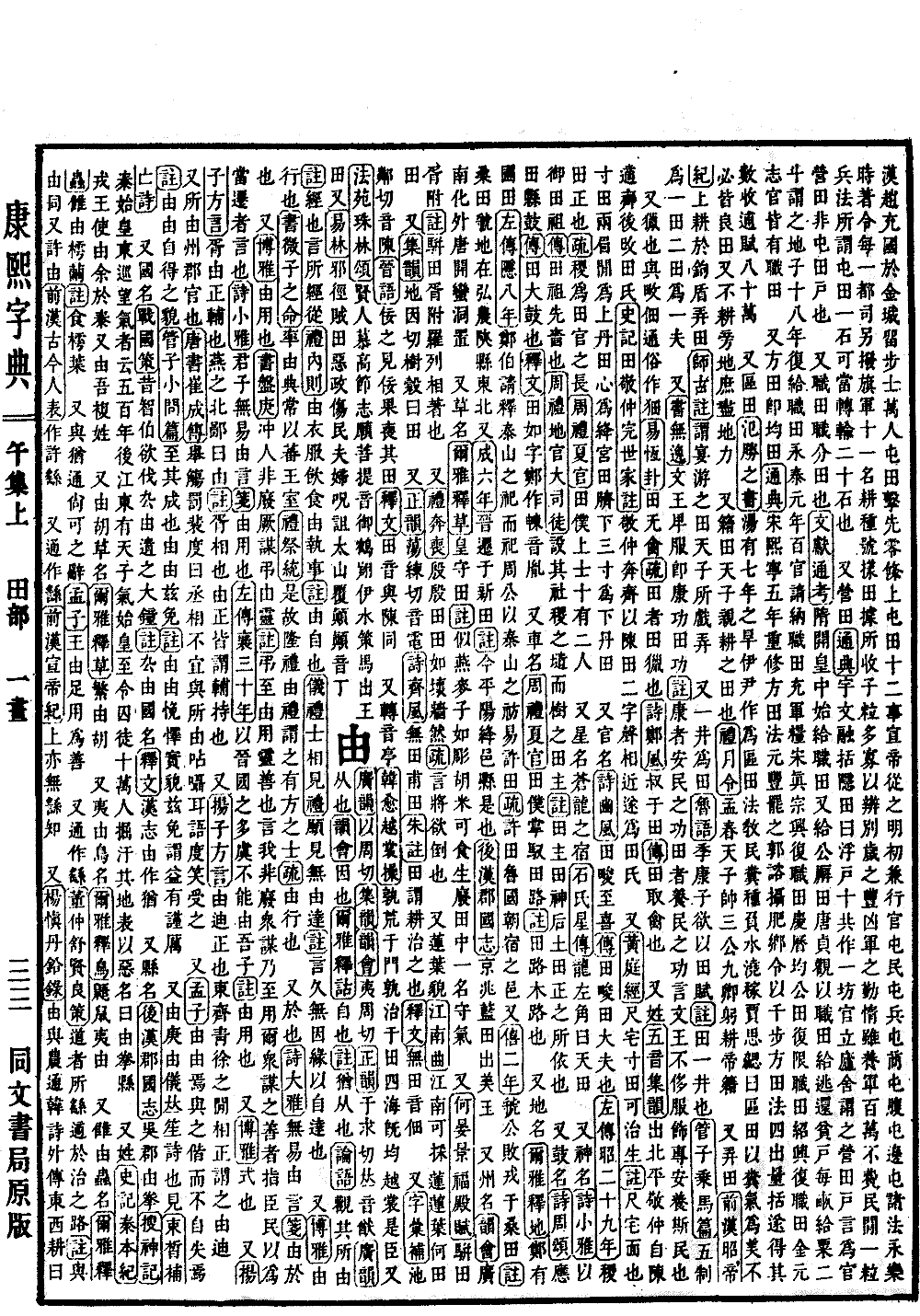
Wu Collection, Upper Volume
Radical: Field (tián)
Kangxi Strokes: 5
Page 757, Entry 01
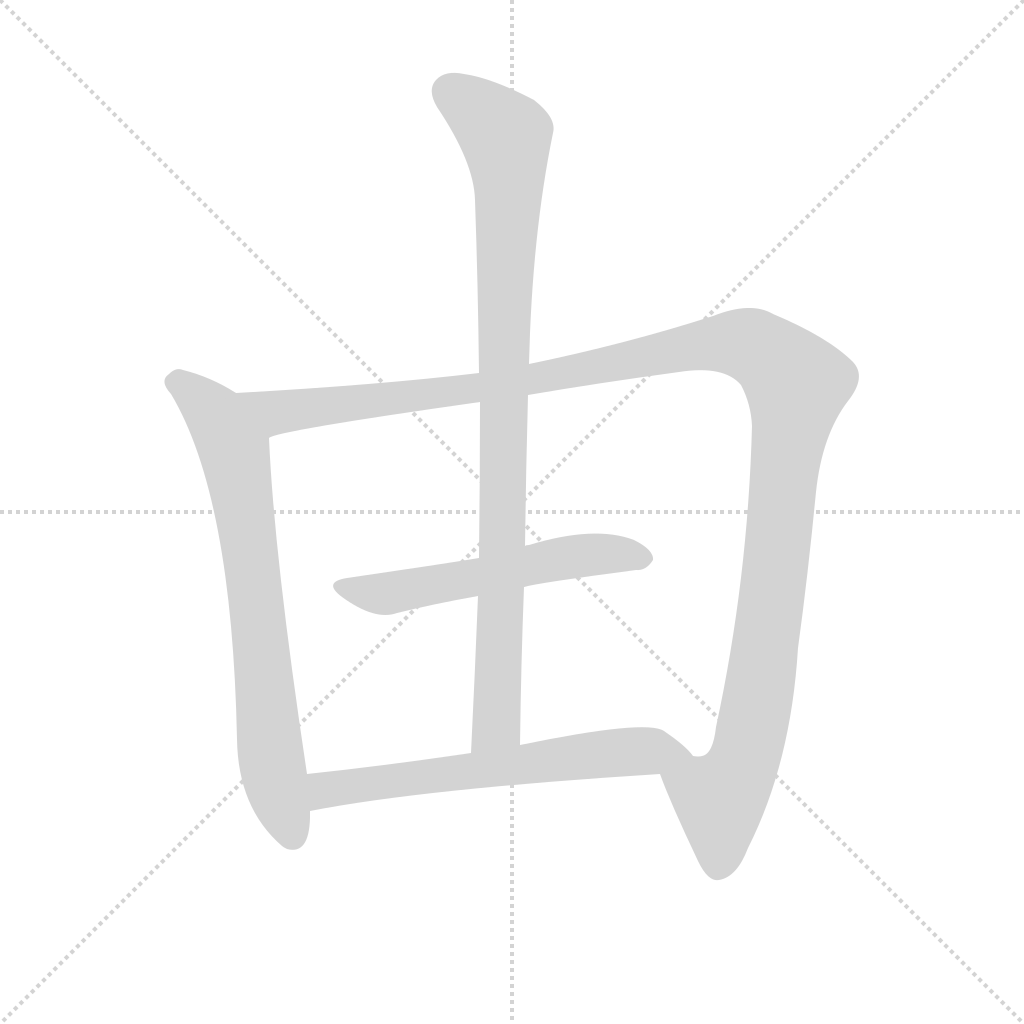
Pronounced you.
According to Broad Rimes (Guangyun), it means to follow. According to Rhyme Collection (Jiyun) and Rhyme Anthology (Yunhui), it means cause or reason.
As defined in the Erya, a dictionary of classical Chinese synonyms, it means from. The commentary explains: "It is synonymous with following."
In the Analects (Lunyu), it is written: "Observe what he follows." The commentary notes: "It refers to the path or method one traverses, meaning what one relies upon as a path."
In the Book of Rites (Liji), it is written: "Follow the protocols of clothing and food; follow those in charge of affairs." The commentary notes: "Here, it means from."
In the Book of Etiquette and Ceremonial (Yili), it is written: "Wishing to seek an audience, but having no way to reach him." The commentary notes: "It indicates having long been without a connection or causal factor to reach him on one's own."
Furthermore, according to the Boya (a dictionary of classical terms), it means to act or walk.
In the Book of Documents (Shujing), it is written: "Always follow the classic norms to protect the royal house."
In the Book of Rites (Liji), it is written: "Therefore, to value ritual and follow ritual is called being a person of proper conduct." The commentary explains: "Here, it means to walk or practice."
It also means at or in. In the Book of Odes (Shijing), it is written: "Do not easily follow such words." The commentary notes: "Here, it means in."
It also means to use. In the Book of Documents (Shujing), it is written: "The young person does not discard their plans, reaching to use their goodness." The commentary explains: "Reaching means to arrive; using means to employ; goodness means virtue. It means I have not discarded the plans of the masses, but instead have employed the good strategies of the masses, referring to those officials and subjects deemed suitable for relocation."
In the Book of Odes (Shijing), it is written: "A gentleman should not easily use such words." The commentary notes: "Here, it means to use."
In the Zuo Commentary (Zuo Zhuan), it is written: "Given the many anxieties of the Jin state, one cannot rely on your son." The commentary notes: "Here, it means to use."
It also means a pattern or model.
According to Yang Xiong’s Dialects (Fangyan), it means to assist or correct. In the northern borders of the Yan state, it is called you. The commentary notes: "Xu and you both refer to assisting or holding steady."
According to Yang Xiong’s Dialects (Fangyan), you-di means to correct. In the region between eastern Qi, Qing, and Xu, mutual correction is called you-di.
It also refers to officials of prefectures and counties. In the Old Book of Tang (Tangshu), it is recorded: "When someone raised a cup to penalize Pei Du, he said: 'The prime minister should not whisper to the officials in charge.' Du laughed and accepted the penalty."
In Mencius (Mengzi), it is written: "Walking along with them, yet not losing one's self." The commentary notes: "You-you describes the appearance of being self-content."
In the Guanzi, it is written: "Upon its completion, you-you carefully avoid." The commentary notes: "You-you refers to a calm and satisfied appearance; carefully avoid refers to increasing one's caution and rigor."
It also refers to Yougeng and Youyi, which are titles of poems accompanied by sheng flutes. See the poems by Shu Xi.
It also refers to a state name. In the Stratagems of the Warring States (Zhanguoce), it is written: "In the past, Zhi Bo wished to attack Qiuyou and sent them a large bell." The commentary notes: "Qiuyou is the name of a state." The Explanatory Text (Shiven) states: "In the Han History, it is written as you."
It also refers to a county name. In the History of the Later Han (Hou Hanshu), it is recorded: "Wu Commandery, Youquan County." According to the In Search of the Supernatural (Soushenji): "When Qin Shi Huang toured the east, a diviner of qi said: 'After five hundred years, there will be the aura of an emperor in the Jiangdong region.' When the emperor arrived, he ordered one hundred thousand prisoners to dig and pollute the land, marking it with an ominous name: Youquan County."
It also refers to a surname. In the Records of the Grand Historian (Shiji), it is recorded: "The Rong king sent You Yu to the Qin state."
Youwu is a compound surname.
Youhu is the name of a plant. In the Erya, it is written: "Fan is Youhu."
Yiyou is the name of a bird. In the Erya, it is written: "The flying squirrel is called Yiyou."
Chouyou is the name of an insect. In the Erya, it is written: "Chouyou eats the leaves of the Ailanthus tree."
It is also used interchangeably with you. It is a word expressing agreement or permissibility. In Mencius (Mengzi), it is written: "The king is indeed sufficient to practice goodness."
It is also commonly written in a variant form (yao). In the Memorials of Dong Zhongshu, it is written: "The Way is that which is followed to reach the path of governance." The commentary notes: "It is the same as you."
Xu You. In the History of the Former Han (Qianshu), it is written as Xu Yao.
It is also used interchangeably with another form. In the History of the Former Han (Qianshu), it is written: "The emperor also had no knowledge."
According to Yang Shen’s Danqianlu, you is interchangeable with nong (agriculture). The Han School of Poetry states: "Plowing east-west is called heng, plowing north-south is called you." The Lu Family Spring and Autumn (Lüshi Chunqiu) and the Guanzi both state: "Yao ordered Hou Ji to be the Great You." The commentary says: "Great You means Great Agriculture." In the Coin Records, in the text of the Shennong currency, the character for agriculture is written as you.
It is also borrowed as a variant form. According to the Leipian, the Shuowen Jiezi dictionary does not have the character you; it only has a character defined as "the sprouting of branches on a tree." The ancient form omitted the bow, and later people omitted the rest, commonly using it for words meaning "cause" or "reason." In the Book of Documents (Shujing), it is written: "Like a fallen tree with sprouting branches." The commentary notes: "In ancient times it was written as this, meaning to topple or fall. It refers to the sprouting of branches on wood." According to the commentary on the Shangshu, it belongs to the ancient script, though this seems to be an error.
It also rhymes with yan (tone: rising) and is pronounced yi. In Feng Yan’s Rhapsody on Manifesting Ambition, it is written: "The past cannot be grasped, and the future cannot be anticipated. I am saddened that my life does not match my aspirations; I wish to pass away horizontally with no reason to stay."
It also rhymes with zhu (tone: level) and is pronounced yu. In the Ancient Poem for the Wife of Jiao Zhongqing, it is written: "The mother told the official: 'Why are you so pedantic? This woman has no etiquette, and her actions are entirely self-determined.'"
According to the Zhengzitong, it is pronounced yao. Yeyou describes the smiling appearance of a woman.