Chou Collection, Lower Volume
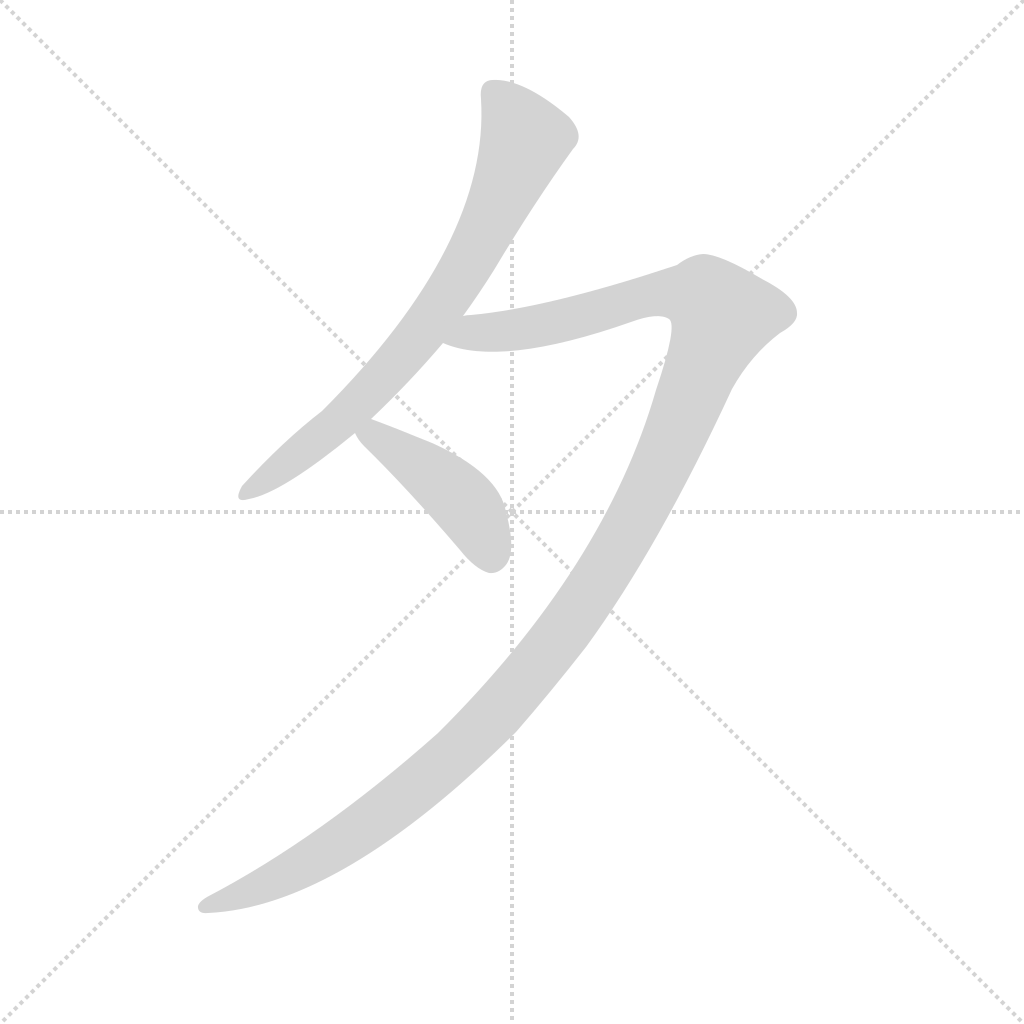
Radical: Evening (xì)
Kangxi Strokes: 3
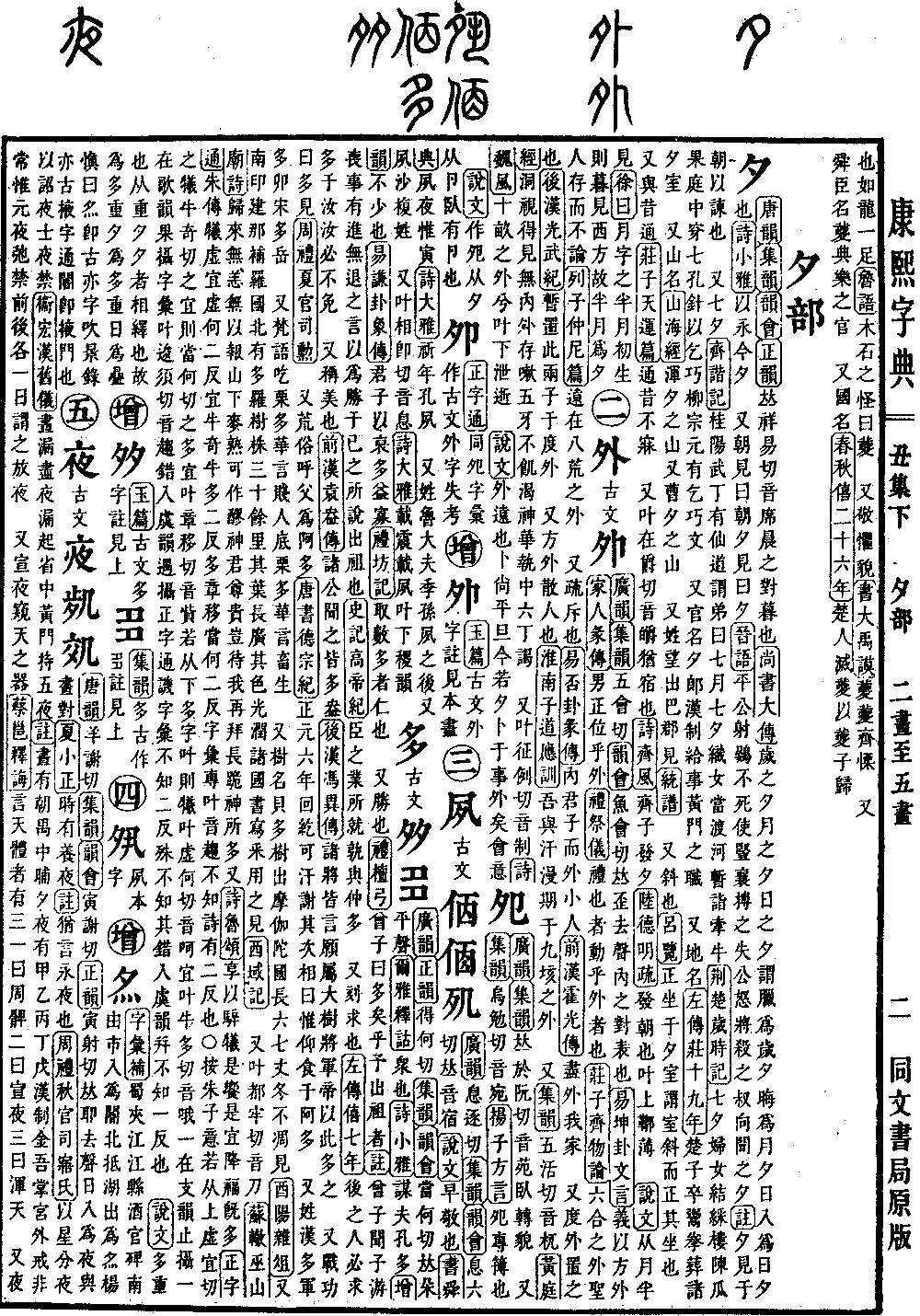
Page 246, Entry 01
Tang Rhymes (Tangyun), Collected Rhymes (Jiyun), Dictionary of Rhymes (Yunhui), Correct Rhymes (Zhengyun): Pronounced xi. The opposite of morning; refers to the evening.
Book of Documents Commentary (Shangshu Dazhuan): The evening of a year, the evening of a month, the evening of a day. The sacrifice at the end of the year is called the annual evening; the end of the month is called the monthly evening; the setting of the sun is called the daily evening.
Book of Odes (Shijing), Lesser Odes (Xiaoya): To extend this night.
Also, a morning audience is called morning, and an evening audience is called evening.
Discourses of the States (Jinyu): Duke Ping of Jin shot a quail but did not kill it; he ordered Shu Xiang to catch it, but he failed. The Duke was enraged and wanted to execute him. When Shu Xiang heard this, he entered the court in the evening to remonstrate.
Also refers to the Qixi Festival. Records of Qi (Qixieji): Wu Ding of Guiyang possessed immortal arts and told his younger brother: On the night of the seventh day of the seventh month, the Weaving Maid will cross the river to briefly visit the Cowherd. Records of the Seasons of Jing and Chu (Jingchu Suishiji): On the Qixi, women erect colorful towers, arrange melons and fruits in the courtyard, and thread seven-holed needles to pray for skillful arts. Liu Zongyuan wrote the Essay on Praying for Skill (Qiqiaowen).
Also a title for an official. The Evening Attendant (Xilang) was a system in the Han dynasty, referring to the post of Attendant at the Yellow Gate.
Also a place name. Zuo Commentary (Zuozhuan), Year 19 of Duke Zhuang: When King Wen of Chu passed away, Yu Quan buried him in the Western Chamber (Xishi).
Also a mountain name. Classic of Mountains and Seas (Shanhaijing): Mount Hunxi. There is also Mount Caoxi.
Also a surname. The ancestral home originated in Ba Commandery. Found in the General Genealogy (Tongpu).
Also means inclined. Annals of Mr. Lu (Lüshi Chunqiu): Sitting upright in an inclined house, meaning the house is tilted but the posture is upright.
Also interchangeable with the character meaning former (xi). Zhuangzi, Chapter on the Revolution of Heaven (Tianyun): Spent the entire night without sleep.
Also phonetically linked to the rhyme jiao, pronounced jue. The meaning is the same as to lodge overnight. Book of Odes (Shijing), Odes of Qi (Qifeng): The woman of Qi set out in the evening. Lu Deming commentary: Set out in the morning. It rhymes with the preceding line containing the term for tanned leather.
Explication of Written Characters (Shuowen Jiezi): The character form depicts the moon partially visible. Xu says: Taking half of the moon character, the moon appears in the west at evening when it first rises, therefore half of the moon character is evening.