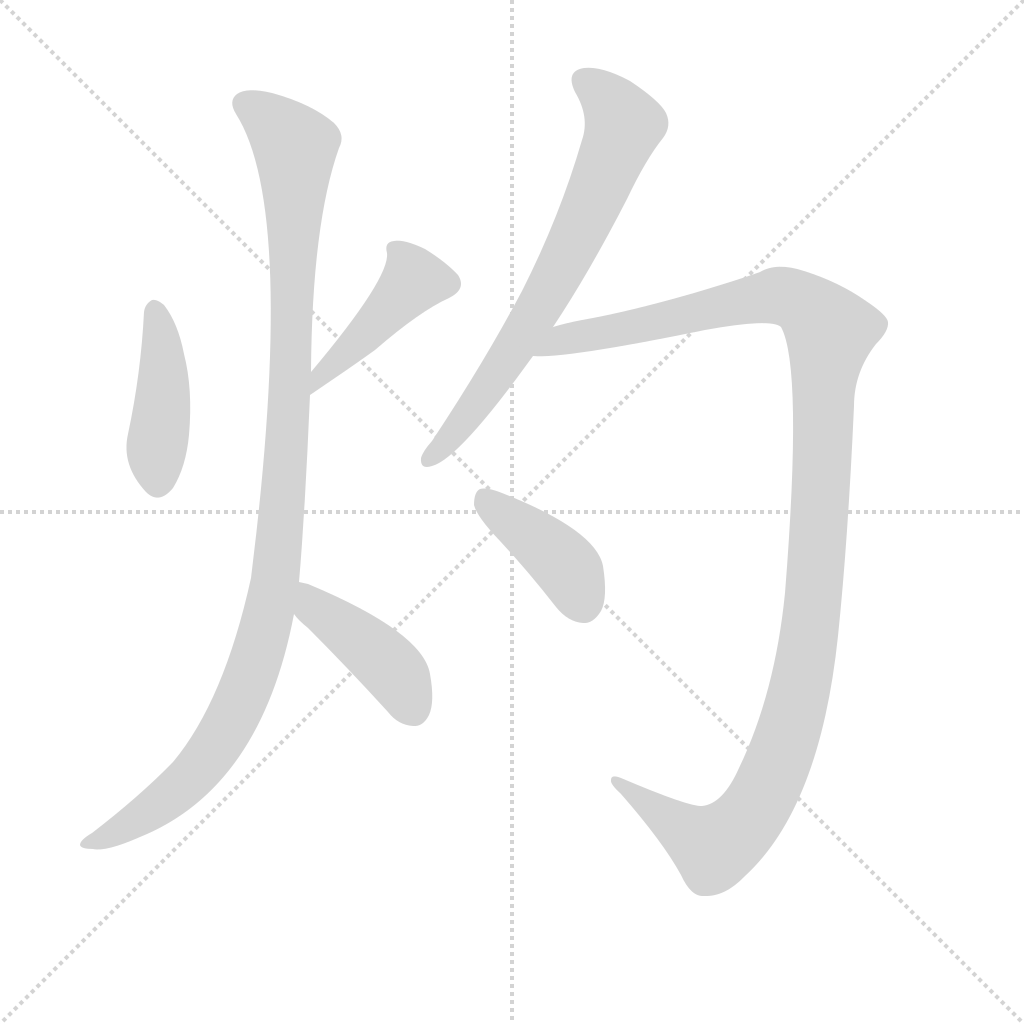
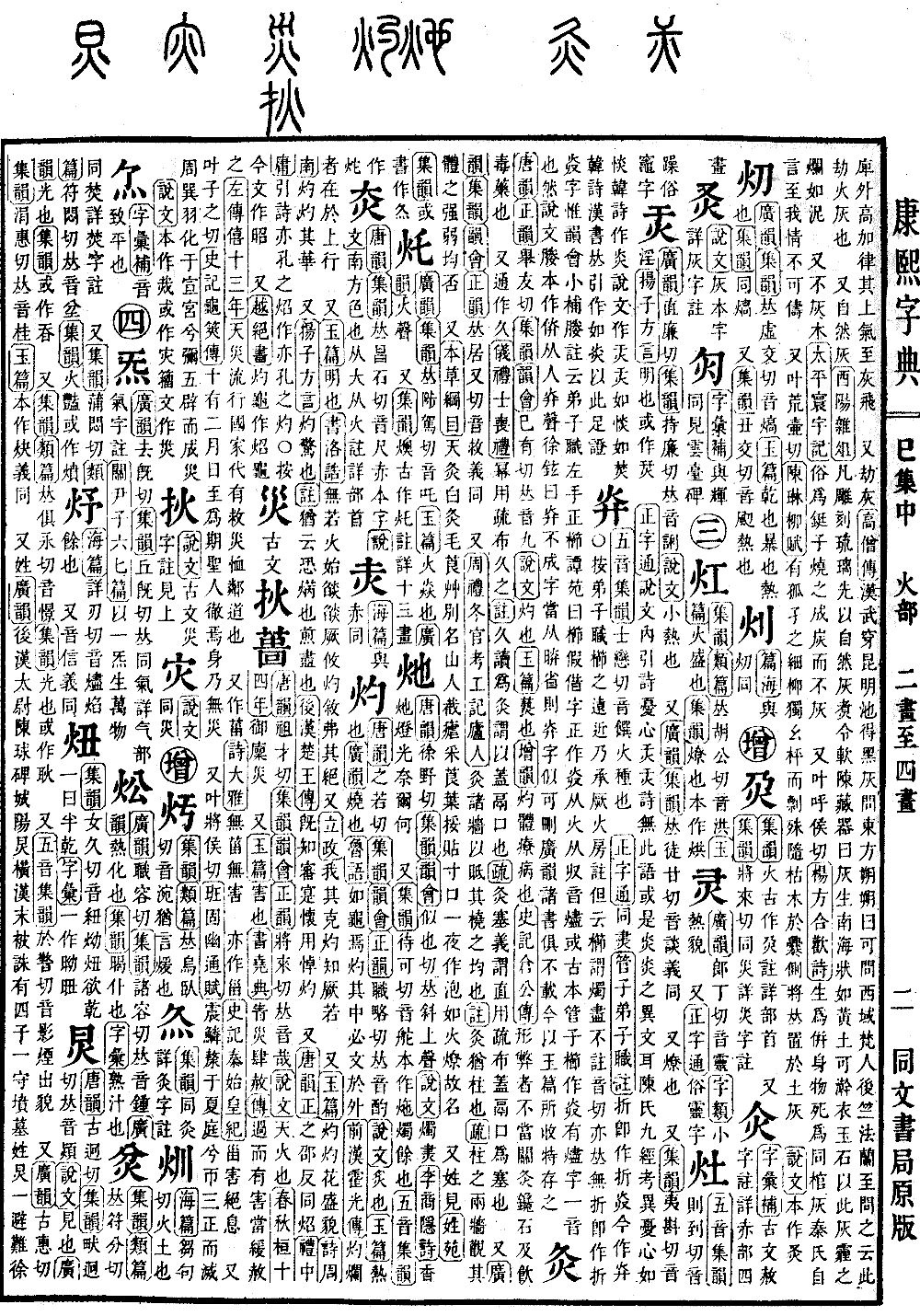
Si Collection, Middle Volume. Radical: Fire (huǒ). Kangxi stroke count: 7. Page 666, Entry 17.
Pronounced zhuo.
In the analytical dictionary of characters (Shuowen Jiezi), it means to roast. In the collection of jade characters (Yupian), it means heat. In the broad rhyme (Guangyun), it means to burn. In the Discourses of the States (Lüyu), it states: If the interior of a tortoise shell is scorched, the markings will surely appear on the exterior. In the History of the Former Han (Qianhan Shu), biography of Huo Guang, it mentions: Those who were scorched and mangled were placed in the upper category.
Also, in the collection of jade characters (Yupian), it means bright. In the Book of Documents (Shujing), specifically the Luo Announcement (Luogao) chapter: Do not be like a fire that starts as a flickering flame; if its path burns in order, it will not be extinguished. Also in the Establishment of Government (Lizheng) chapter: I can clearly perceive their compliance.
Also, in the collection of jade characters (Yupian), it describes flowers in full bloom. In the Book of Odes (Shijing), Zhou Nan section: Brightly blooming are its flowers.
Also, in the dialect dictionary of Master Yang (Yangzi Fangyan), it means to be startled. The annotation explains: It is like saying to be afraid, or to have one's spirit exhausted. In the History of the Later Han (Houhan Shu), biography of the King of Chu, it says: Once the reality was known, I truly felt sorrow and alarm.
Also, in the corrections of the Tang rhyme (Tangyun Zheng), pronounced zhao. It is the same as the character for illuminate. The Book of Rites (Liji), in the Doctrine of the Mean (Zhongyong) section, quotes the Book of Odes (Shijing): It is also very bright. It is written as it is very scorching. Note that in modern texts, it is written as illuminate. Also, in the Record of the Annals of Yue (Yuejue Shu), scorching a tortoise shell is written as illuminating a tortoise shell.