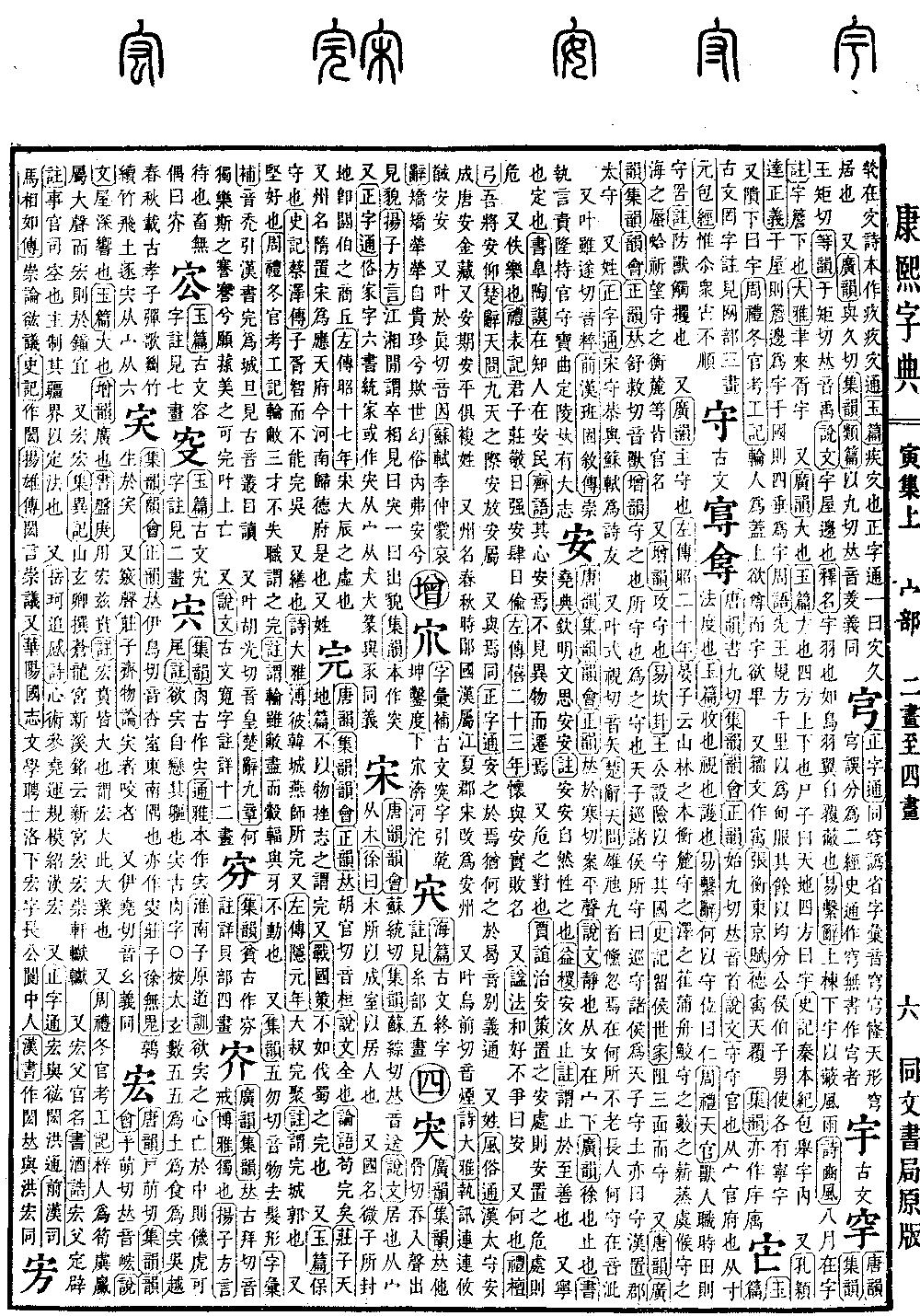
Yin Collection, Upper Volume
Radical: Roof (mián)
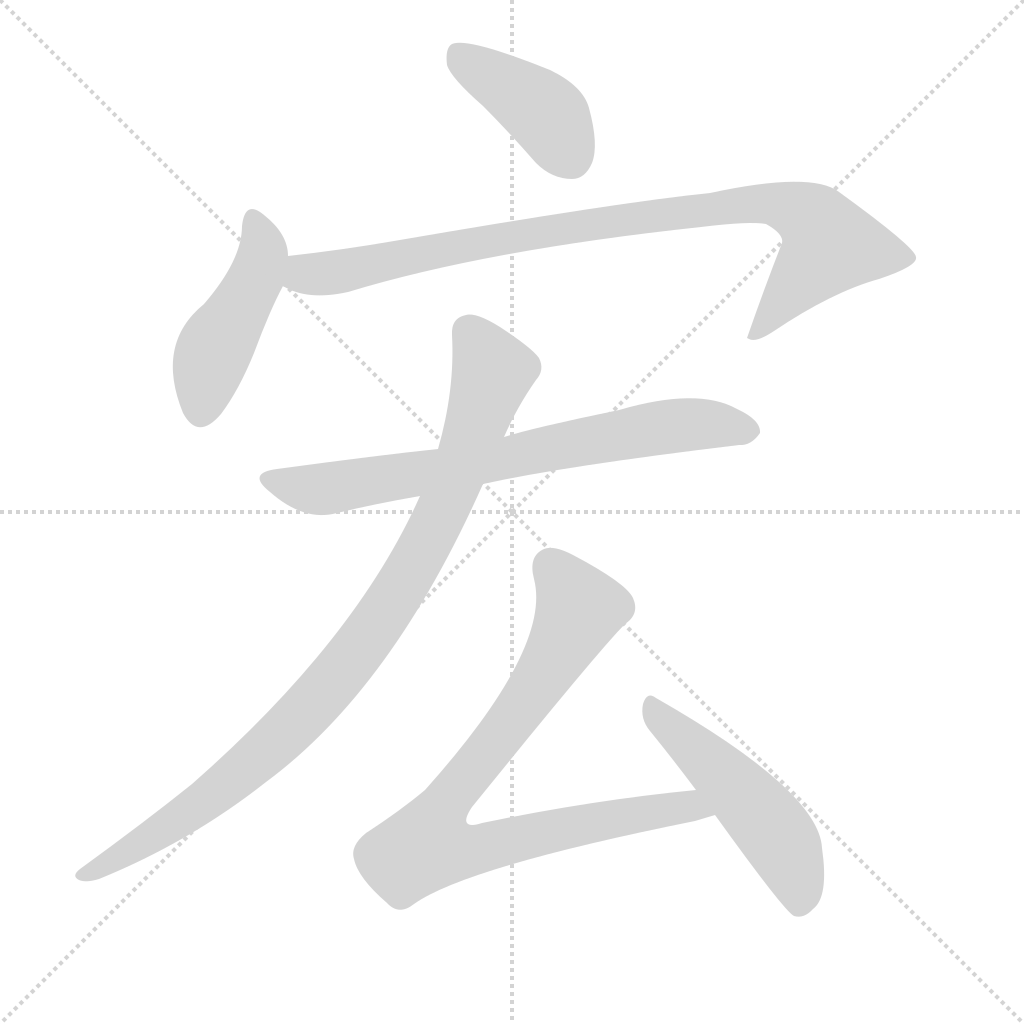
Entry: 宏
Kangxi strokes: 7
Page 282, Entry 20
Pronounced hong (rising tone).
Shuowen Jiezi (Explanation of Script and Analysis of Characters): The depth and resonance of a building.
Yupian (Jade Chapters): Great.
Zengyun (Augmented Rhymes): Vast.
Book of Documents (Shujing), Pan Geng chapter: To expand this great legacy. Commentary: Both hong and ben mean great; it refers to expanding this great enterprise.
Also, Rites of Zhou (Zhouli), Winter Bureau, Artificer's Record: When the carpenter makes a stand for bells or chimes, if the sound is great and resonant (hong), it is suitable for bells.
Also, honghong. Jiyiji (Records of Anomalies): A mountain minister composed the Inscription for the New Stream at the Green Dragon Palace, stating: The new palace is grand (honghong) with soaring eaves.
Also, Hongfu, an official title. Book of Documents (Shujing), Announcement on Spirits (Jiugao): The Hongfu establishes laws. Commentary: An official position in charge of public works (sikong), responsible for defining territorial boundaries to establish laws.
Also, Yue Ke, Poems of Reminiscence: His mindset participated in the operation of the sage king Yao, and his scope continued the greatness (hong) of the Han.
Also, Zhengzitong (Dictionary of Proper Character Usage): Hong is used interchangeably with hong (hóng, variant) and hong (hóng, flood).
History of the Former Han (Hanshu), Biography of Sima Xiangru: Exalted discourse and grand (hong) discussions. Records of the Grand Historian (Shiji) uses the character hong (hóng, variant). In the Biography of Yang Xiong: Grand (hong) words and exalted discussions.
Also, Chronicles of Huayang (Huayang Guozhi): The scholar-official Luoxia Hong, courtesy name Chang-gong, was a native of Langzhong. The History of the Former Han (Hanshu) writes the name as Hong (hóng, variant). Used interchangeably with hong (hóng, flood) and hong (hóng, great).