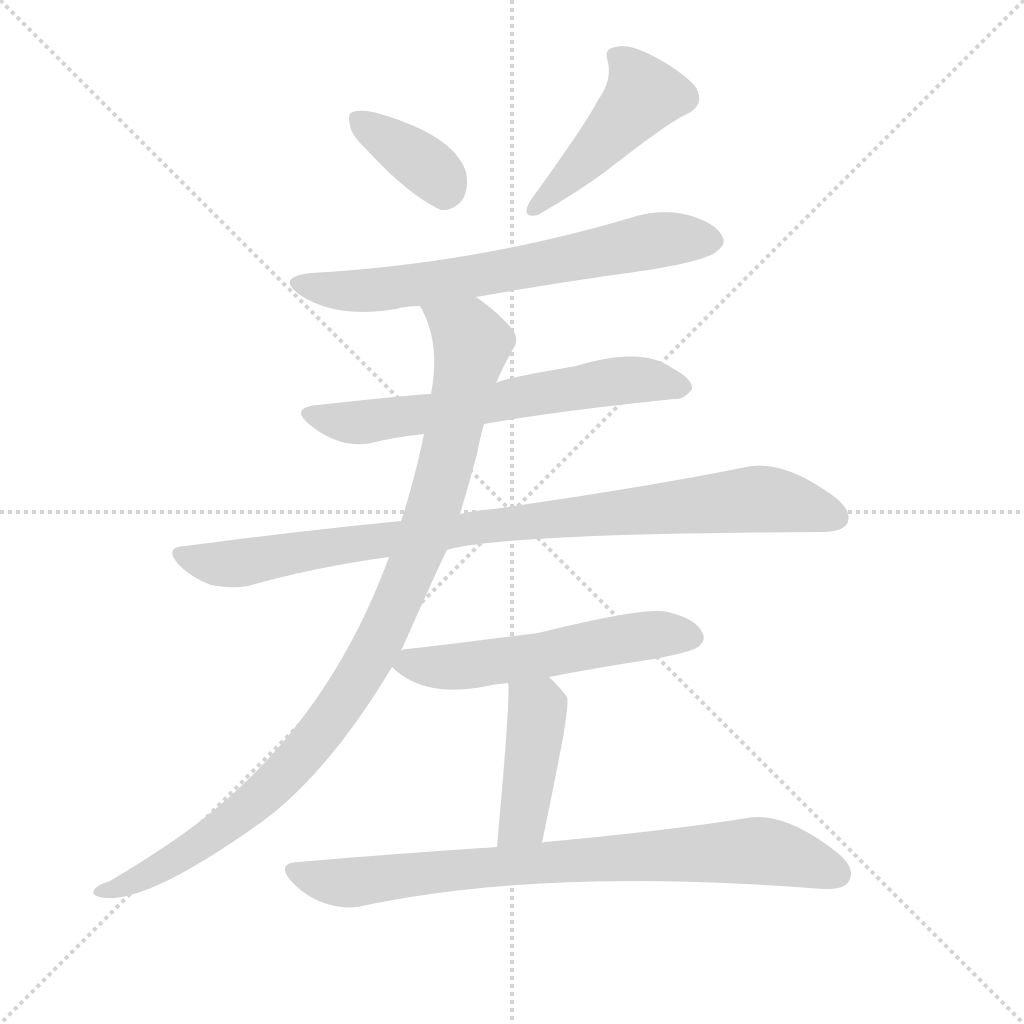
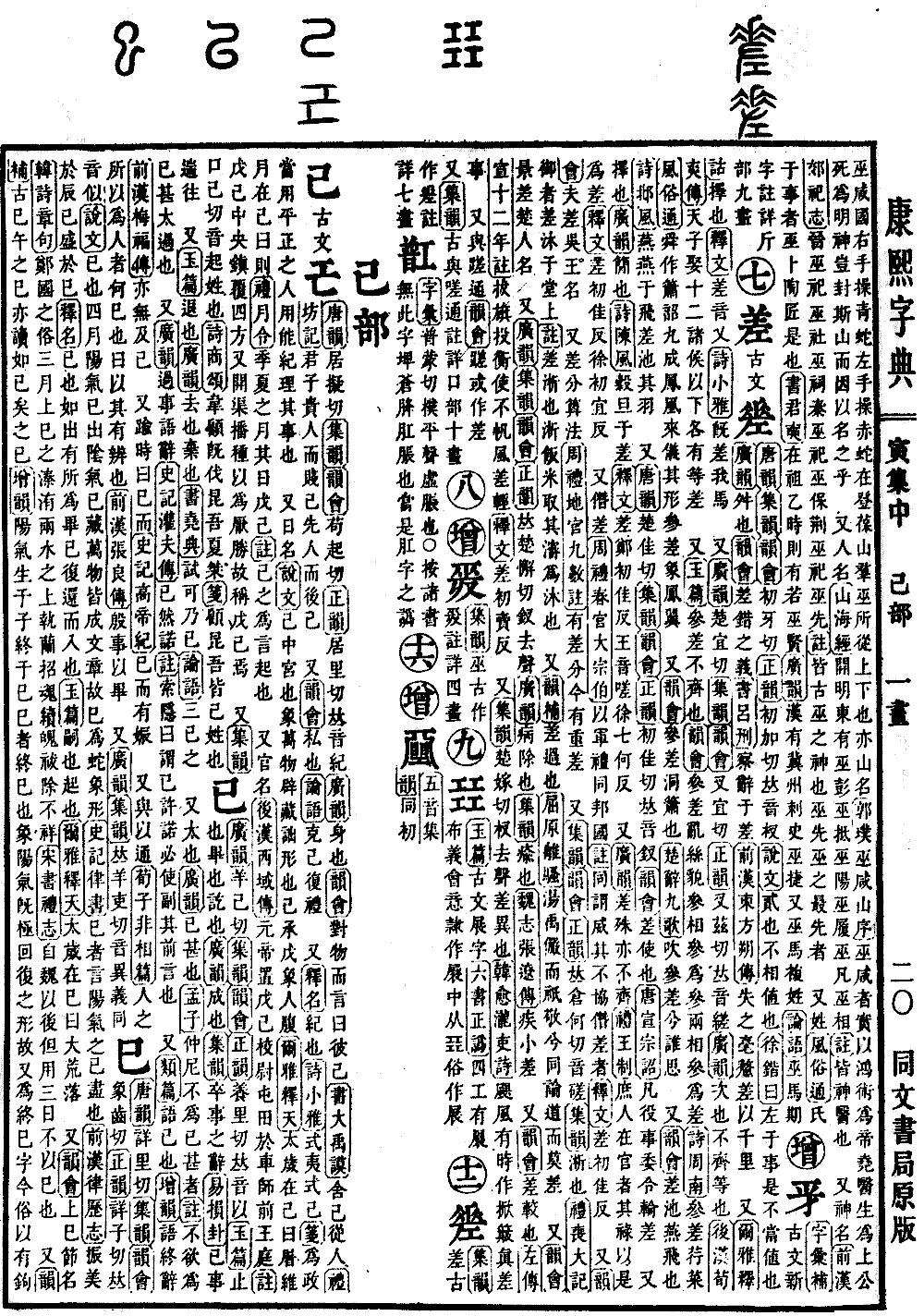
Yin Collection, Middle Volume. Radical: Work (gōng). Kangxi stroke count: 10. Page 326, Entry 02.
In ancient texts. Tang Rhyme (Tangyun), Collection of Rhymes (Jiyun), and Collection of Rhymes and Explanations (Yunhui) all state the pronunciation is cha (level tone). Collected Rhymes (Zhengyun) states the pronunciation is cha (level tone), with the sound of cha. Explaining Characters (Shuowen) says: To differ; to not align. Xu Kai says: To be at variance with a task is to not be properly aligned. Broad Rhymes (Guangyun) says: To be in error. Collection of Rhymes and Explanations (Yunhui) says: The meaning of discrepancy or error. Book of Documents (Shujing), Chapter on the Punishments of Lu (Lüxing): To examine the language for discrepancies. History of the Former Han (Qian Han Shu), Biography of Dongfang Shuo: If you lose a hair's breadth at the beginning, you will be off by a thousand miles.
Also, Approach to the Fine Arts (Erya), Interpretation of Words: To select. Commentary: Pronounced cha. Book of Odes (Shijing), Lesser Odes (Xiao Ya): Already selected my horses.
Also, Broad Rhymes (Guangyun) says: Pronounced chai. Collection of Rhymes (Jiyun), Collection of Rhymes and Explanations (Yunhui) say: Pronounced chai. Collected Rhymes (Zhengyun) says: Pronounced chai. Broad Rhymes (Guangyun) says: To follow; inequality or unevenness in rank. History of the Later Han (Hou Han Shu), Biography of Xun Shuang: The Son of Heaven marries twelve, and those of the rank of feudal lords and below each have their distinctions in rank.
Also, Jade Chapter (Yupian): Uneven, not uniform. Collection of Rhymes and Explanations (Yunhui): Uneven, the appearance of chaotic silk. Intertwining is called can; the two sides mutually intertwining is called cha. Book of Odes (Shijing), Odes of Zhou (Zhou Nan): Uneven is the water cress. Customs (Fengsu Tong): Shun created the Shao music in nine movements, and the phoenix arrived to perform; its shape was uneven, imitating the phoenix's wings.
Also, Collection of Rhymes and Explanations (Yunhui): A type of bamboo flute. Songs of Chu (Chu Ci), Nine Songs: Playing the bamboo flute, for whom do I pine?
Also, Collection of Rhymes and Explanations (Yunhui): Used in the term for the flight of swallows. Book of Odes (Shijing), Odes of Bei (Beifeng): The swallows are flying, their wings uneven.
Also, Tang Rhyme (Tangyun) says: Pronounced chai. Collection of Rhymes (Jiyun), Collection of Rhymes and Explanations (Yunhui), and Collected Rhymes (Zhengyun) all say: Pronounced chai. Collection of Rhymes and Explanations (Yunhui): To dispatch an envoy. Edict of Emperor Xuanzong of Tang: All corvee labor is delegated to be dispatched by rotation.
Also, to select. Broad Rhymes (Guangyun) says: To select. Book of Odes (Shijing), Odes of Chen (Chenfeng): On a lucky day, to select. Commentary: Pronounced cha (Zheng reading), or pronounced jie (Wang reading), or pronounced chi (Xu reading).
Also, Broad Rhymes (Guangyun) says: To differ, also to be uneven. Book of Rites (Liji), Royal Regulations (Wangzhi): The common people who hold office have their stipends determined by these differences. Commentary: Pronounced cha, or pronounced chi (Xu reading).
Also, transgression or error. Book of Rites (Zhou Li), Office of Spring, Grand Minister of Rites: Using military ritual to unify the states. Commentary: Unity refers to awe-inspiring those who do not comply or are in error. Commentary: Pronounced cha.
Also, Collection of Rhymes and Explanations (Yunhui): Fu Chai, the name of a King of Wu.
Also, proportional division, a method of calculation. Book of Rites (Zhou Li), Office of Earth, Nine Mathematical Categories: There is proportional division, now there is heavy-duty calculation.
Also, Collection of Rhymes (Jiyun), Collection of Rhymes and Explanations (Yunhui), and Collected Rhymes (Zhengyun) all say: Pronounced cuo (level tone). Collection of Rhymes (Jiyun): To wash rice. Book of Rites (Liji), Notes on Mourning (Sangdaji): The attendant washes the rice in the hall to make washing water. Commentary: To wash; the water from washing rice is taken as washing water.
Also, Rhyme Supplement (Yunbu): To err, to transgress. Qu Yuan, Encountering Sorrow (Lisao): Tang and Yu were solemn and respectful, while the Zhou discussed the Way and did not err.
Also, Collection of Rhymes and Explanations (Yunhui): Jing Cha, the name of a person from Chu.
Also, Broad Rhymes (Guangyun), Collection of Rhymes (Jiyun), Collection of Rhymes and Explanations (Yunhui), and Collected Rhymes (Zhengyun) all say: Pronounced chai (falling tone). Broad Rhymes (Guangyun): Illness removed. Collection of Rhymes (Jiyun): To recover. Records of the Three Kingdoms (Wei Zhi), Biography of Zhang Liao: The illness has slightly recovered.
Also, Collection of Rhymes and Explanations (Yunhui): To compare. Commentary on Zuo Tradition (Zuo Zhuan), 12th year of Duke Xuan: Remove the banners and lower the beams so the sails do not catch, the wind is slightly lighter. Commentary: Pronounced cha (falling tone).
Also, Collection of Rhymes (Jiyun): Pronounced cha (falling tone). To differ. Han Yu, Poem on the Long Official: Typhoons sometimes arise, the churning is truly a strange matter.
Also, synonymous with cuo (to polish). Collection of Rhymes and Explanations (Yunhui): The character cuo is sometimes written as cha.
Also, Collection of Rhymes (Jiyun): Anciently synonymous with jie (to sigh). Note detailed in Mouth Radical, ten strokes.