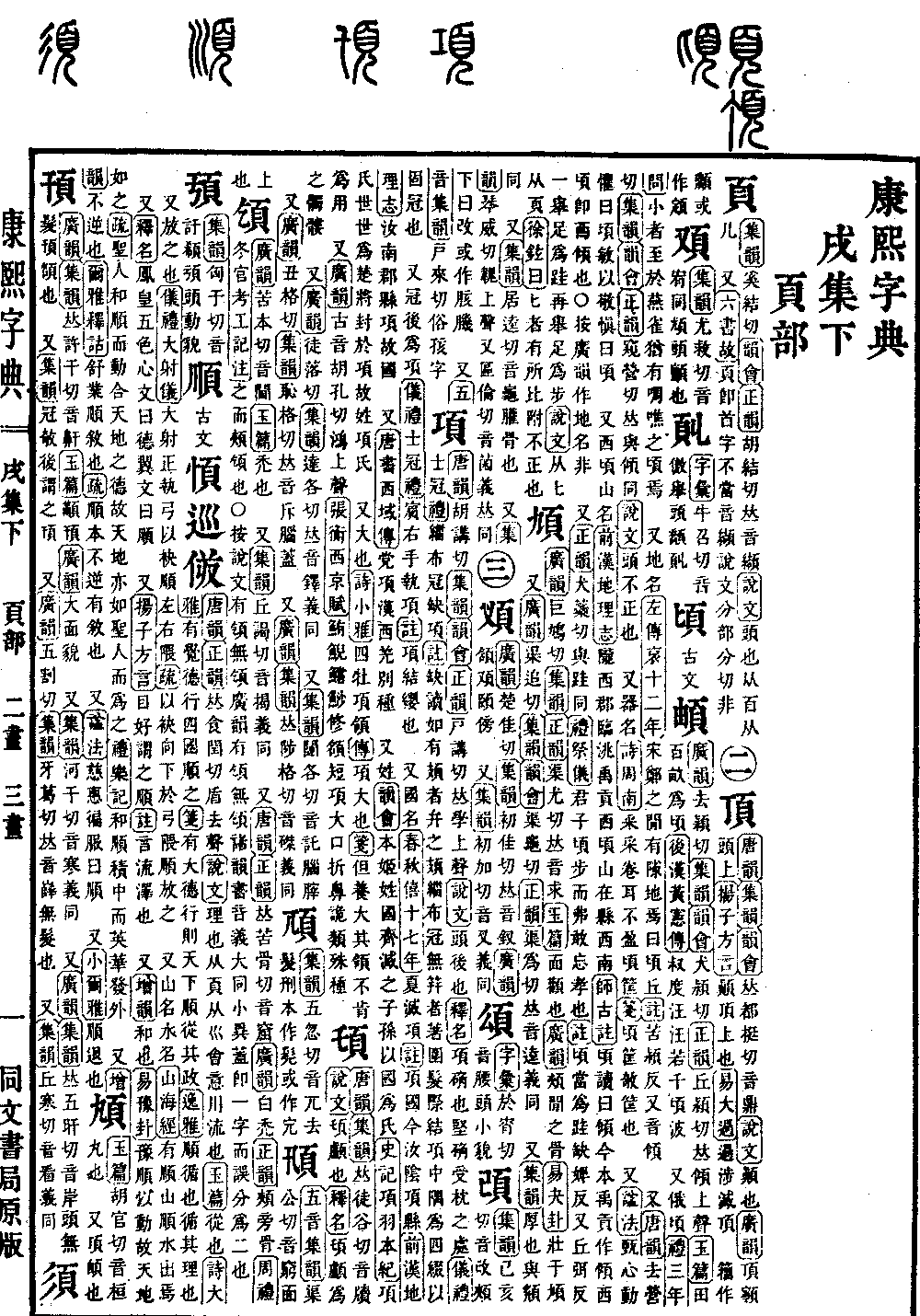
Xu Collection, Lower Volume
Radical: Page (yè)
Kangxi Strokes: 12
Page 1399, Entry 11
Pronounced xiang (third tone).
Shuowen Jiezi (Explanation of Graphs and Analysis of Characters): The back part of the head.
Shiming (Explication of Names): Xiang means firm. It refers to the part that is firm and can support a pillow.
Book of Etiquette and Ceremonial (Yili), Section on Scholar's Capping: The black cloth cap has a gap at the neck. Commentary: The gap is pronounced like the kui in the phrase "the cap with a head-band." The black cloth cap has no hairpin; when worn, a head-band is used to wrap around the hairline and tied at the nape of the neck, with four corners made into four strips to secure the cap.
Also refers to the back part of a cap. Book of Etiquette and Ceremonial (Yili), Section on Scholar's Capping: The guest uses his right hand to grasp the back part of the cap. Commentary: Xiang refers to the place where the cap strings are tied.
Also refers to the name of a state. Spring and Autumn Annals (Chunqiu), 17th Year of Duke Xi: In the summer, the State of Xiang was destroyed. Commentary: The State of Xiang is located in present-day Xiang County, Ruyin. Book of Han (Hanshu), Treatise on Geography: Xiang is a county in Runan Commandery. It was a feudal state in ancient times.
Also refers to a people. Old Book of Tang (Tangshu), Record of the Western Regions: The Dangxiang people are a branch of the Western Qiang of the Han dynasty.
Also a surname. Rhyme Compilation (Yunhui): Originally a feudal state of the Ji surname; after the State of Qi destroyed it, its descendants took the state name as their surname. Records of the Grand Historian (Shiji), Annals of Xiang Yu: The Xiang family served as generals of the State of Chu for generations, and their fief was in Xiang, hence the surname Xiang.
Also means large. Book of Odes (Shijing), Lesser Odes: Four public stallions with thick necks. Commentary: Xiang means large. Supplementary Commentary: They are merely raised to have thick necks, yet they are unwilling to exert effort or be used.
Pronounced hong (third tone). Zhang Heng, Western Capital Rhapsody (Xijing Fu): The sturgeon, the giant salamander, the yellow catfish, and the loach have long foreheads and short necks. With large mouths and flat noses, their shapes are strange and their species unique.
Editorial Note: Regarding the Book of Etiquette and Ceremonial (Yili) citation, the original text omitted the word kui. It has been corrected to include it. The statement in the Guangyun regarding the ancient pronunciation being hu kong qie is actually found in the Tang Yun Zheng, not the Guangyun. The text has been updated to reflect this.