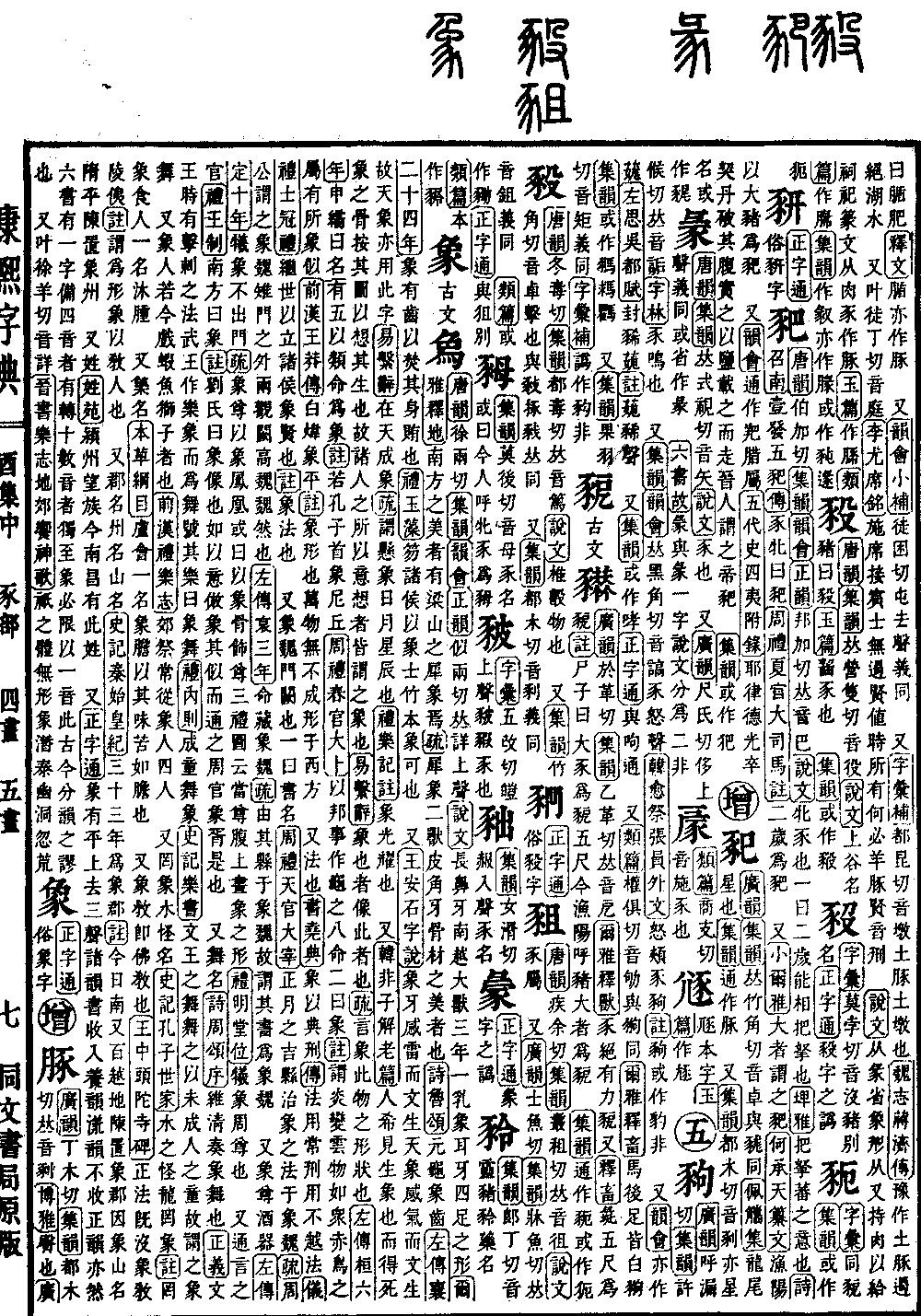
You Collection, Lower Volume
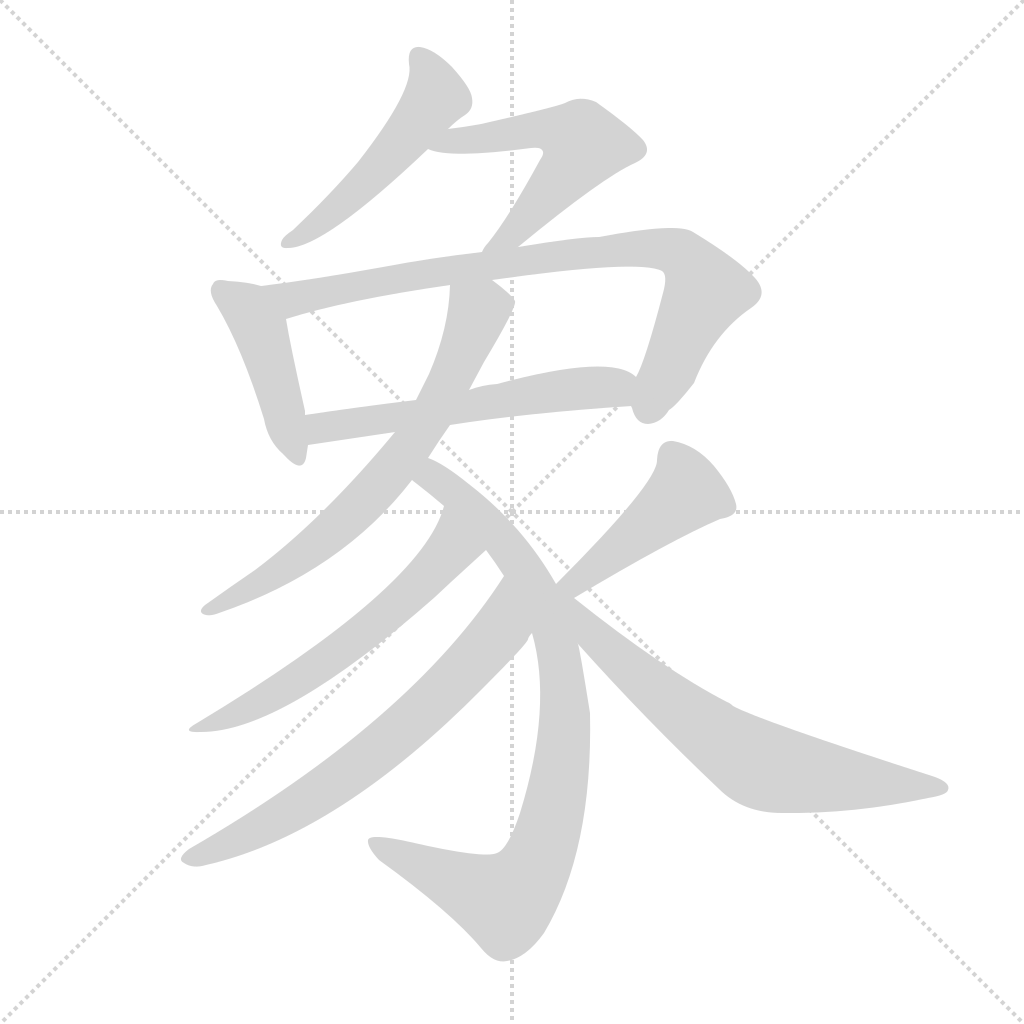
Radical: Elephant (xiàng)
Kangxi Strokes: 12
Page 1195, Entry 21
In ancient texts, Tang Yun records the pronunciation as xiang (rising tone). Jiyun, Yunhui, and Zhengyun record the pronunciation as xiang (rising tone). For detailed pronunciation, see the entry for the rising tone.
Shuowen Jiezi explains: A large wild animal from the Yue region in the south with a long trunk and long tusks, giving birth once every three years. The character shape mimics the appearance of its ears, tusks, and four feet.
Erya: Shidi records: Among the fine products of the south, there are rhinoceroses and elephant tusks from Liangshan. The commentary explains: The hides, horns, tusks, and bones of these two beasts, the rhinoceros and the elephant, are high-quality raw materials.
Book of Odes (Shijing): Lusong mentions: Great tortoises and elephant tusks.
Zuo Zhuan: Lord Xiang, Year 24, says: The great elephant invites disaster upon itself because of its tusks, as ivory is a precious commodity.
Book of Rites (Liji): Yuzao records: Regarding hu (ceremonial tablets), feudal lords use ivory, while officials use bamboo, though the bottom may be decorated with ivory.
Additionally, Wang Anshi, Zishuo, believes: Elephant tusks grow grain patterns in response to thunder, and celestial phenomena display patterns in response to the changes of qi; therefore, the character for elephant is also used for the celestial elephant (phenomena).
Book of Changes (Yijing): Xici says: Forming phenomena in the heavens. The commentary explains: This refers to images such as the sun, moon, and stars suspended in the sky.
Book of Rites (Liji): Yueji, with annotations, says: Elephant refers to the shining of light.
Furthermore, Han Feizi: Jielao says: People rarely see live elephants, but upon obtaining the bones of a dead elephant, they infer its living appearance from its skeletal structure. Thus, whenever people infer the unknown based on the known, it is called elephant (resemblance).
Book of Changes (Yijing): Xici says: That which is called elephant is the imitation of the forms of things. The commentary explains: This speaks of imitating the shape of an object.
Zuo Zhuan: Lord Huan, Year 6, Shen Xu states: There are five ways to bestow names, one of which is elephant, meaning to name based on resemblance. The annotation explains: For example, the shape of Confucius’s skull resembles the Niqiu Mountain.
Rites of Zhou (Zhouli): Chunguan, Dabu, records: There are eight types of divination commands for state affairs, the second of which is called elephant. The annotation explains: This refers to cloud formations and physical phenomena that appear during disasters, such as flocks of red birds, which serve as signs or resemblances.
Book of Han (Hanshu): Wang Mang Zhuan records: White radiance symbolizes peace. The annotation explains: Elephant means form. There is nothing in the myriad things that does not mature and take shape in the west (autumn).
It also carries the meaning of law and standard.
Book of Documents (Shangshu): Shundian says: To regulate by standard law. The commentary explains: Using standard laws so that actions do not exceed the regulations.
Ceremonial Rites (Yili): Shiguanli says: Feudal lords inherit through generations by emulating the virtue of their ancestors. The annotation explains: Elephant means to emulate.
It also refers to Xiangwei, a pair of tall platforms outside the palace gate. Some say it refers to legal documents.
Rites of Zhou (Zhouli): Tianguan, Dazai, records: On the first day of the first lunar month, the laws of the state are hung upon the Xiangwei. The commentary explains: The Duke of Zhou called it Xiangwei; it refers to the two towering watchtowers outside the Zhi Gate.
Zuo Zhuan: Lord Ai, Year 3, orders the collection of the Xiangwei. The commentary explains: Because laws were hung on the Xiangwei, those legal documents were also called Xiangwei.
It also refers to the Xiangzun, a type of wine vessel.
Zuo Zhuan: Lord Ding, Year 10, says: The Xizun and Xiangzun vessels must not leave the country. The commentary explains: The Xiangzun is carved with the image of a phoenix. Some say it is decorated with ivory. The Three Rites Illustrations (Sanlitu) says: The shape of an elephant is painted on the belly of the wine vessel.
Book of Rites (Liji): Mingtangwei records: The Xizun and Xiangzun are wine vessels of the Zhou dynasty.
It also refers to officials responsible for translation and communication.
Book of Rites (Liji): Wangzhi says: The translators of the south are called elephant. The annotation by Master Liu explains: Elephant means to resemble. By imitating and guessing the meaning of the other party to facilitate communication, the Xiangxu in the Zhou officials refers to this type of official.
It also refers to the name of a dance.
Book of Odes (Shijing): Zhousong Preface says: Weiqing is the musical score for the Elephant Dance. The commentary explains: During the time of King Wen, there were techniques of striking and thrusting; King Wu composed music and compiled a dance that simulated these techniques, calling it the Elephant Dance.
Book of Rites (Liji): Neize records: Youths of fifteen study the Elephant Dance.
Records of the Grand Historian (Shiji): Yue Shu records: The dance of King Wen was performed by young boys, hence it is called the Elephant Dance.
It also refers to the elephant-man, similar to modern performers playing the roles of fish, shrimp, or lions.
Book of Han (Hanshu): Liyue Zhi records: When performing suburban sacrifices, four elephant-men usually follow.
It also refers to Wangxiang, the name of a water monster.
Records of the Grand Historian (Shiji): Kongzi Shijia records: Monsters in the water include dragons and Wangxiang. The annotation explains: The Wangxiang eats humans, and another name for it is Muzhong.
It also refers to the name of a medicine.
Compendium of Materia Medica (Bencao Gangmu) records: Aloe, another name for which is elephant gall, so-called because its taste is as bitter as bile.
It also refers to Elephant Teaching, meaning Buddhism.
Wang Zhong: Touzhusi Beiweng says: The true Buddhist law has already vanished, and the Elephant Teaching has also declined. The annotation explains: It refers to using images such as Buddha statues to educate people.
It also refers to the names of commanderies, prefectures, and mountains.
Records of the Grand Historian (Shiji): Qin Shihuang Ji records: In the 33rd year, Xiang Commandery was established. The annotation explains: It is today’s Rinan. It was originally the land of the Baiyue, and it was established as Xiang Commandery because of Elephant Mountain. After the Sui dynasty pacified the region, Xiang Prefecture was established.
It also refers to a surname.
Xianyuan records: It is a prominent clan in Yingzhou. Currently, there are people with this surname in Nanchang.
Additionally, Zhengzitong points out: The character for elephant has level, rising, and departing tones. Various rhyme books only include it under the rising tone Yang rhyme; the departing tone Yang rhyme is not included, and Zhengyun is the same. In philology, there are characters that possess four pronunciations or even over ten, but only the character for elephant is strictly limited to one pronunciation; this is an error in the division of rhymes from ancient to modern times.
Also, in rhythmic rhyming (ye yun), it is pronounced xiang (level tone), with the same sound as the character for detailed.
Jin Shu: Yue Zhi, Dijiao Xiangshen Ge, sings: The essence of the earth has no form. It hides in the tranquil and profound, and reaches into the hazy and vast.
Critical note: Rites of Zhou: Chunguan, Dabu, records: There are eight types of divination commands for state affairs, the second of which is called elephant. The annotation explains: It refers to cloud formations and physical phenomena that appear during disasters, such as flocks of red birds. Following the original text, disaster (zai) has been substituted for the erroneous character. Book of Documents: Shundian records: Regulated by standard law. Following the original book, Shundian has been substituted for the erroneous Yaodian.