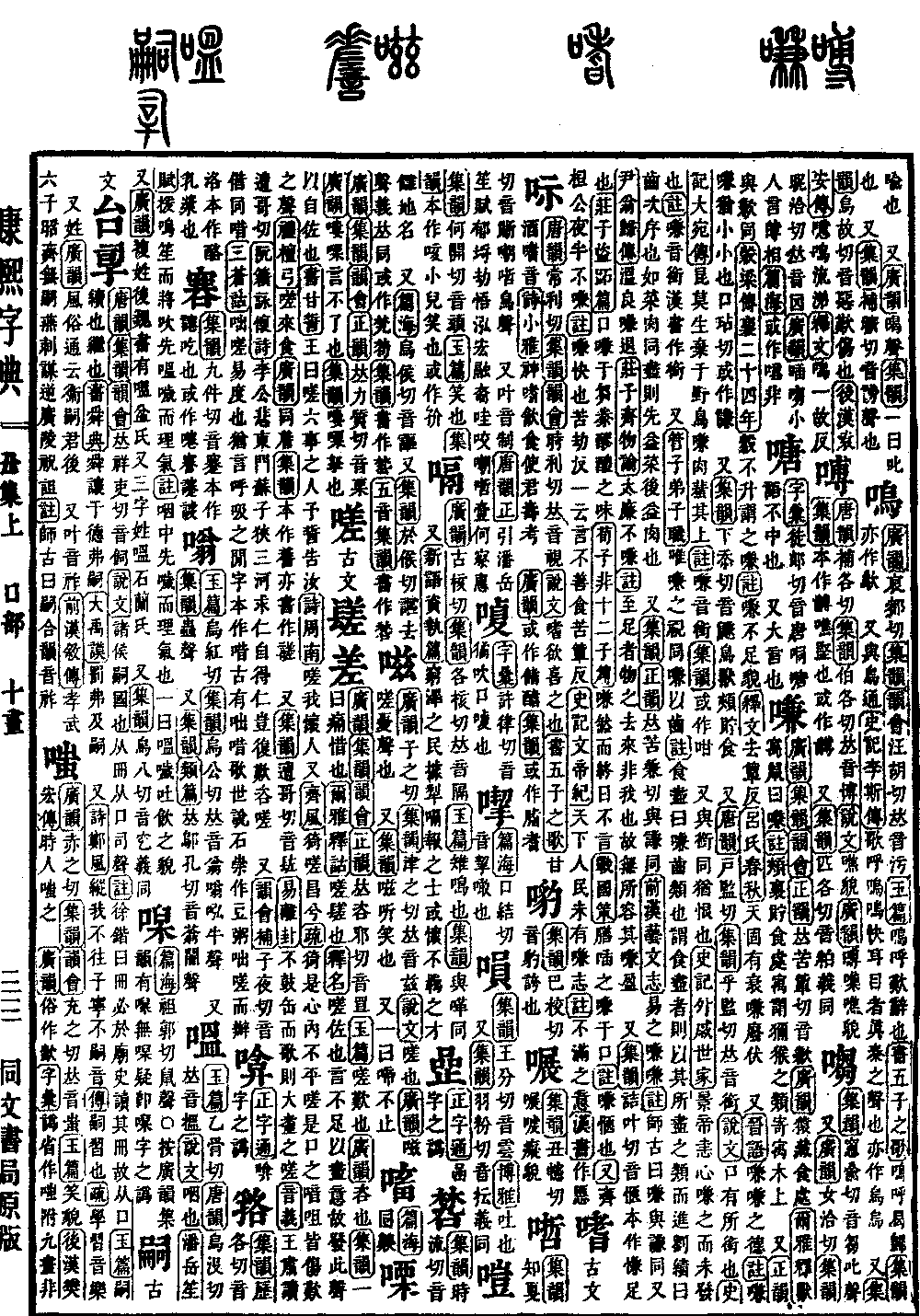
Chou Collection, Upper Volume
Radical: Mouth (kǒu)
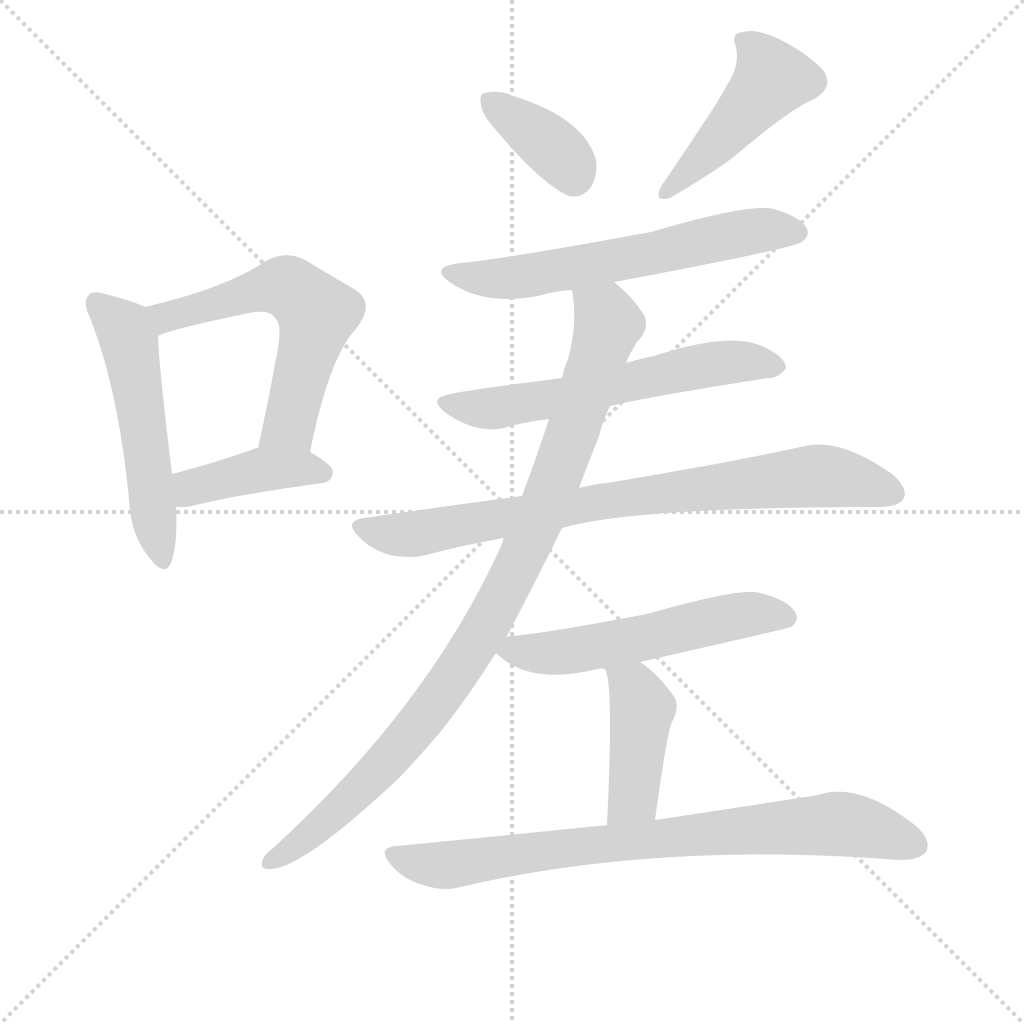
嗟
Kangxi stroke count: 13
Page 203, Entry 21
Ancient form of the character chai (difference).
According to Guangyun (Broad Rhymes), Jiyun (Collected Rhymes), Yunhui (Collection of Rhymes), and Zhengyun (Correct Rhymes), the pronunciation is ju.
According to Yupian (Jade Chapter), to sigh or lament.
According to Guangyun (Broad Rhymes), to sigh.
According to Jiyun (Collected Rhymes), another definition is to feel pain or regret.
According to Erya: Shigu (Approaching Elegance: Explaining Ancient Terms), jie means to sigh.
According to Shiming (Explanation of Names), jie serves as an auxiliary sound. It means that words are insufficient to exhaust one's meaning, so this sound is uttered to assist oneself.
Book of Documents (Shangshu), Ganshi (Speech at Gan): The King said, O men of the six ministries, I solemnly inform you.
Book of Odes (Shijing), Zhounan: Sighing for the one I cherish.
Also in Qifeng (Odes of Qi): Ah, how flourishing.
Commentary: Yi is inner emotional agitation, and jie is the vocal expression from the mouth, both being sounds of sorrow and sighing.
Book of Rites (Liji), Tangong: Alas, come and eat.
According to Guangyun (Broad Rhymes), the same as above.
According to Jiyun (Collected Rhymes), originally written as the character appearing here, also written as the character appearing here.
Also, according to Jiyun (Collected Rhymes), the pronunciation is ge.
Book of Changes (Yijing), Li Hexagram: If one does not beat the earthen pot and sing, then one will sigh with the old age of a great man.
Commentary on Pronunciation and Meaning: Wang Su reads this as ge.
Ruan Ji, Yonghuai Poetry: Master Li mourns at the east gate, Master Su looks down upon the three rivers. Seeking benevolence and obtaining benevolence, why would one sigh and lament again?
Also, according to Yunhui Bu (Supplement to the Collection of Rhymes), the pronunciation is jie.
Same as the character jie.
According to Sancang Gu (Glossary of the Three Repository), duo jie means to pass quickly. It is akin to the interval of a breath. The character was originally written as jie. In ancient times, there were Duo Jie songs. In Shishuo (New Account of Tales of the World), it is noted that Shi Chong prepared bean porridge, and it was ready in an instant.