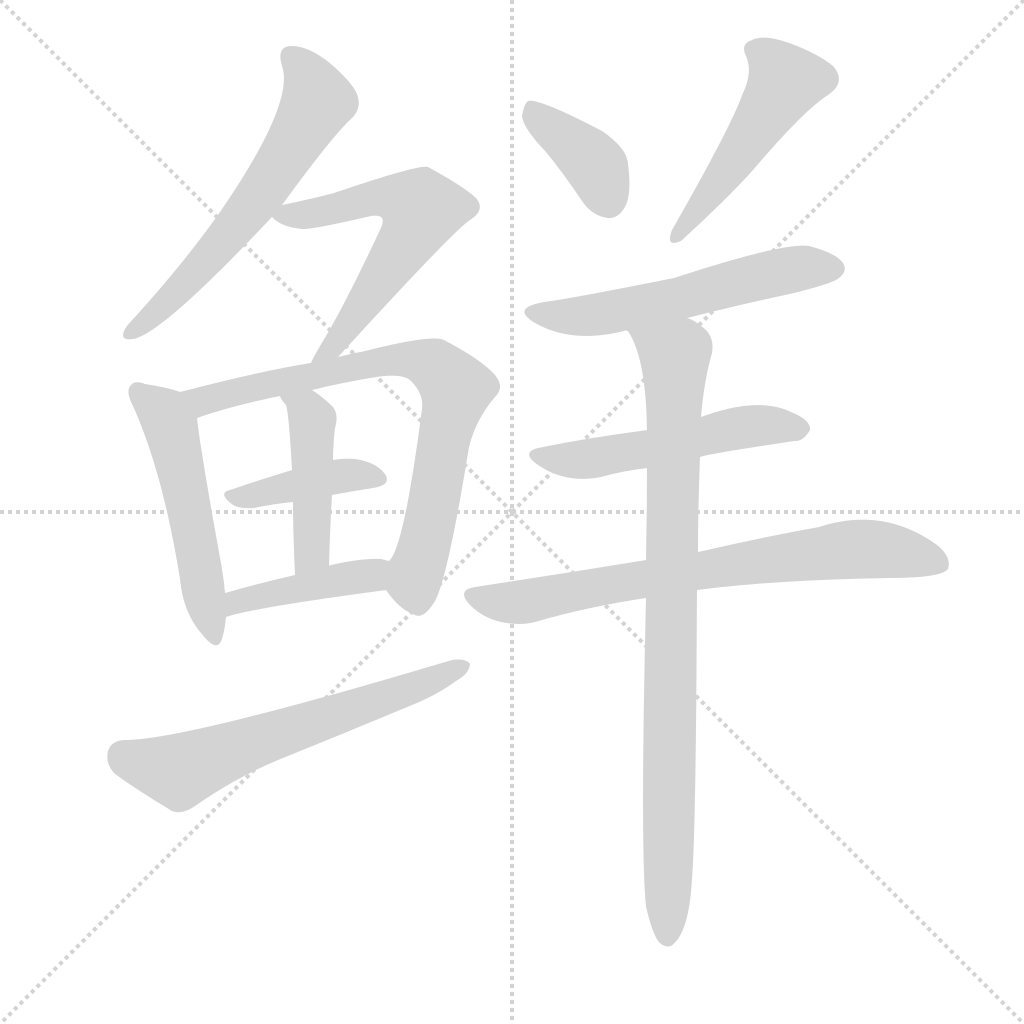
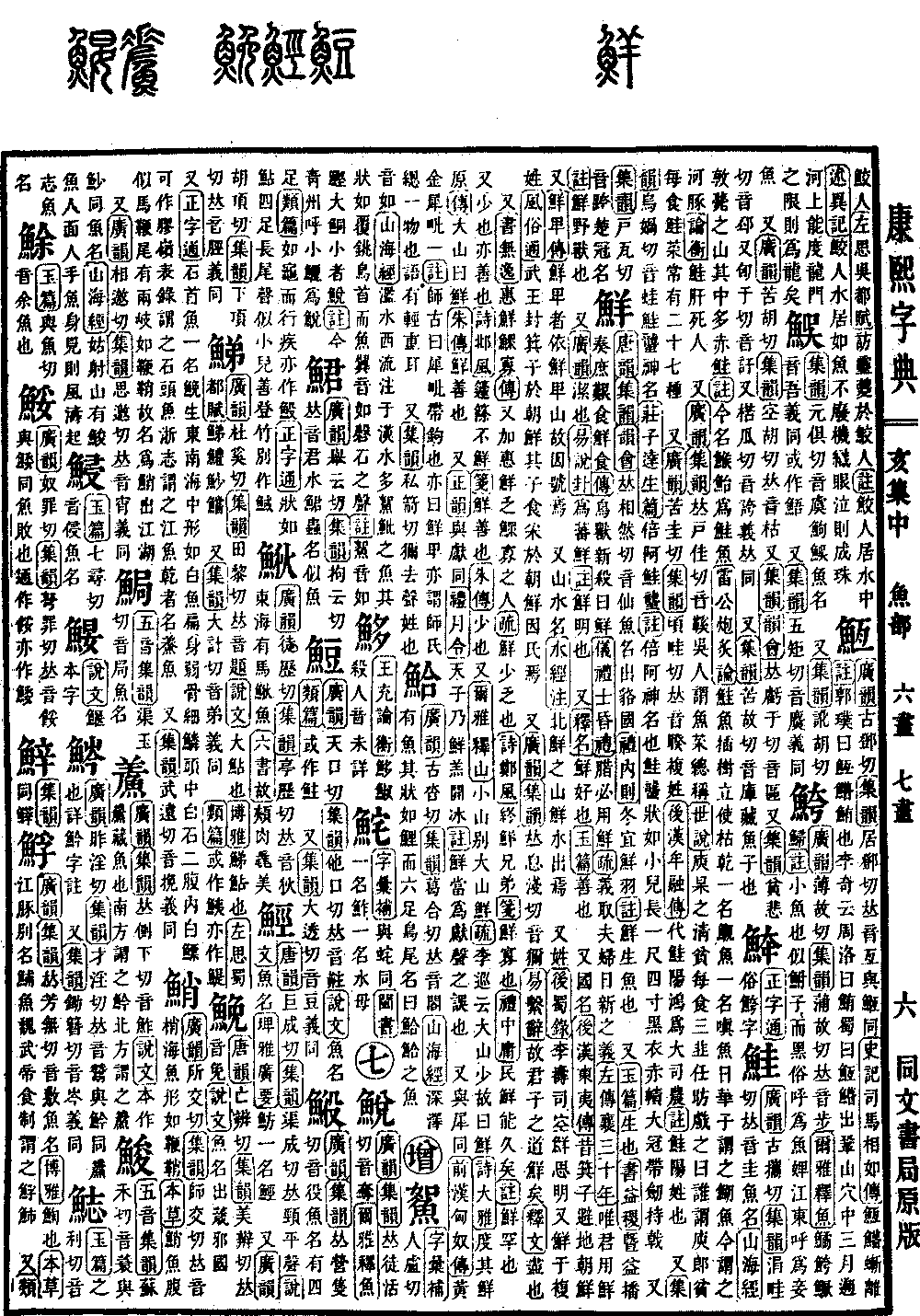
Hai Collection, Middle Volume
Radical: Fish (yú)
Kangxi stroke count: 17
Page 1470, Entry 01
Pronounced xian. A type of fish. Originates from the Mo state.
Book of Rites (Liji), Inner Chapters (Neize): In winter, fresh feathers are appropriate. Commentary: Fresh refers to raw fish.
Also, Yu Pian (dictionary): Raw.
Book of Documents (Shujing), Yi and Ji (Yiji): Together with Yi, they broadcast the songs of the various difficult foodstuffs and fresh foods. Commentary: Birds and beasts newly killed are called fresh.
Ceremonial and Rituals (Yili), Marriage Rites for Scholars (Shihunli): Dried meat must be served fresh. Sub-commentary: The meaning implies the principle of husband and wife renewing themselves daily.
Zuo Commentary (Zuozhuan), Thirtieth Year of Duke Xiang: Only the ruler uses fresh meat. Commentary: Fresh refers to wild game.
Also, Guangyun (dictionary): Clean.
Book of Changes (Yijing), Discussion of the Trigrams (Shuogua): To be luxuriant and fresh. Commentary: Fresh means bright.
Also, Explanation of Names (Shiming): Fresh means good.
Yu Pian (dictionary): Fine.
Also, a state name.
History of the Later Han (Hou Hanshu), Account of the Eastern Barbarians (Dongyizhuan): In the past, Jizi fled to the land of Joseon.
Also, Xian Biography (Xianzhuan): Those who are called Xian depend on Mount Xian, hence they take it as their name.
Also, a mountain and water name.
Commentary on the Water Classic (Shuijingzhu): The mountain of North Xian, from which the Xian River flows.
Also, a surname.
Records of the Later Shu (Houshulü), Li Shou, Minister of Works (Sikong): Xian Siming.
Also, Xianyu, a double-surname.
Customs (Fengsutong): King Wu enfeoffed Jizi in Joseon; his descendants held land in Joseon and thus took it as their surname.
Also, pronounced xian (rising tone).
Book of Changes (Yijing), Appended Remarks (Xici): Therefore, the way of the gentleman is rare. Explanations of the Text (Shiwen): Means exhausted.
Also, Book of Documents (Shujing), Without Ease (Wuyi): Extend kindness to the widowed and destitute. Commentary: Extend kindness to the few and destitute. Sub-commentary: Fresh means few or lacking.
Book of Odes (Shijing), Zheng Airs (Zhengfeng): In the end, there are few brothers. Commentary: Fresh means few.
Book of Rites (Liji), Doctrine of the Mean (Zhongyong): Few among the people have been able to practice it for long. Commentary: Fresh means rare. It also means few. It also means fine.
Book of Odes (Shijing), Bei Airs (Beifeng): The fawning are not fine. Commentary: Fresh means fine. Zhu Xi Commentary: Means few.
Also, Erya (dictionary), Explanation of Mountains (Shishan): A small mountain separated from a large mountain is called xian. Sub-commentary: Li Xun says: Because a large mountain is few in number, it is called xian.
Book of Odes (Shijing), Greater Odes (Daya): Survey its fine plains. Commentary: A large mountain is called xian. Zhu Xi Commentary: Fresh means fine.
Also, Zheng Yun (dictionary): Same as xian (to offer).
Book of Rites (Liji), Monthly Ordinances (Yueling): The Son of Heaven offers lambs and opens ice. Commentary: Fresh should be xian (to offer); it is an error in sound.
Also, same as xi (rhinoceros).
History of the Former Han (Qian Hanshu), Account of the Xiongnu (Xiongnuzhuan): One gold belt buckle. Commentary: Shigu says: The belt buckle is a waist hook. It is also called xian, and also referred to as a shi, all referring to the same object, differing only in the heaviness of the speech.
Also, Jiyun (dictionary): Pronounced xian (departing tone). A surname.