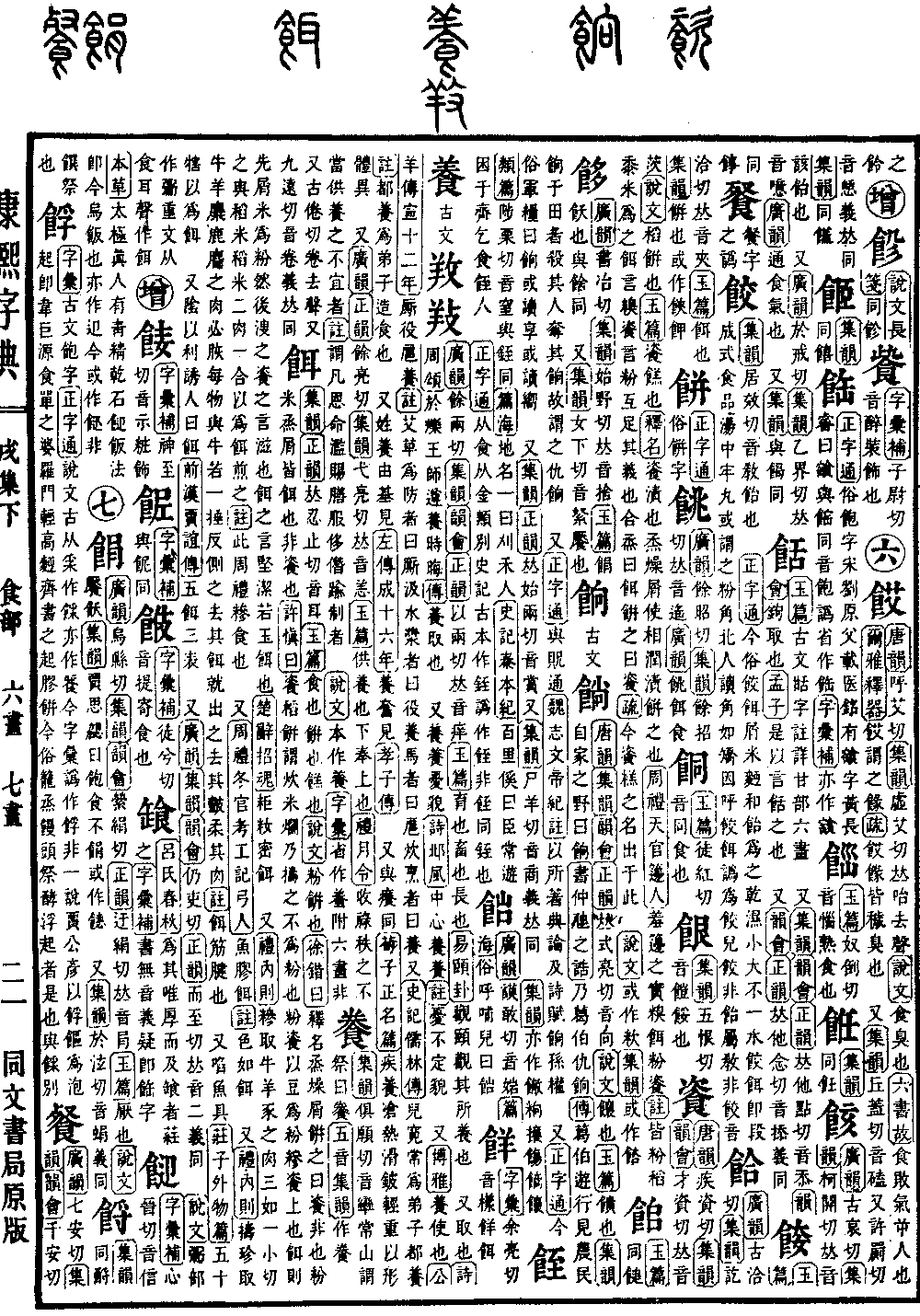
Xu Collection, Lower Volume
Radical: Food (shí)
The character Yǎng
Kangxi strokes: 15
Page 1419
Ancient form
According to Guangyun, the fanqie is yu liang qie. According to Jiyun, Yunhui, and Zhengyn, the fanqie is yi liang qie. Pronounced yǎng.
Yu Pian defines it as: to nurture, to raise, to grow. "Observe the sustenance; observe what is nourished" - Book of Changes (Yijing), Yi hexagram. Also, to take. "Oh, brilliant royal army, following the taking of this obscure time" - Book of Odes (Shijing), Zhou Song. The Commentary states: Yǎng means to take. Also, yǎngyǎng describes an appearance of worry. "My heart is full of worries" - Book of Odes (Shijing), Bei Feng. The Commentary states: The appearance of unsettled worry. Also, according to Boya, yǎng means to cause or to employ. "Sī, yì, hù, yǎng" - Gongyang Commentary (Gongyang Zhuan), Duke Xuan, 12th year. The Commentary states: Sī refers to those who cut grass for defense; Yì refers to those who draw water and liquids; Hù refers to those who tend horses; Yǎng refers to those who cook. Also, in the Records of the Grand Historian (Shiji), "Biographies of Confucian Scholars": Er Kuan often duyang for his disciples. The Commentary states: Duyang means to prepare food for the disciples. Also, a surname. Yǎng Youji, seen in Zuo Commentary (Zuozhuan), Duke Cheng, 16th year. Yǎng Fen, seen in The Biographies of Filial Sons (Xiaozi Zhuan). Also, it is synonymous with yǎng (itch). "Sickness (jí), itch (yǎng), cold (cāng), heat (rè), smoothness (huá), sharpness (pí), lightness (qīng), heaviness (zhòng) are distinguished by their physical forms" - Xunzi, Zhengming chapter.
Also, according to Guangyun and Zhengyn, the fanqie is yu liang qie. According to Jiyun, the fanqie is yi liang qie. Pronounced yàng. Yu Pian defines it as: to provide for, for inferiors to serve superiors. "Reclaim inappropriate salaries and ranks, and those whose provisions and care are unsuitable" - Book of Rites (Liji), Monthly Ordinances. The Commentary states: This refers to all instances where favors and decrees lead to excessive grants of food and clothing, or extravagant and overstepping practices. Shuowen states: The original form of this character is Yǎng. Zihui states: The simplified form with six strokes is incorrect.
Correction: For the line "yu shuo wang shi, zun yang shi hui" in "Book of Odes (Shijing), Zhou Song", the character for "shuo" should be corrected to an alternative character for "shuo" as per the original text.