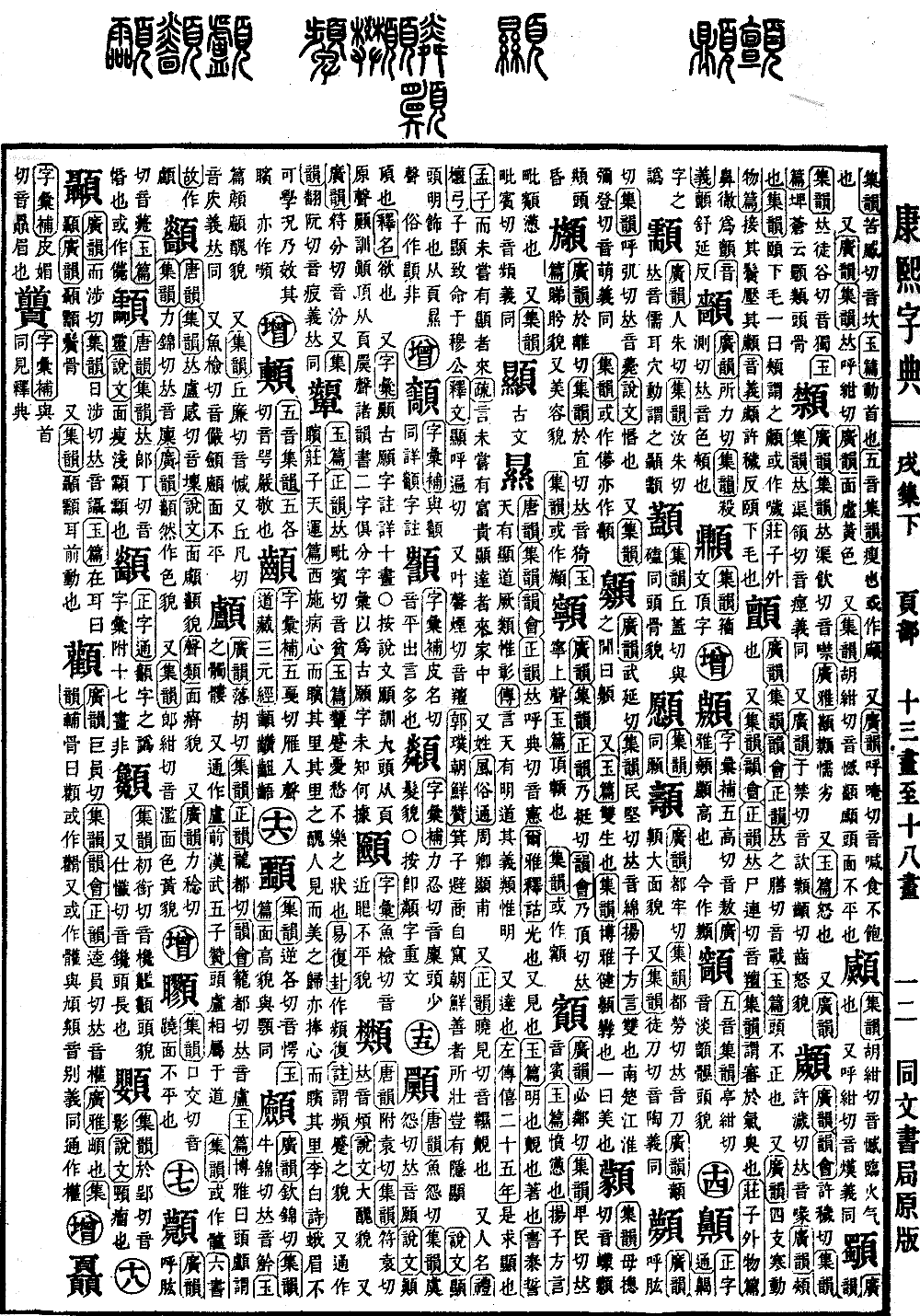
Xu Collection, Lower Volume
Radical: Head (yè)
Kangxi Strokes: 23
Page 1410, Entry 01
Classical records state: Tang Rhyme (Tangyun), Collection of Rhymes (Jiyun), Rhyme Meetings (Yunhui), and Correct Rhymes (Zhengyun) all record the pronunciation as xian (third tone). It is homophonous with the character for constitution. Erya: Explaining Ancient Words states the meaning is light. It also indicates to appear. Jade Chapter (Yupian) states the meaning is bright, to see, or prominent. Book of Documents (Shangshu): Great Oath (Taishi) mentions that the heavens have manifest laws, and their categories are clear. The commentary explains that the heavens have distinct principles, and the logic behind them is clear. It also indicates to be prominent or successful. Zuo Commentary (Zuozhuan): Twenty-fifth Year of Duke Xi mentions the pursuit of prominence. Mencius mentions that there has never been a noble or prominent person who has come. The sub-commentary explains that no wealthy or prominent person has arrived at the home. It is also used as a surname. Customs and Manners (Fengsutong) records that in the Zhou Dynasty, there was a minister named Xian Fu. Correct Rhymes (Zhengyun) also provides the pronunciation xian (fourth tone), homophonous with the character for leather strap. The meaning is to see. It is also used in personal names. Record of Rites (Liji): Tan Gong mentions that Zi Xian reported back to Duke Mu. The Explanation of Text (Shiwen) notes the pronunciation of Xian as xian (fourth tone). It also rhymes with the pronunciation xian (first tone). Guo Pu: Praise of Korea (Chaoxian Zan) notes that Jizi, to avoid the Shang Dynasty, retreated to Korea. Regarding those who are good and admired, is there truly a distinction between hiding and manifesting? Explaining Characters (Shuowen) states that this character refers to a bright ornament on the head. The structure is derived from the radical for head, with a phonetic component. The common variant is incorrect.