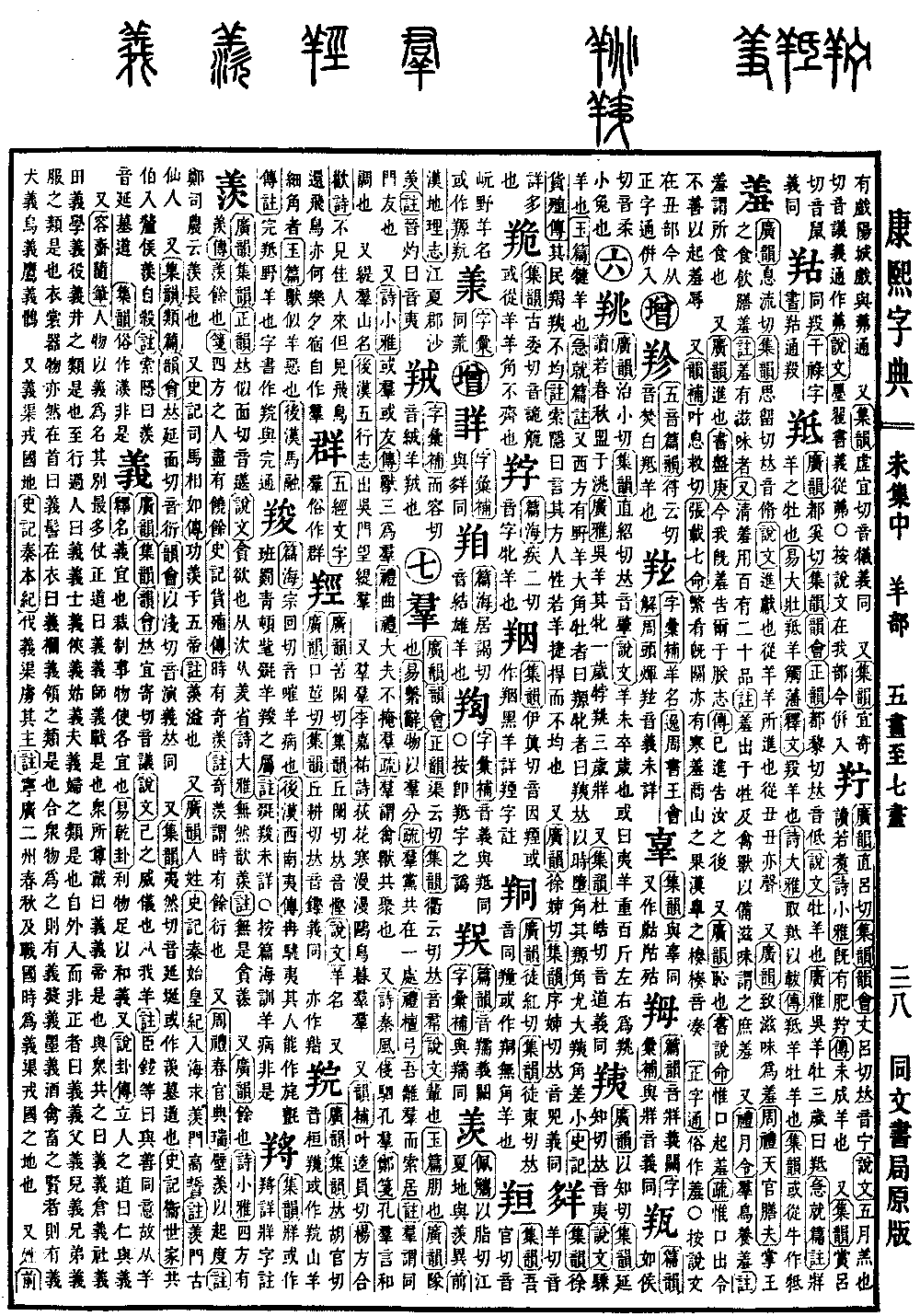
Wei Collection, Middle Volume. Radical: Sheep (yáng). Kangxi strokes: 11. Page 952, Number 04.
According to the Broad Rhymes (Guangyun), the fanqie phonetic notation is xi-liu-qie. According to the Collected Rhymes (Jiyun), the fanqie phonetic notation is si-liu-qie. It is pronounced the same as the character xiu.
The Explaining Graphs and Analyzing Characters (Shuowen Jiezi) defines the character as the act of offering or presenting. The character structure follows the radical for sheep (yang) because sheep are animals frequently used for offerings; it also follows the phonetic component chou.
Also, the Broad Rhymes (Guangyun) states that the preparation of delicious food is called xiu.
The Rites of Zhou (Zhouli) in the section on Celestial Officials (Tianguan) regarding the Dietary Official (Shanfu) records that the official's duty is to manage the king's meals and delicacies (shanxiu). The commentary states that xiu refers to flavorful food.
The same text records that there are one hundred and twenty varieties of delicacies (xiu). The commentary states that xiu are derived from livestock and wild animals and are used to enhance flavor, referred to as various delicacies (shuxiu).
Furthermore, the Record of Rites (Liji) in the Monthly Ordinances (Yueling) records that various birds nourish their food (xiu). The commentary states that xiu refers to the food eaten by birds.
Also, the Broad Rhymes (Guangyun) defines the term as to offer or present.
The Book of Documents (Shangshu) in the Pan Geng section records: Now that I have presented (xiu) my words, I inform you of my will. The commentary explains this as having already spoken to inform them of his intentions.
Also, the Broad Rhymes (Guangyun) defines the term as shame or disgrace.
The Book of Documents (Shangshu) in the Charge to Yue (Yue Ming) section records: It is the mouth that gives rise to shame (xiu). The sub-commentary explains that if speech is improper, it will bring about disgrace.
According to the Rhyme Supplement (Yunbu), the pronunciation can also be read as the fanqie notation xi-jiu-qie to fit a rhyme.
Zhang Zai wrote in the Seven Commands (Qi Ming): When the elaborate dishes are finished, there are also cold delicacies (hanxiu). The fruits of Mount Shang, the hazelnuts of the Han River banks. The character for hazelnut (cou) is pronounced the same as cou.
The Correct Character Mastery (Zhengzitong) notes that the common form is written as xiu. According to the Explaining Graphs and Analyzing Characters (Shuowen Jiezi), it was originally classified under the radical chou, but is now merged here following the Correct Character Mastery (Zhengzitong).
Verification: The original text stating that the six clear drinks and delicacies (qingxiu) use one hundred and twenty varieties is incorrect. According to the Rites of Zhou (Zhouli), for drinks use the six clear liquids (liuqing), and for delicacies (xiu) use one hundred and twenty varieties. The word for clear (qing) belongs to the preceding phrase and should not be cited together with xiu; therefore, the word for clear (qing) has been removed.