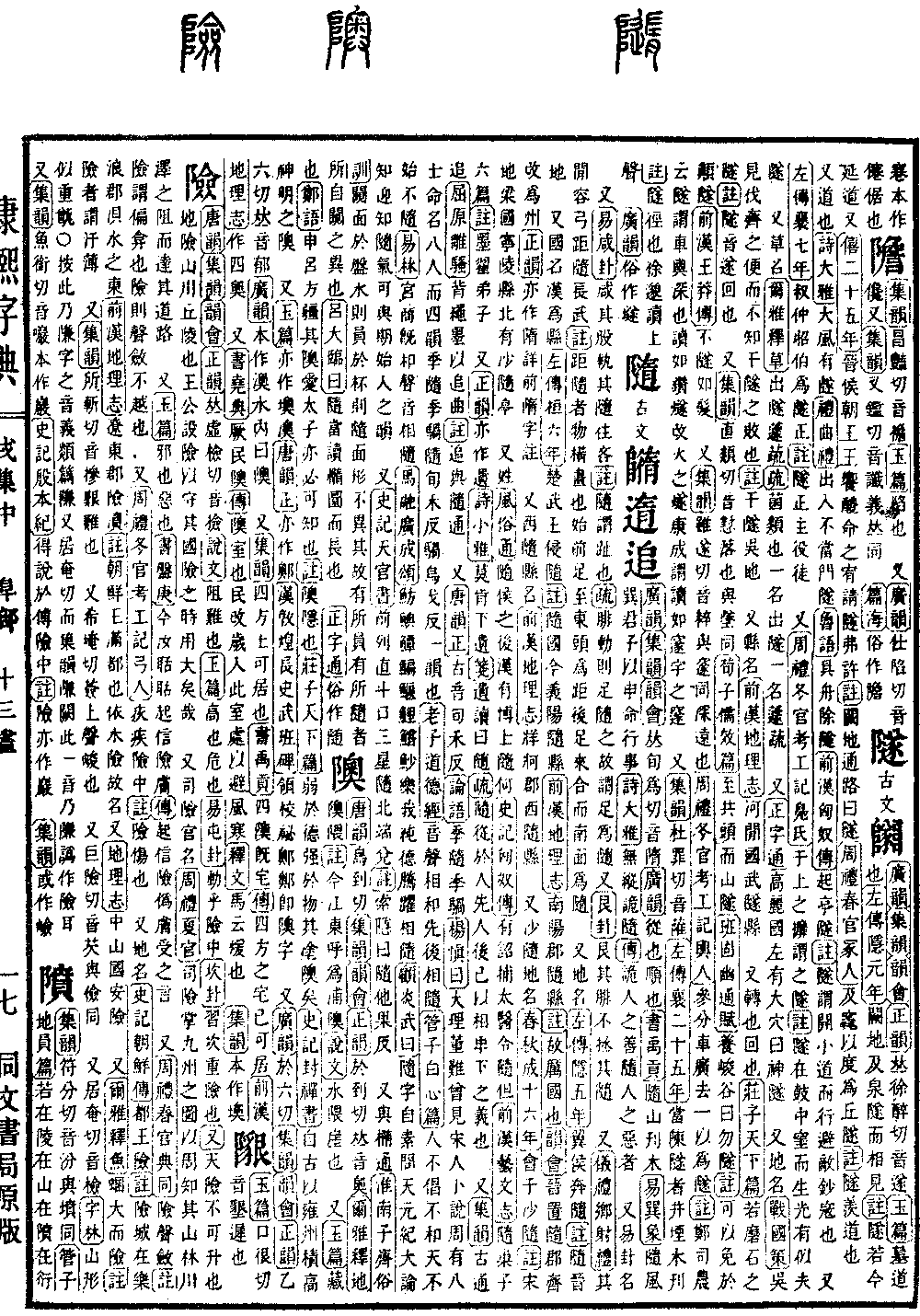
Xu Collection, Middle Volume
Radical: Mound (fù)
险; Kangxi strokes: 21; Page 1361
According to Tangyun, Jiyun, Yunhui, and Zhengyun, the pronunciation is xūjiǎnqiè, with the sound of xiǎn. According to Shuowen Jiezi (Shuōwén Jiězì), it means obstruction and difficulty. According to Yupian (Yùpiān), it means high and dangerous. "Movement in the midst of danger" — Book of Changes (Yijing), Tun Hexagram. "Repeated Kǎn (abysmal water), repeated danger" — Book of Changes (Yijing), Kan Hexagram. Also from the Book of Changes (Yijing): "Heaven's dangers are unscalable; Earth's dangers are mountains, rivers, hills; Kings and dukes establish dangers to protect their states. The usefulness of dangers is truly great!"
Also, Sīxiǎn (Supervisor of Dangers) is an official title. "The Sīxiǎn in the Office of Summer Officials (xiàguān) within the Rites of Zhou (Zhōulǐ) manages maps of the nine provinces to be thoroughly familiar with the obstructions of their mountains, forests, rivers, and marshes, and to open up their roads."
Also, according to Yupian (Yùpiān), it means evil and wicked. "Now you chatter loudly, stirring up belief in superficial dangers." — Book of Documents (Shujing), Pangeng. The commentary explains: "Stirring up belief in treacherous falsehoods, words that are superficial."
Also, in the Office of Spring Officials (chūnguān), Diǎntóng (Master of Music) of the Rites of Zhou (Zhōulǐ) states: "The xiǎn voice is restrained." The commentary explains: "Xiǎn refers to being biased and restricted. If it is xiǎn, the sound is restrained and does not go beyond."
Also, in the Office of Winter Officials (dōngguān), Kǎogōngjì (Artificers' Record) of the Rites of Zhou (Zhōulǐ), Bow-makers section, states: "Diseases and illnesses within dangers." The commentary explains: "Xiǎn here means injury."
Also, a place name. "The capital was Wángxiǎn" — Records of the Grand Historian (Shǐjì), Account of Korea. The commentary explains: "Xiǎn City was east of the Pèishǔi River in Lelang Commandery." In the Book of Han (Hànshū), Treatise on Geography, "Xiǎndú of Liaodong Commandery." The commentary explains: "It was the capital of King Mǎn of Joseon, named for its perilous waters." Also, in the Treatise on Geography, "Ānxiǎn of Zhongshan Kingdom."
Also, in Erya (Ěryǎ), Explanation of Fish, "The jiān is large and xiǎn." The commentary explains: "Xiǎn refers to being dirty and thin."
Also, according to Jiyun (Jíyùn), the pronunciation is suǒzhǎnqiè, with the sound of chǎn. It means difficult and arduous. Also, the pronunciation is xī'ǎnqiè, with the upper tone of xiǎn. It means precipitous. Also, the pronunciation is jùxiǎnqiè, with the sound of qiàn. It is the same as jiǎn.
Also, the pronunciation is jūyǎnqiè, with the sound of jiǎn. According to Zilin (Zìlín), "The shape of a mountain resembling a double steamer." This is actually the meaning and pronunciation of the character yǎn. In Leipian (Lèipiān), yǎn also has the pronunciation jūyǎnqiè, but Jiyun omits this pronunciation for yǎn, so it seems that yǎn was erroneously written as xiǎn here.
Also, according to Jiyun (Jíyùn), the pronunciation is yúxiánqiè, with the sound of yán. The original character was yán. "He found Yuè (Fu Yue) among the dangers of Fù" — Records of the Grand Historian (Shǐjì), Annals of Yin. The commentary explains: "Xiǎn is also written as yán." Jiyun (Jíyùn) also states it can be written as xiǎn.