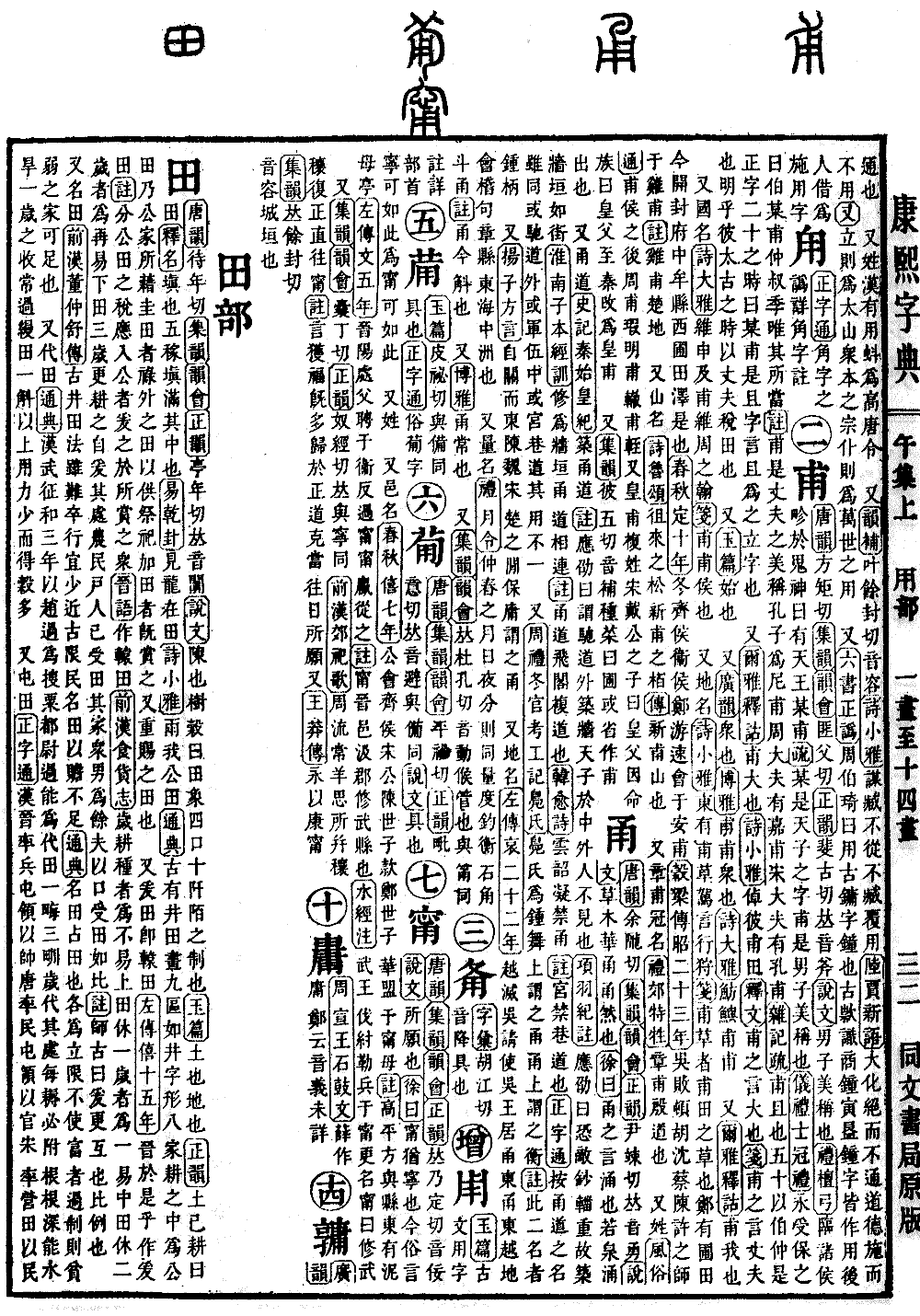
Wu Collection, Upper Volume. Radical: Field (tián). Kangxi strokes: 5. Page 756, Entry 11.
Pronounced tian. According to Tang Rhyme (Tangyun), gathered collection of rhymes (Jiyun), rhyme collection (Yunhui), and standard rhymes (Zhengyun), the sound is tian. According to Explaining Graphs and Analyzing Characters (Shuowen), it is a place for planting crops; the shape resembles four squares (mouths). The character ten signifies the regulation of paths between fields. According to The Jade Chapter (Yupian), it refers to soil or earth. According to Standard Rhymes (Zhengyun), cultivated land is called field. According to Explaining Names (Shimingshi), it means to fill, as various crops fill the area. Book of Changes (Yijing), Qian hexagram: See the dragon in the fields. Book of Odes (Shijing), Lesser Odes: Irrigate our public fields. General Administrative Statutes (Tongdian): In ancient times, there was the well-field system, dividing land into nine regions like the character for well, where eight families farmed, and the center was the public field, dedicated to state taxes. Gui fields are lands outside of official salary, used to provide for sacrifices. Jia fields are lands granted a second time after an initial reward. There are also Yuan fields; in the Zuo Commentary (Zuozhuan), year 15 of Duke Xi, the state of Jin implemented Yuan fields. The commentary explains this as distributing tax from public fields, turning what should have gone to the public over to those rewarded. In Discourses of the States (Jinyu), it is written as Yuan fields. History of the Former Han (Qianhan), Treatise on Food and Money: Land cultivated annually is called non-rotated upper field; land rested for one year is called once-rotated middle field; land rested for two years is called twice-rotated lower field. Every three years, the rotation requires shifting to different fields. Once a peasant head of household received land, other males in the family, as surplus laborers, received land proportionally. The commentary by Shiguy says: Yuan means rotation and proportion. Also called Tian. In Biography of Dong Zhongshu (Qianhan), it is stated: Although the ancient well-field system is difficult to implement immediately, it should be approached closely. Restrict the amount of land people can occupy to provide for those in need. General Administrative Statutes (Tongdian) defines Ming fields as occupied land, setting limits so the wealthy cannot exceed regulations, allowing the poor and weak to be satisfied. Also Dai (surrogate) fields: General Administrative Statutes (Tongdian) states that in the third year of the Zhenghe era of Emperor Wu of Han, Zhao Guo was appointed as the Commandant of Grain Collection. He promoted the surrogate field method, opening three furrows per acre and rotating them annually, weeding and mounding earth at the roots to withstand drought and flooding. Yields often exceeded non-furrowed flat fields by over one hu, with less effort and greater harvest. Also Tun (military colony) fields: According to Zhengzitong, during the Han and Jin dynasties, troops were often sent to cultivate land under generals; in the Tang, civilians were often sent under officials; in the Song, camps were used with civilians. Zhao Chongguo of the Han left ten thousand infantry in Jincheng to cultivate land and attack the Xianling Qiang; he submitted a twelve-point memorial on these colonies, which Emperor Xuan accepted. In the early Ming, official, civilian, military, merchant, interior, and border colonies were all implemented. During the Yongle reign, orders were issued for each regional military commission to allocate eleven flag-soldiers for farming, known as Yang fields. Based on the harvest, officials assessed the year's quality and the army's diligence. Even feeding a million troops, it did not consume a grain from the people. This is what military texts mean: one stone harvested from a colony is worth twenty stones transported. Also Ying (camp) fields: General Administrative Statutes (Tongdian) records that when Yuwen Rong investigated hidden land, he stated that ten transient households formed a residential area, and officials built houses for them, known as Ying field households, meaning they cultivated land for the government, distinct from military colonies. Also Zhi (official) fields, or duty fields: According to the Comprehensive Examination of Literature (Wenxian Tongkao), during the Kaihuang era of the Sui dynasty, duty fields were first granted, along with public office fields. In the Zhenguan era of the Tang, duty fields were given to returning refugees or impoverished households, with each acre yielding two dou of grain, known as Di Zi. In the eighteenth year of Zhenguan, duty fields were restored. In the first year of Yongtai, officials offered their duty fields to serve as military provisions. Emperor Zhenzong of the Song restored them. During the Qingli era, public fields were divided, and duty fields were restricted. During the Shaoxing era, they were restored. In the Jin and Yuan dynasties, officials were granted such fields based on their rank. Also Fang (square) fields, or equalized fields: General Administrative Statutes (Tongdian) notes that in the fifth year of Xining of the Song, the square field law was revised, and abolished in the Yuanfeng era. Guo Zi, while acting as magistrate of Feixiang, used the thousand-pace square field method to survey land, revealing the true acreage and recovering eight hundred thousand in tax arrears. Also Qu (district) fields: In the Book of Fan Shengzhi, it is said that during the Shang dynasty, a seven-year drought occurred, and Yi Yin created the district field method, teaching people to fertilize, plant, and carry water for irrigation. Jia Sixie stated: For district fields, the fertility of manure is key; they do not necessarily require superior land. One does not plow adjacent land, hoping to maximize the soil's potential. Also Ji (sacrificial) fields, which are lands plowed by the Emperor himself. Book of Rites (Liji), Monthly Ordinances: In the first month of spring, the Emperor leads the three high ministers and nine ministers to personally plow the imperial sacrificial fields. Also Nong fields: In the Annals of Emperor Zhao (Qianhan), the Emperor plows in the Goudu Nong fields. The commentary by Shiguy says these are fields provided for feasts and leisure, places for imperial play. Also, one well-region is called one field. In Discourses of Lu (Luyu), Ji Kangzi wanted to collect military taxes based on fields; the commentary notes that field means one well. In the Guanzi, Book of Riding: Five systems make one field, two fields make one husband. Also, in Book of Documents (Shujing), Book of No Ease: King Wen worked, which refers to the merit of pacifying and nourishing the people. The commentary says Kang is the merit of making people live in peace; Tian is the merit of nourishing the people. It says King Wen did not seek fancy clothing, but focused on pacifying and nourishing the people. It also refers to hunting, interchangeable with the characters tian and dian. Commonly written in a variant form. Book of Changes (Yijing), Heng hexagram: Hunting without catching game. Commentary: Tian means to hunt. Book of Odes (Shijing), Zheng Odes: Uncle goes to the fields. Commentary: Tian means to hunt animals. Also a surname: In Five Tones Collection of Rhymes (Wuyin Jiyun), it originates from Beiping; Jingzhong went to the state of Qi, and later the name was changed to Tian. In the commentary to Records of the Grand Historian (Shiji), Biography of Tian Jingzhong Wan, it is noted that Jingzhong fled to Qi, and because the sounds of the characters Chen and Tian were similar, he changed it to Tian. Also, in the Yellow Court Canon (Huangting Jing): The inch-square field of the inch-house can heal life. The commentary explains the inch-house as the face; the inch-field is the space between the brows, the upper elixir field; the heart is the Crimson Palace field; three inches below the navel is the lower elixir field. Also an official title: Book of Odes (Shijing), Bin Odes: The field official arrived happily. Commentary: Tian Jun is an official who manages the fields. Zuo Commentary (Zuozhuan), 29th year of Duke Zhao: Ji is the chief of the field officials. Commentary: Ji is the head of the field officials. Book of Rites (Zhouli), Ministry of Summer: There are twelve senior officials of the field servants. Also a star name: The Azure Dragon constellation. In Star Records of the Shi Family (Shishi Xingzhuan), the left horn of the dragon is called the Heavenly Field star. Also a deity name: Book of Odes (Shijing), Lesser Odes: To serve the field ancestor. Commentary: The field ancestor is the deity who first taught people how to farm. Book of Rites (Zhouli), Ministry of Earth, Grand Minister of Education: Establish altars for the soil and grain, and erect the master of the fields. Commentary: The master of the fields is the deity of the fields, supported by the spirits of the Earth and the field administration. Also a drum name: Book of Odes (Shijing), Zhou Eulogies: The large field drum is hung. Commentary: Tian is a large drum. Annotation: Tian is read with its original sound; Zheng Xuan wrote it with a different character, pronounced yin. Also a carriage name: Book of Rites (Zhouli), Ministry of Summer: The field servant manages the driving of the field carriage. Commentary: The field carriage is the wooden carriage. Also a place name: In Erya, Explanation of Lands: The state of Zheng has the Pu field. Zuo Commentary (Zuozhuan), 8th year of Duke Yin: The Earl of Zheng requested to be excused from sacrifices to Mount Tai and instead sacrifice to the Duke of Zhou, exchanging the Feng land of Mount Tai for the Xu field of the state of Lu. Commentary: The Xu field is the city where the state of Lu would lodge when visiting the King of Zhou. Also, 2nd year of Duke Xi: The Duke of Guo defeated the Rong people in the Mulberry Field. Commentary: Mulberry Field is land of the state of Guo, located northeast of Shan County in Hongnong Commandery. Also, 6th year of Duke Cheng: The state of Jin moved its capital to New Field. Commentary: This is the current Jiangyi County of Pingyang Commandery. In the Book of Commanderies and States (Houhan), it is noted that Lantian in Jingzhao produces beautiful jade. Also a prefecture name: According to the Rhyme Collection (Yunhui), it is in the territory beyond the southern borders, established by the Tang dynasty after opening up regions inhabited by barbarian tribes. Also a grass name: In Erya, Explanation of Plants: Huangshoutian. Commentary: Resembles oats, the seeds look like wild rice, edible, grows in barren fields; another name is Shouqi. Also in the Rhapsody on the Jingfu Hall by He Yan: Linked fields and attached dwellings. Commentary: This describes a lined-up and connected appearance. Also Book of Rites (Liji), Mourning of the Dead: Collapsing and tottering, like a wall about to fall. Commentary: Describes the appearance of something about to collapse. Also describes the lush appearance of lotus leaves; in the Southern Tune: In the south one can pick lotuses, how lush are the lotus leaves. Also, according to Collected Rhymes (Jiyun), pronounced yin: to plant grain is called tian. Also, according to Standard Rhymes (Zhengyun), pronounced dian: Book of Odes (Shijing), Qi Odes: Do not cultivate the vast fields. Zhu’s commentary: Tian means to plow and govern. Annotation: The tian in do not cultivate is pronounced dian. Also, in Supplement to the Dictionary (Zihuibu), pronounced chen: Discourses of the States (Jinyu): The villain met the villain, and indeed lost his fields. Annotation: Pronounced chen, identical to the character chen. Also a shift in sound to ting: Han Yu, Overcoming the Rites: Who is left fallow at the gate, who is governed in the fields, the four seas are equalized, and the Yue-Shang are subjects. Also, from the Dharma Garden Pearl Forest (Fayuan Zhulin) eulogies: Wise men admire high virtue, aspiring for the Bodhi sound. Riding cranes to soar over the Yi River, spurring horses out of the royal fields. Also, in Forest of Changes (Yilin): Evil paths ruin the fields, bad governance hurts the people. Couples curse, and Mount Tai collapses. Dian is pronounced ding.