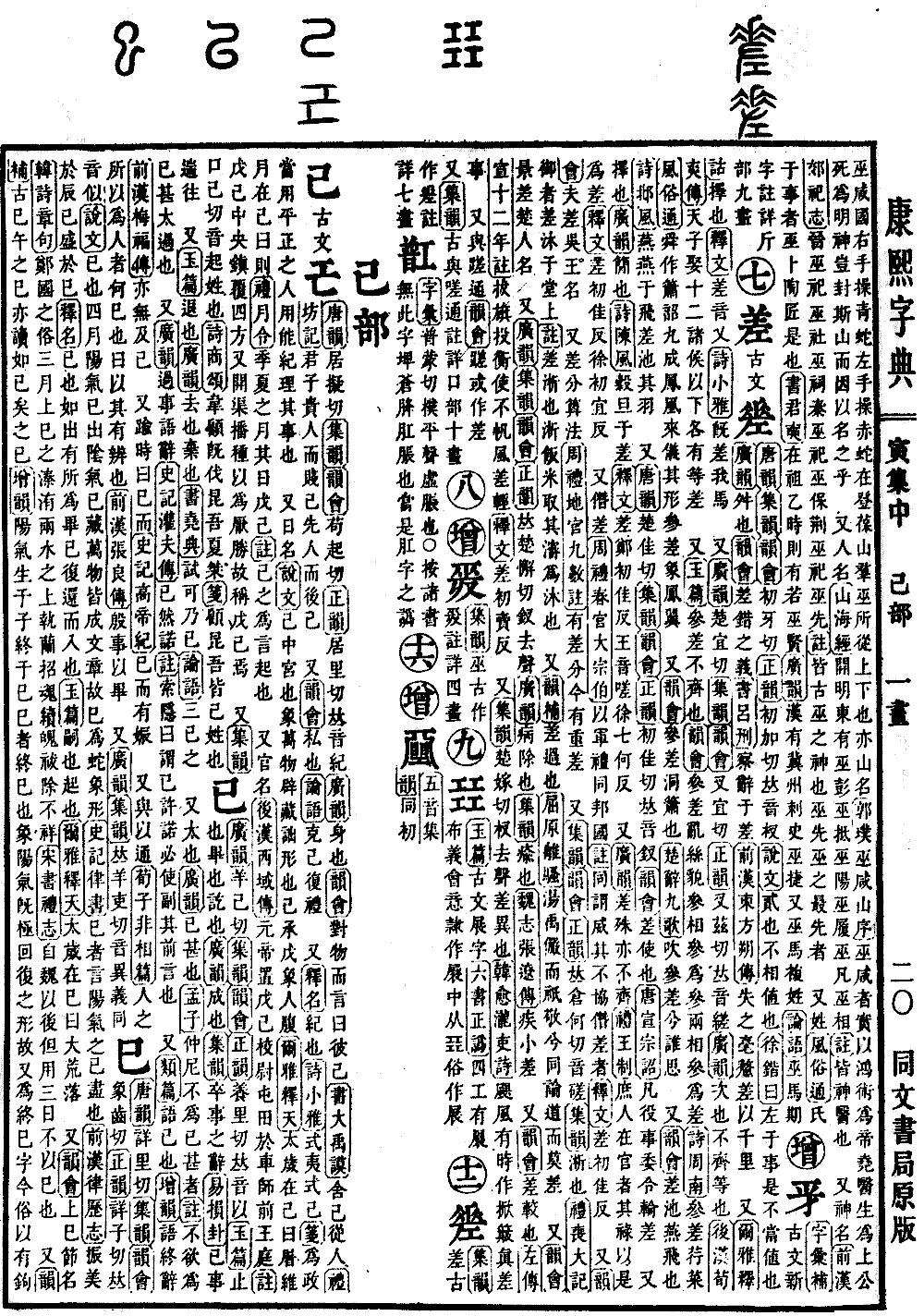
Yin Collection, Middle Volume
Radical: Self (jǐ)
Kangxi Strokes: 3
Page 326, Entry 09
Historical phonetic records: Pronounced jǐ (rising tone) according to Tang Rhyme (Tangyun); pronounced gǒu (third tone) according to Collected Rhymes (Jiyun) and Rhyme Assembly (Yunhui); pronounced jǐ (rising tone) according to Correct Rhymes (Zhengyun). Guangyun defines it as oneself. Yunhui explains it as referring to oneself in contrast to external things as the other. Book of Documents (Shujing): Abandon one's own prejudices and listen to others. Book of Rites (Liji): A gentleman respects others and treats himself lightly, putting others first and himself last.
Also, Yunhui defines it as personal or private. Analects (Lunyu): Subdue one's private desires so that words and actions conform to propriety.
Also, Shi Ming (Explanation of Names) defines it as to govern or to establish order. Book of Odes (Shijing): Employ fair and upright people to govern. Zheng Xuan commentary: When handling government affairs, one should employ fair and upright people to govern well.
Also, used as a name for one of the Heavenly Stems. Shuowen Jiezi (Explaining Graphs and Analyzing Characters) explains: Ji corresponds to the central position, symbolizing the convergence and concealment of all things and the shape of being bent. Ji follows Wu and is shaped like a human abdomen. Erya (Approaching Elegance): The year in the cycle of the Great Year corresponding to Ji is called Tuwei, and the month is called Ze. Book of Rites (Liji): The last month of summer is associated with the Heavenly Stems Wu and Ji. Zheng Xuan commentary: Ji has the meaning of to arise.
Also, used as a title for a government office. Book of the Later Han (Hou Hanshu): Emperor Yuan of the Han dynasty established the Wu-Ji Colonel to garrison and farm at the royal court of Jushi. Li Xian commentary: Wu and Ji correspond to the central direction, symbolizing the defense of all four quarters. Irrigation canals were dug and crops were planted as a means of stabilization, hence the name Wu-Ji.
Also, pronounced qǐ (rising tone) according to Jiyun. Used as a surname. Book of Odes (Shijing): The states of Wei and Gu were conquered, followed by Kunwu and Xia Jie. Zheng Xuan commentary: Both the state of Gu and the state of Kunwu were of the surname Ji.