Wu Collection, Lower Volume
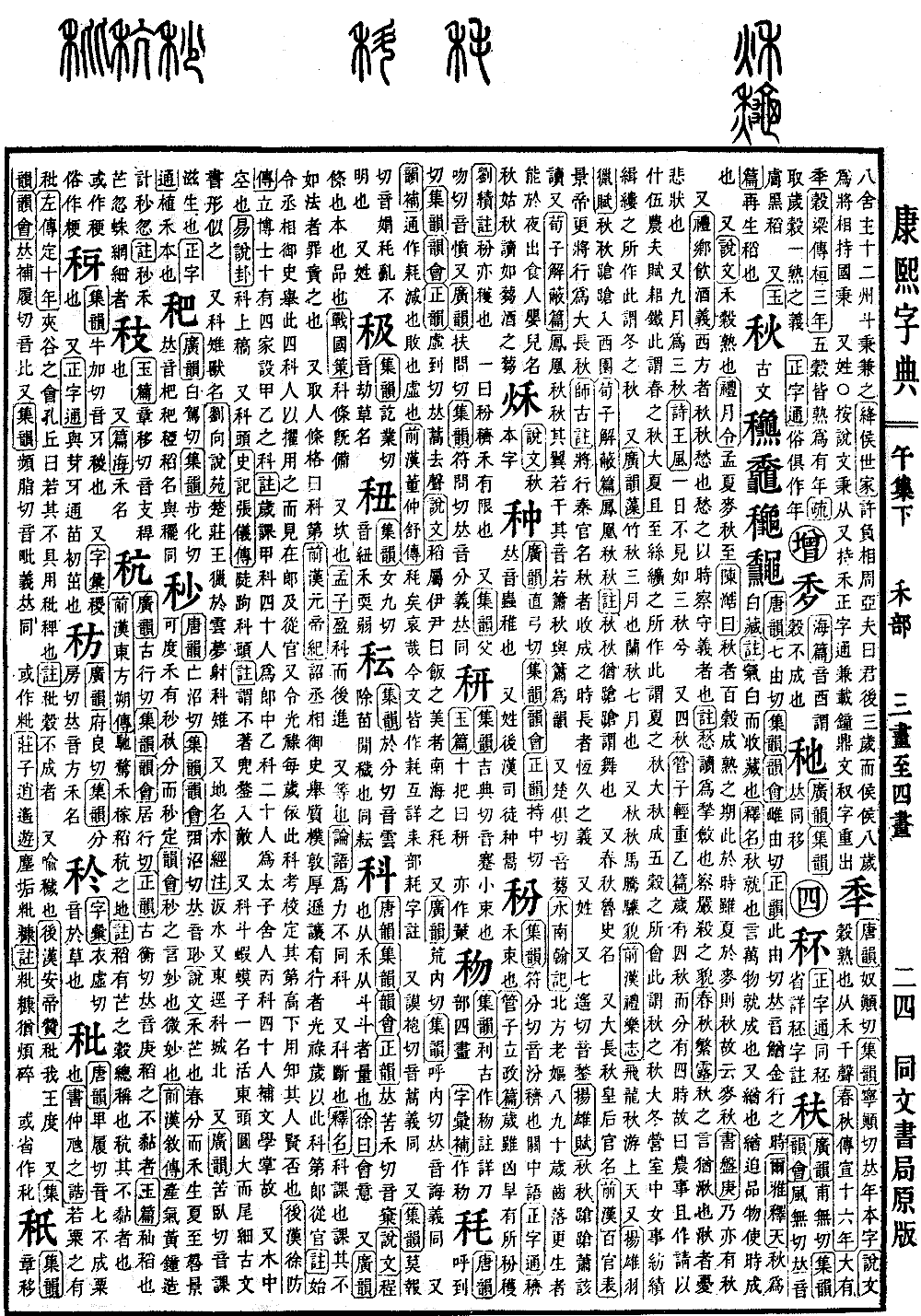
Radical: Grain (hé)
Kangxi Strokes: 9
Page 850, Entry 20
Tang Rhyme (Tangyun), Collection Rhymes (Jiyun), Dictionary of Rhymes (Yunhui), Correct Rhymes (Zhengyun): Pronounced ke (level tone).
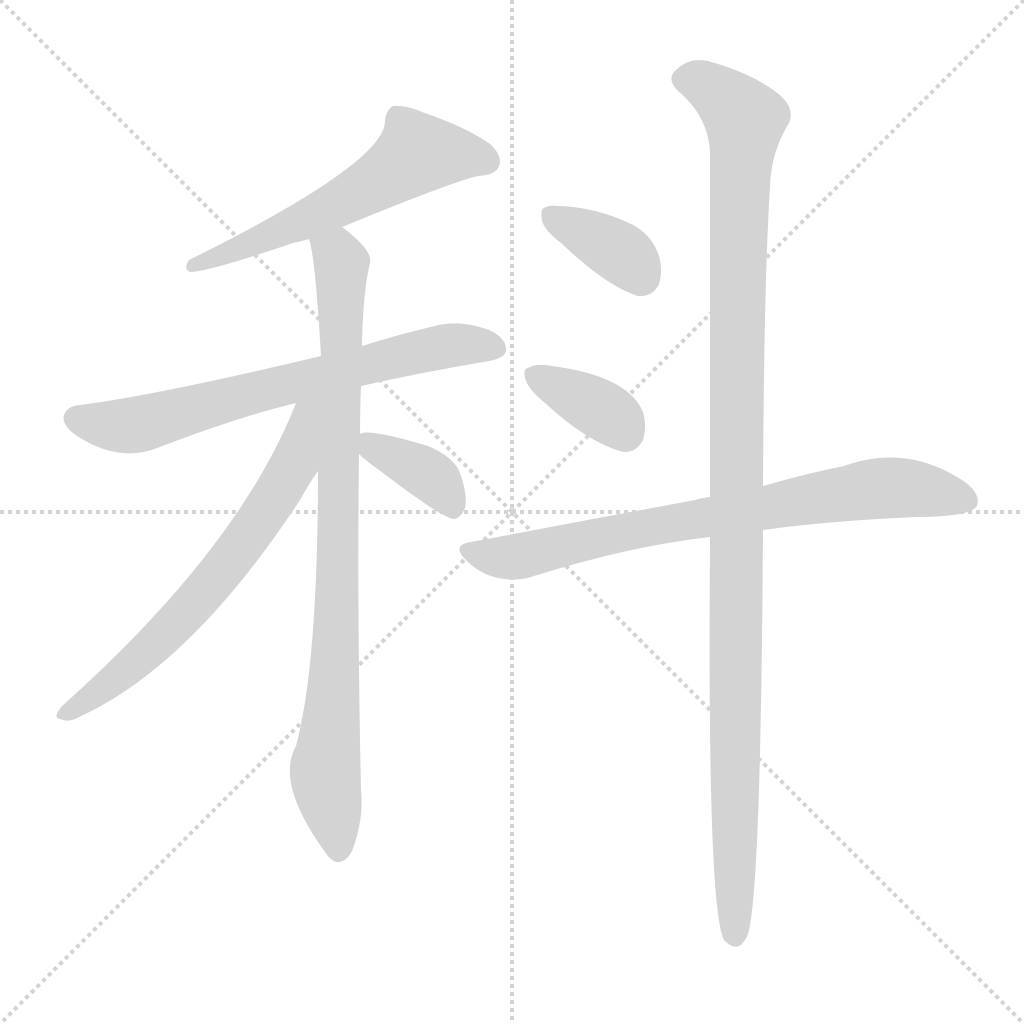
Explaining Characters (Shuowen): A standard or rule. Composed of grain and measuring cup (dou). The measuring cup represents measuring. Xu says: This is a compound ideograph.
Broad Rhymes (Guangyun): A branch; a root; a classification.
Strategies of the Warring States (Zhanguoce): Rules and regulations are already complete.
Also: A hole or pit. Mencius (Mengzi): Filling the pit before advancing.
Also: A grade or level. Analects (Lunyu): To use strength without being in the same category.
Also: To judge. Explanation of Names (Shiming): A judgment, an assessment. To assess those who do not comply with the law and assign punishment.
Also: Regulations for selecting candidates, known as kedi.
Book of Han (Qianhan), Chronicle of Emperor Yuan: An edict to the Chancellor and the Censor-in-Chief to recommend those who are plain, simple, honest, and humble. Every year, the Guanglu should use these criteria to rank the palace attendants. Commentary: Initially ordered the Chancellor and Censor-in-Chief to recommend people based on these four criteria for appointment. The existing attendants were also ordered to be evaluated annually by the Guanglu based on these criteria to determine their rank, thus revealing their talents and failings.
History of the Later Han (Houhan), Biography of Xu Fang: Established fourteen schools of Erudites and set up categories of Grade A and Grade B. Commentary: Every year, forty people of Grade A were selected to be palace attendants, twenty of Grade B to be attendants to the Crown Prince, and forty of Grade C to be literary officials.
Also: A hollow in a tree. Book of Changes (Yijing), Explanation of the Trigrams: The top is hollow and withered.
Also: Bareheaded. Records of the Grand Historian (Shiji), Biography of Zhang Yi: Crouching and bareheaded. Commentary: Refers to entering enemy lines without a helmet.
Also: Tadpoles, the offspring of frogs. Another name is huodong; the head is round and large, the tail is thin. Ancient writing scripts resemble their shape.
Also: Kezhi, a type of beast. Liu Xiang, Garden of Stories (Shuoyuan): King Zhuang of Chu hunted in Yunmeng and shot a kezhi.
Also: A place name. Commentary on the Water Classic (Shuijingzhu): The Bian River flows east, passing north of Ke City.
Broad Rhymes (Guangyun): Pronounced ke (falling tone). To grow or sprout.
General Compilation of Characters (Zhengzitong): To plant the base of a grain stalk.