Wu Collection, Lower Volume
Radical: Grain (hé)
Kangxi Strokes: 7
Page 849, Entry 03
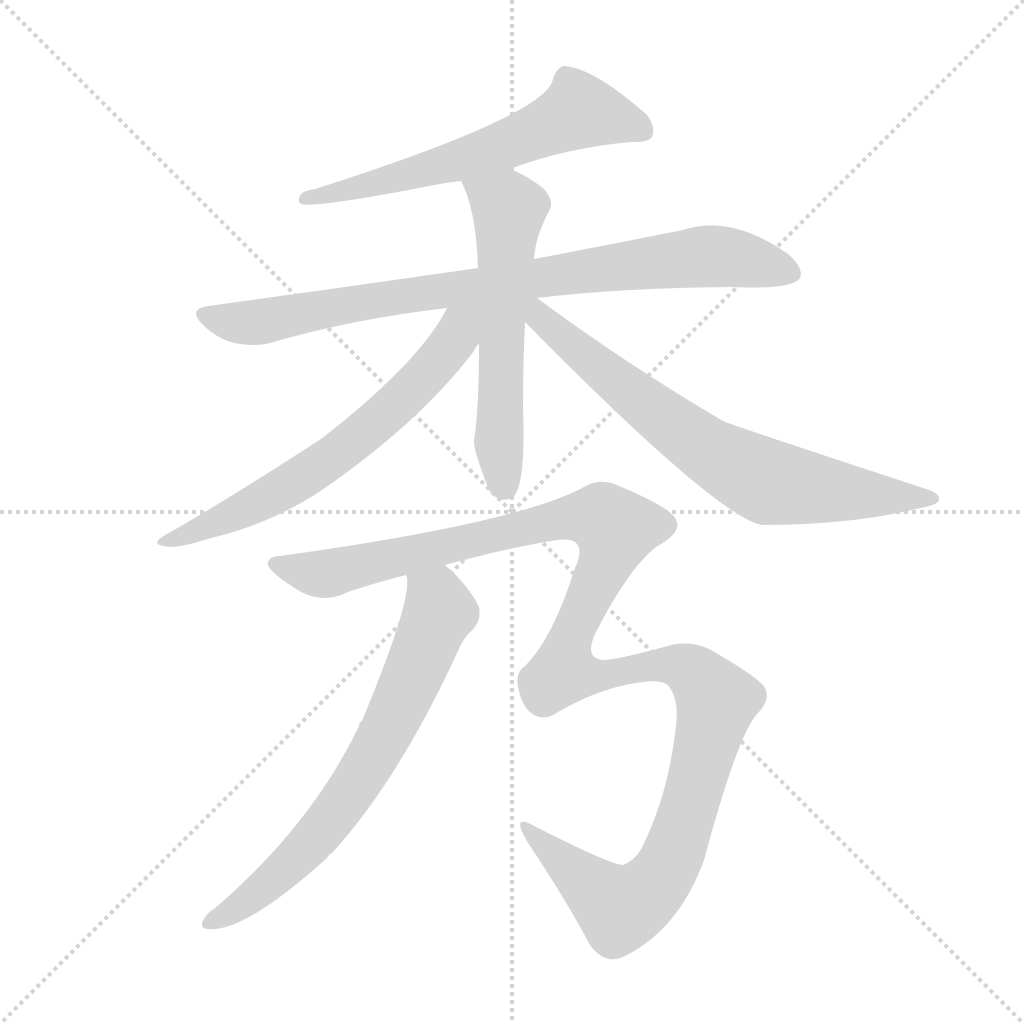
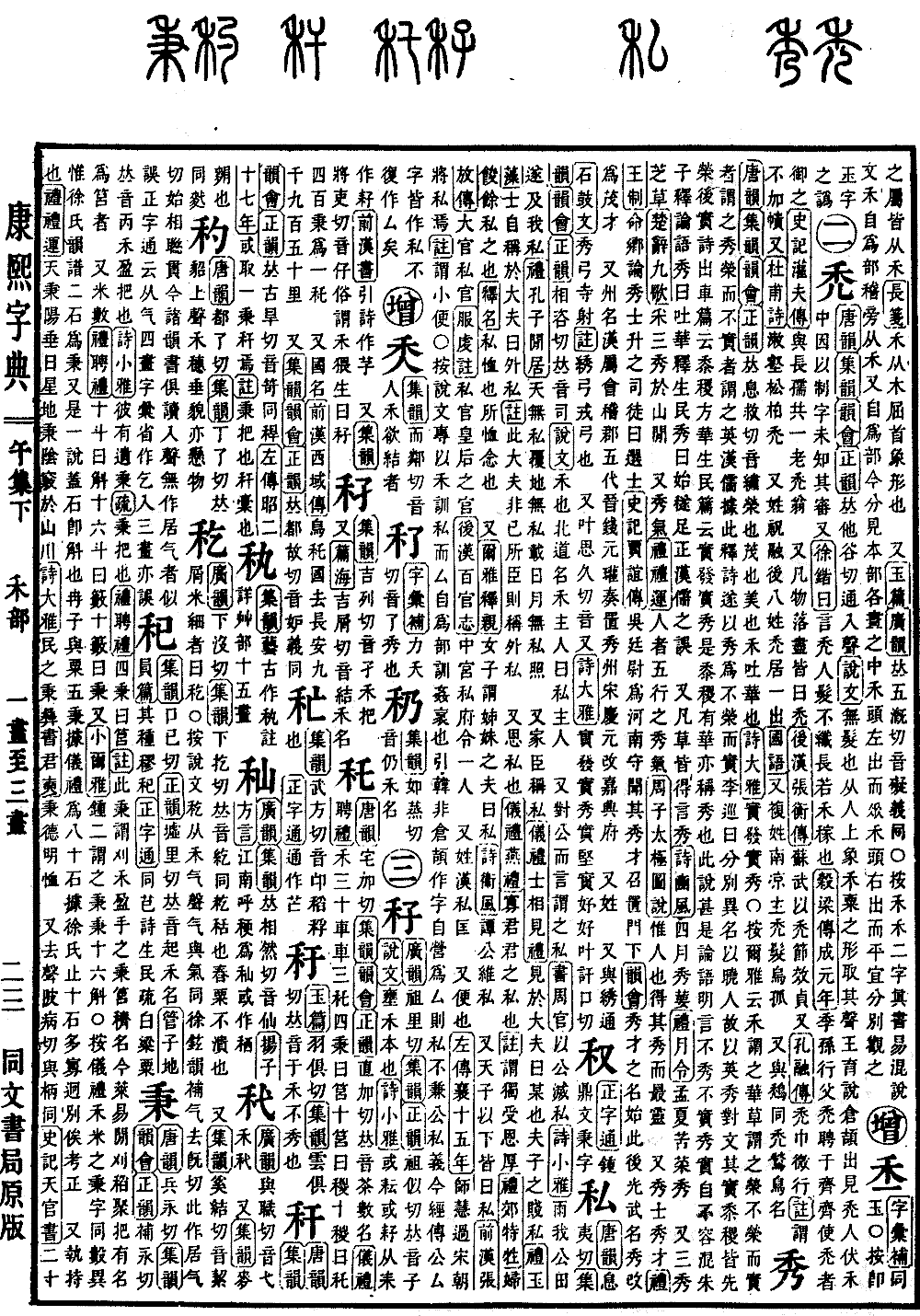
Pronounced xiu (falling tone). Refers to flourishing, thriving, beauty, or grain producing flowers. Book of Odes (Shijing), Greater Odes: The grain sprouts and flowers. According to the Er Ya (Approaching Elegance): The flower of grain is called hua, the flower of herbs is called rong, plants that do not flower but produce fruit are called xiu, and those that flower but do not produce fruit are called ying. Scholars of the Han dynasty used this to interpret the Book of Odes, thus defining xiu as not flowering but producing fruit. Li Xun stated: This was to differentiate names for clarity, contrasting ying and xiu in the text; in reality, millet and broomcorn millet both flower before producing fruit. The Book of Odes, Chu Che section, mentions millet and broomcorn millet in flower. The Sheng Min section mentions sprouting and flowering, indicating that millet and broomcorn millet can be called xiu even when they have flowers. This explanation is correct. The Analects (Lunyu) explicitly states that if it does not flower, it does not produce fruit; thus xiu and fruit are clearly distinct. Zhu Xi interpreted xiu in The Analects as flowering, and xiu in the Sheng Min section as the beginning of earing. This is sufficient to correct the errors of the Han scholars. Also, any herb can be described as xiu. Book of Odes (Shijing), Bin Feng: In the fourth month the ya herb flowers. Book of Rites (Liji), Monthly Ordinances: In the first month of summer the bitter vegetable flowers. Also, the three flowers refer to the lingzhi fungus. Songs of Chu (Chuci), Nine Songs: Plucking the three flowers on the mountainside. Also, elegant spirit. Book of Rites (Liji), Evolution of Rites: Man is the elegant spirit of the five elements. Zhou Dunyi, Explanation of the Diagram of the Supreme Ultimate: Only man attains this elegant spirit and is thus the most spiritually intelligent. Also, accomplished scholar, scholar (xiucai). Book of Rites (Liji), Royal Regulations: Order the villages to evaluate accomplished scholars and recommend them to the Minister of Education; these are called selected scholars. Records of the Grand Historian (Shiji), Biography of Jia Yi: When the magistrate of Wu served as governor of Henan, he heard of his reputation as a scholar and summoned him to his staff. The Rhyme Compilation (Yunhui) notes that the title of scholar began at this time; later, because the personal name of Emperor Guangwu of Han was Xiu, it was changed to flourishing talent. Also, the name of a prefecture. In the Han dynasty, it belonged to Kuaiji Commandery. During the Later Jin dynasty of the Five Dynasties period, Qian Yuanguan petitioned to establish Xiu Prefecture. During the Qingyuan era of the Song dynasty, it was renamed Jiaxing Prefecture. Also, a surname. Also, interchangeable with embroidered. Stone Drum Inscriptions: Embroidered bows and temple archery. Note: Embroidered bows refer to military bows. Also, read as you (falling tone). Book of Odes (Shijing), Greater Odes: It is firm and it is good. Good rhymes with the pronunciation of kou (rising tone).