Wu Collection, Lower Volume
Radical: Grain (hé)
Kangxi Strokes: 9
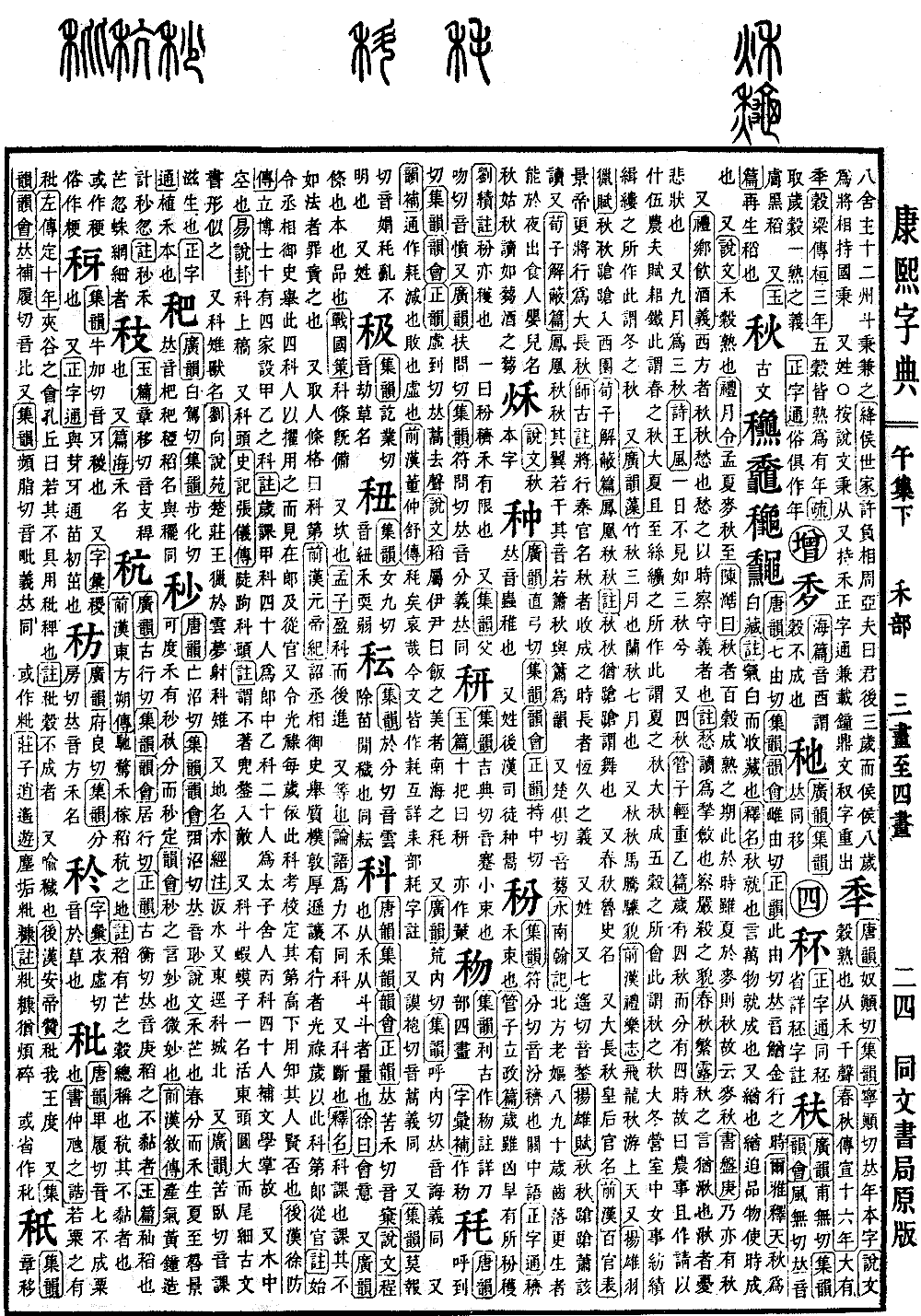
Page 850, Entry 06
In ancient script, written as a variant form.
According to Tang Rhyme (Tangyun), pronounced qiu. According to Collection of Rhymes (Jiyun) and Rhyme Compilation (Yunhui), pronounced qiu. According to Standard Rhymes (Zhengyun), pronounced qiu. The pronunciation is the same as the character for a type of loach.
It is the season governed by the Metal element in the five elements.
Classic of Rites (Erya), section on Explaining the Heavens (Shitian), states that autumn is called Baizang (White Storehouse).
The commentary explains that this is because in autumn, the atmosphere turns white and the focus is on storage.
Explanation of Names (Shiming) states: Autumn (qiu) means to arrive (jiu), meaning that at this time, all things reach maturity. It also implies the meaning of being constrained, urging all things to ripen according to their proper time.
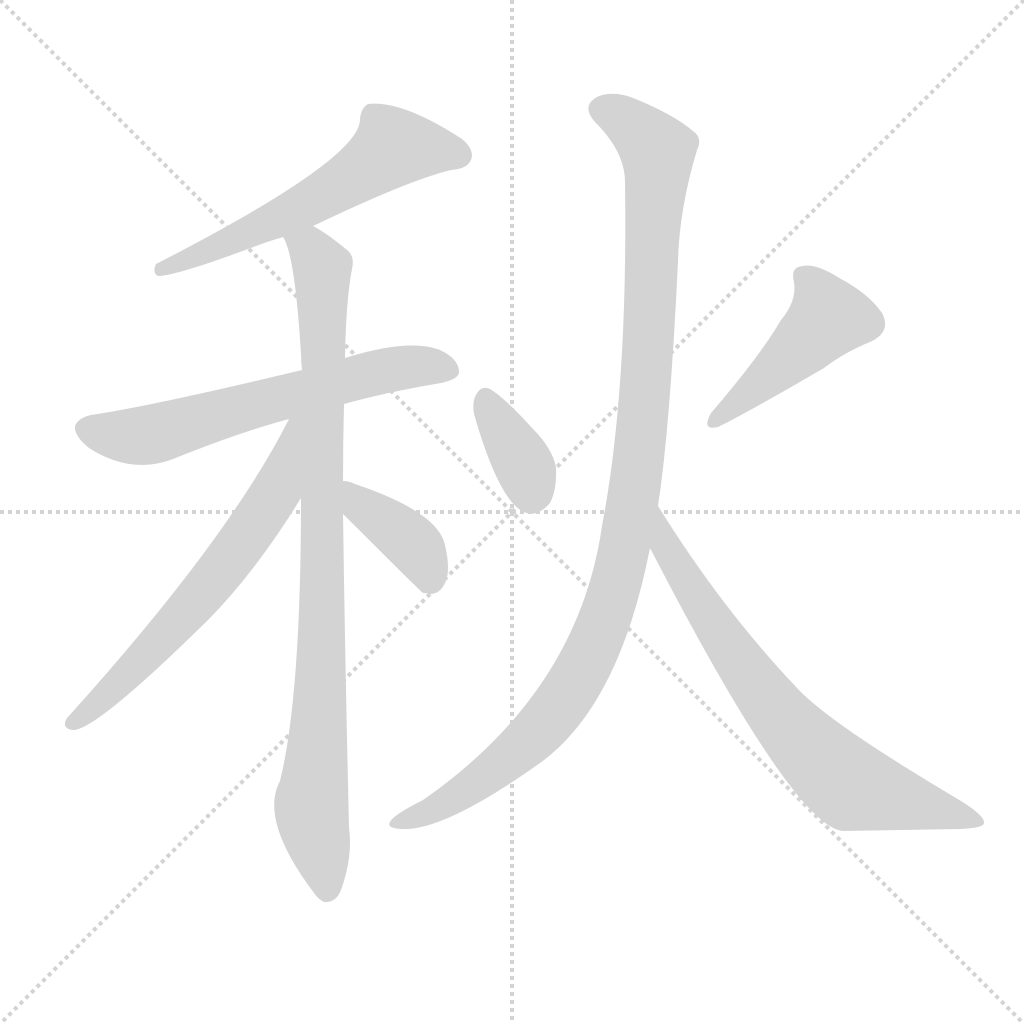
Furthermore, Discussion of Writing and Explaining Characters (Shuowen Jiezi) states: Autumn means the ripening of grain.
Book of Rites (Liji), section on Monthly Ordinances (Yueling), states: During the first month of summer, the autumn of wheat arrives.
Commentator Hao explains: What is called autumn is the season when all grains ripen. Although it is still summer in this season, it is the autumn for wheat, hence the term wheat autumn.
Book of Documents (Shangshu), section on The Announcement of Pan Geng (Pan Geng), mentions: Thus there was a harvest (autumn).
Furthermore, Book of Rites (Liji), section on The Meaning of the Village Drinking Ceremony (Xiangyinjiuyi), states: The West corresponds to autumn. Autumn (qiu) means to be anxious (chou). Performing the act of gathering (chou) during the autumn season is an expression of observing and holding to righteousness.
The commentary notes: The word for anxious here is pronounced jiu, meaning to gather or draw in. It refers to observing the stern and killing atmosphere of autumn.
Spring and Autumn Annals Prosperity and Dew (Chunqiu Fanlu) states: The meaning of the character for autumn is like that of the character for a pool (qiu). A pool represents a state of sorrow and sadness.
Also, the ninth month is called the three autumns.
Classic of Poetry (Shijing), section on Odes of Wang (Wangfeng), states: Not seeing each other for one day is like three autumns have passed.
There is also the concept of the four autumns.
Master Guan (Guanzi), section on Light and Heavy (Qingzhong Yi), states: A year has four autumns, divided into four seasons. Thus it says: When farming is about to begin, organize farmers into groups of five and collect the iron needed for plows and hoes. This is called the autumn of spring. When mid-summer approaches, it is time to make silk, which is called the autumn of summer. When the great autumn harvest arrives and the five grains are gathered, this is called the autumn of autumn. In deep winter, while indoors, it is when women engage in spinning, weaving, and twisting hemp, which is called the autumn of winter.
Additionally, Comprehensive Rhymes (Guangyunzao) records: Bamboo autumn refers to the third month; Orchid autumn refers to the seventh month.
There is also the term qiuqiu, describing the galloping of horses.
History of the Former Han (Qianhanshu), section on Records of Rituals and Music (Liyuezhi), states: Flying dragons roam the heavens in a qiuqiu manner.
Furthermore, Yang Xiong in his Rhapsody on Feathered Hunting (Yulie Fu) states: Walking in a qiuqiu qiangqiang manner into the West Park.
Master Xun (Xunzi), section on Dispelling Blindness (Jiebi), states: The phoenix dances in a qiuqiu manner.
The commentary notes: Qiuqiu is like qiangqiang, describing the appearance of dancing.
There is also the Spring and Autumn Annals (Chunqiu), the name of the historical records of the State of Lu.
There is also the title Da Changqiu, an official title for the Empress.
History of the Former Han (Qianhanshu), section on Table of Officials (Baiguanbiao), records: Emperor Jing of Han renamed the official post of Jiangxing to Da Changqiu.
Master Shigu's commentary states: Jiangxing was an official post in the Qin dynasty. Qiu is the season of harvest, and Chang means long-lasting.
It is also used as a surname.
Also, pronounced qiao, the sound is the same as the character for a shovel.
The qiu in qiuqiu qiangqiang in the Rhapsody by Yang Xiong is read this way by the scholar Xiao Gai.
Furthermore, in Master Xun (Xunzi), section on Dispelling Blindness (Jiebi): The phoenix dances in a qiuqiu manner, its wings like shields, its cry like the sound of a flute. Here, qiu rhymes with xiao (flute).
Also, pronounced chu, the sound is the same as the character for fodder (chu).
Shuinan Hanji records: In the north, there are old women of eighty or ninety years who grow new teeth after losing their old ones; they can go out at night to eat infants, and are called Qiu Gu. Here, qiu is pronounced like the chu in the term for fodder wine.