Wu Collection, Lower Volume
Radical: Grain (hé)
Kangxi Strokes: 7
Page 849, Entry 05
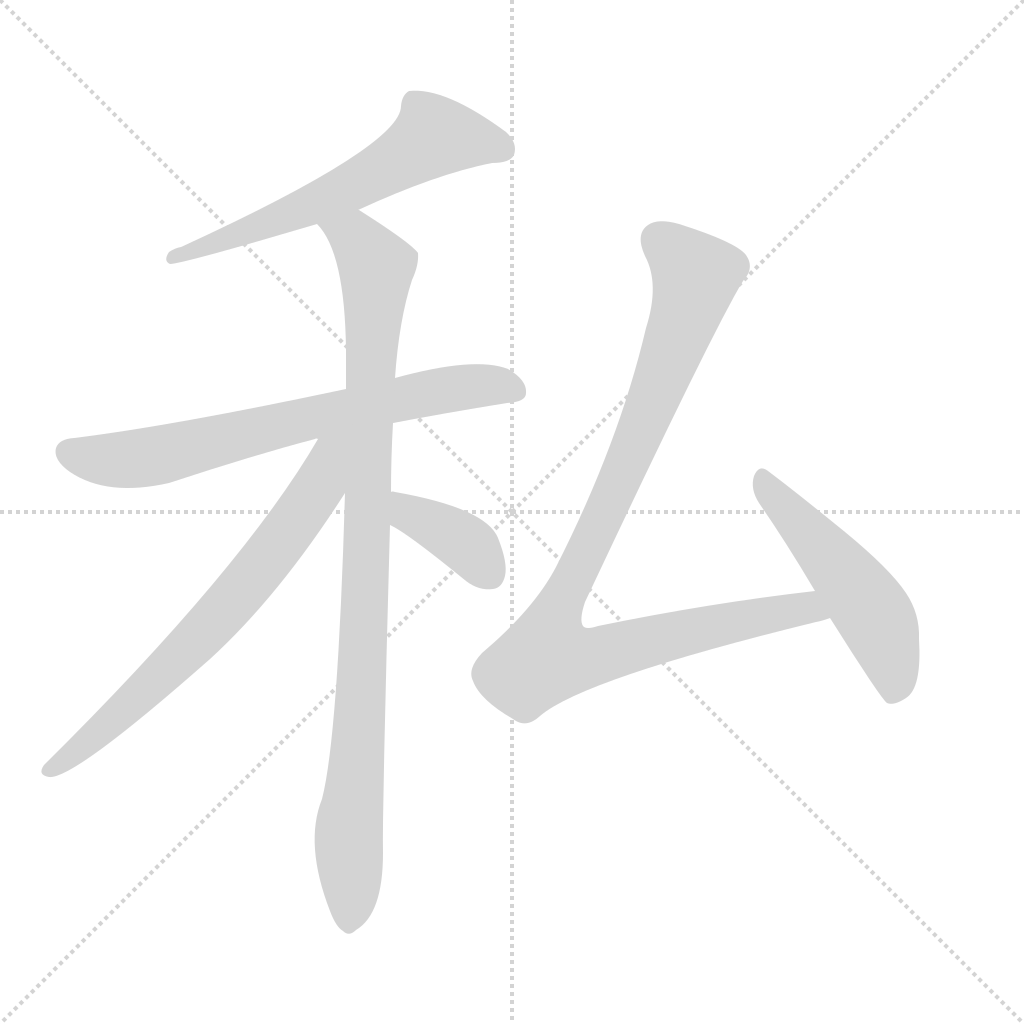
Pronounced si.
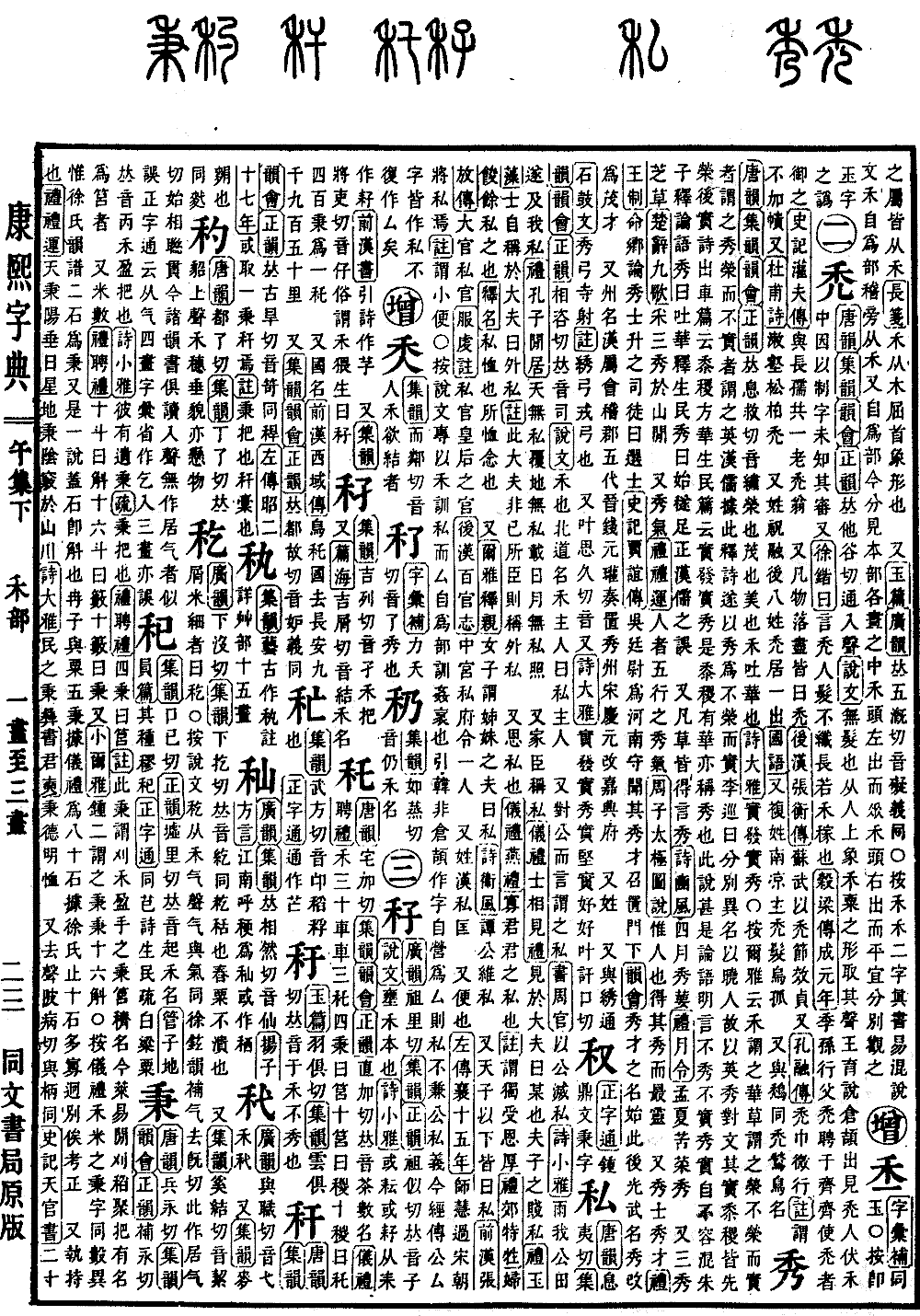
According to the Explaining Graphs and Analyzing Characters (Shuowen Jiezi), it refers to grain. In the northern regions, the owner of the grain is called the private owner. It is also used in contrast to the word public. In the Book of Documents (Shangshu), Zhou Offices (Zhouguan) states: Destroying the private for the public. In the Book of Odes (Shijing), Minor Odes (Xiaoya) states: Rain on our public fields, and then extend to our private ones. In the Book of Rites (Liji), Kongzi Jiangu (Confucius’ Leisurely Dwellings) states: Heaven has no private covering, Earth has no private carriage, the sun and moon have no private illumination.
Also refers to a house retainer. In the Book of Etiquette and Ceremonial (Yili), Meeting of Scholars (Shi Xiangjian Li) states: When appearing before a high official, one says, I, the humble servant of the master. In the Book of Rites (Liji), Jade Pattern (Yuzao) states: A scholar refers to himself before a high official as an external private one. Commentary states: If this high official is not one whom he serves, he calls himself an external private one.
Also refers to grace or favor. In the Book of Etiquette and Ceremonial (Yili), Banquet Rites (Yanli) states: My unworthy ruler is your personal favorite. Commentary states: This means receiving special favor alone. In the Book of Rites (Liji), Suburban Sacrificial Offering (Jiao Tesheng) states: The wife consumes the leftovers, as she is favored.
According to Explaining Names (Shiming), it means to cherish; that which is cherished in thought.
According to the Erya, Explaining Kinship (Shiqin), a woman refers to her sister's husband as si. In the Book of Odes (Shijing), Odes of Wei (Wei Feng) states: Duke Tan is my sister's husband.
From the Emperor downward, everyone uses this term as private. In the History of the Former Han (Qianhan Shu), Biography of Zhang Fang, it mentions officials of the great offices and private officials. Fu Qian’s commentary states: Private officials are the officials of the Empress. In the History of the Later Han (Houhan Shu), Treatise on Officials, it mentions one director of the private palace treasury.
Also a surname. Si Kuang of the Han dynasty.
Also means to urinate. In the Zuo Tradition (Zuo Zhuan), 15th year of Duke Xiang, states: Shi Hui passed through Song, and the court was about to privately attend to him. Commentary states: This refers to urination.
Note: The Explaining Graphs and Analyzing Characters (Shuowen Jiezi) defines si exclusively as grain, while the character for self-interest (si) is treated as a separate radical defined as illicit or crooked. Citing Han Fei, who said that Cangjie created characters such that self-serving is defined as self-interest (si), then the word for grain should not encompass the meaning of public and private. However, in the classic texts and commentaries, both public and private are now written with this character, and no longer with the separate character for self-interest.