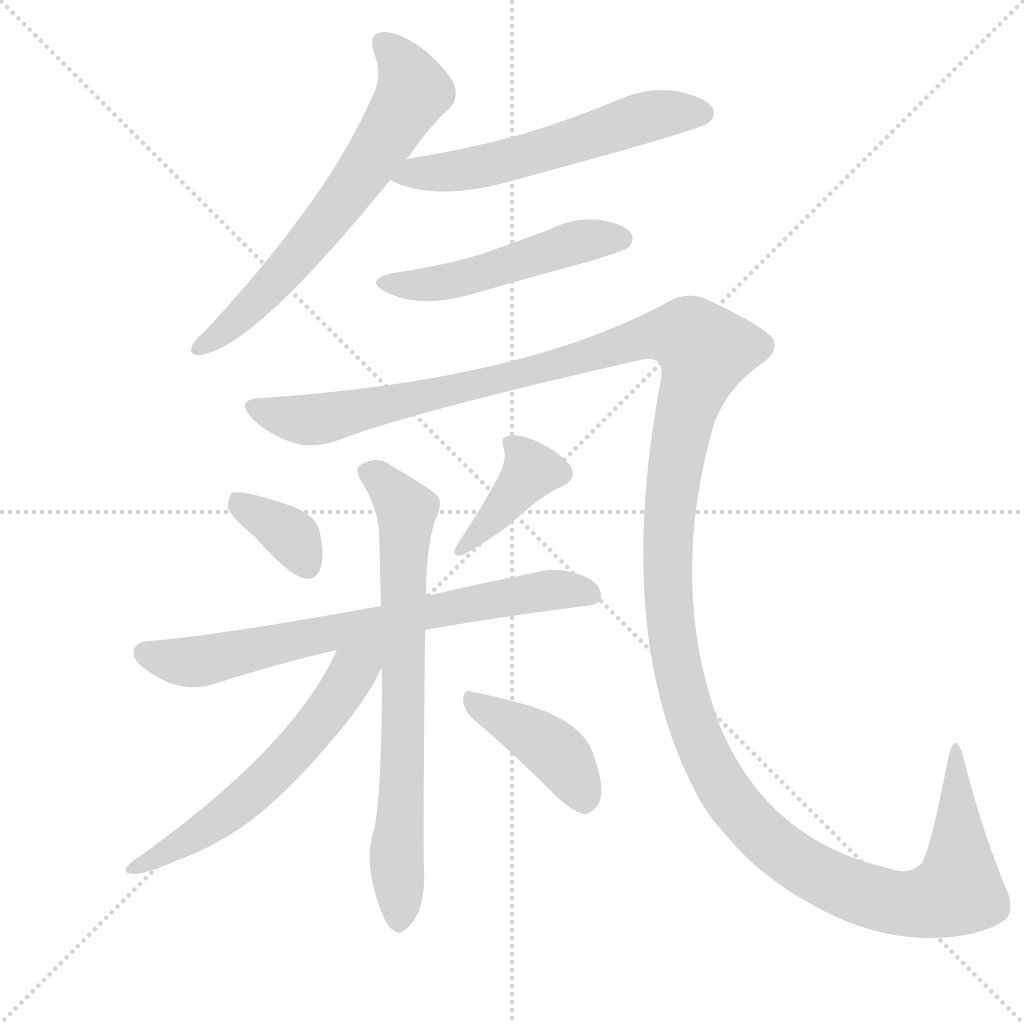
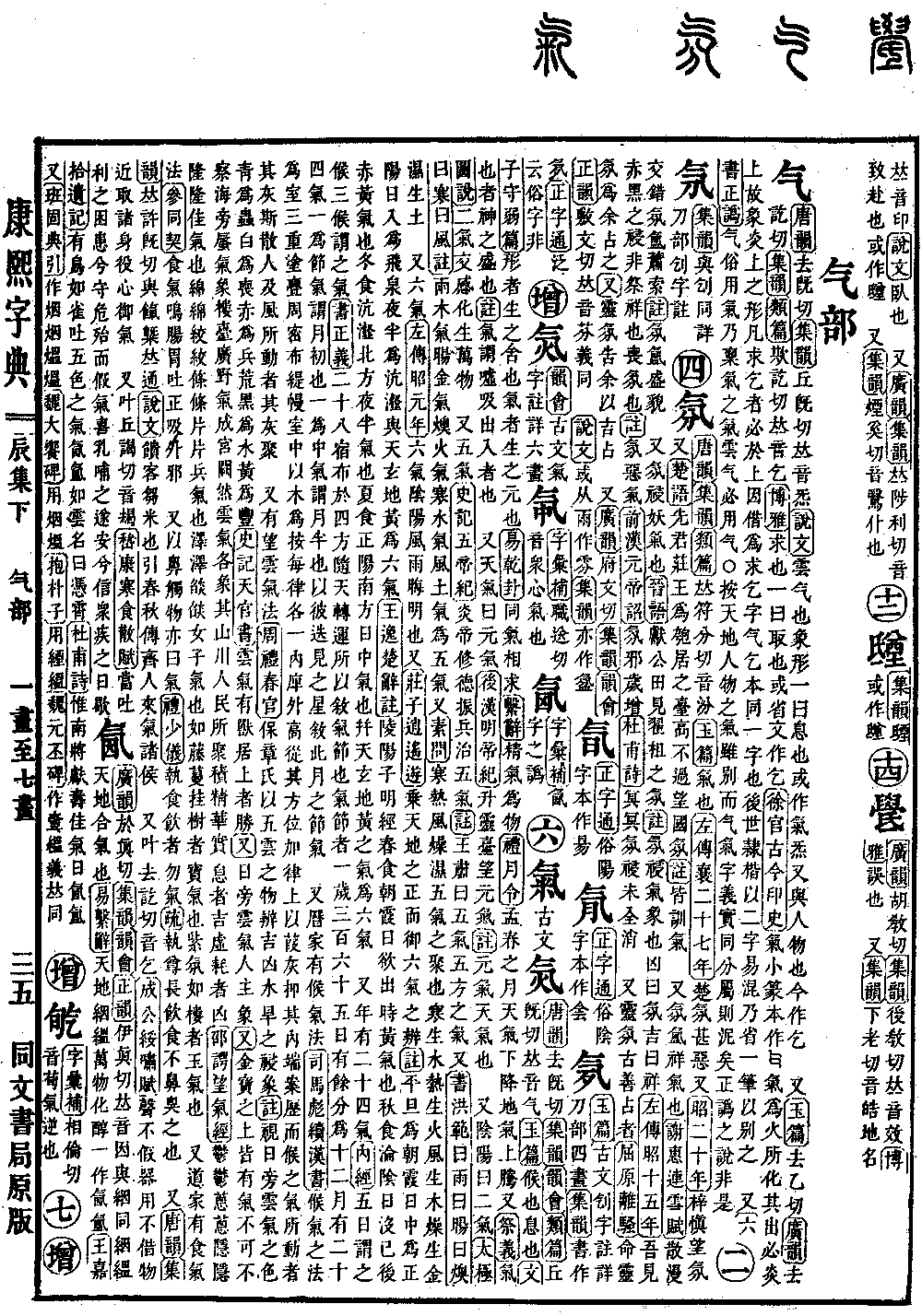
Chen Collection, Lower Volume
Radical: Air (qì)
Kangxi Strokes: 10
Page 599, Entry 12
Ancient form. Pronounced qi (falling tone).
Jade Dictionary (Yupian): Breath, also respiration.
Master Wen: Observing Weakness (Wenzi: Shouruo pian): The physical body is the dwelling place of life. Breath is the origin of life.
Book of Changes (Yijing): Hexagram Qian: Things with similar breaths are mutually attracted.
Appended Remarks (Xici): Refined breaths condense to become the myriad things.
Book of Rites (Liji): Monthly Commands (Yueling): In the first lunar month, the breath of heaven descends, and the breath of earth ascends.
Also, Book of Rites (Liji): Sacrificial Meaning (Jiyi): What is called breath is the manifestation of vigorous spirit. Commentary: Breath refers to what is taken in and breathed out through respiration.
Also, the breath of heaven is called primordial breath (yuanqi).
Book of the Later Han (Hou Hanshu): Chronicle of Emperor Ming: Ascending the spiritual platform to observe the primordial breath. Commentary: Primordial breath is the breath of heaven.
Also, yin and yang are called the two breaths.
Diagram of the Supreme Ultimate (Taijitu shuo): The two breaths of yin and yang mutually respond and intertwine to generate the myriad things.
Also, the five breaths.
Records of the Grand Historian (Shiji): Annals of the Five Emperors: The Yan Emperor cultivated virtue and organized troops to govern the five breaths. Commentary: Wang Su says: The five breaths are the breaths of the five directions.
Also, Book of Documents (Shu): Great Plan (Hongfan): Commentary on rain, sunshine, heat, cold, and wind: Rain is wood breath, sunshine is metal breath, heat is fire breath, cold is water breath, and wind is earth breath. This constitutes the five breaths.
Also, Basic Questions (Suwen): Cold, heat, wind, dryness, and moisture are the gathering of the five breaths. Cold generates water, heat generates fire, wind generates wood, dryness generates metal, and moisture generates earth.
Also, the six breaths.
Zuo Commentary (Zuo Zhuan): First Year of Duke Zhao: The six breaths are yin, yang, wind, rain, obscurity, and brightness.
Also, Zhuangzi: Free and Easy Wandering (Xiaoyao you): Adapting to the proper path of heaven and earth to master the changes of the six breaths. Commentary: Early morning is morning mist, midday is pure yang, sunset is flying springs, midnight is pure dew, plus the yellow breath of heaven and earth, totaling six breaths.
Wang Yi: Commentary on Songs of Chu (Chu Ci): The Classic of Lingyang Zi Ming says: Eating morning mist in spring is the yellow breath when the sun is about to emerge. Eating fading yin in autumn is the reddish-yellow breath after sunset. Eating pure dew in winter is the breath of the northern midnight. Eating pure yang in summer is the breath of the southern noon. Adding the yellow breath of heaven and earth constitutes the six breaths.
Also, a year has twenty-four breaths.
Inner Canon (Neijing): Five days are called one interval, and three intervals are called one breath.
Book of Documents (Shu): Correct Meaning (Zhengyi): The twenty-eight lunar mansions are distributed in the four directions, moving with the rotation of heaven, used to arrange the sequence of solar terms. The sequence of solar terms, just over three hundred and sixty-five days a year, is divided into twelve months, having twenty-four breaths. One is the solar term (jieqi), at the beginning of the month, and one is the central breath (zhongqi), in the middle of the month. Using those successively appearing constellations, one arranges the solar terms of the month.
Also, calendar experts have the method of observing breath.
Sima Biao: Continuation of the Book of the Han (Xu Hanshu): The method of observing breath involves building a triple-walled room, plastered tightly, hanging orange curtains inside, and using wooden stands, one for each pitch pipe, arranged with the inner parts low and outer parts high. Following their directional positions, the pitch pipes are placed on top, and the inner ends are blocked with reed membrane ash, observing according to the calendar. When the breath responds, the ash scatters; when disturbed by humans or wind, the ash clumps together.
Also, there is the method of observing cloud breath.
Rites of Zhou (Zhou li): Spring Officials (Chunguan): The Keeper of Signs uses the phenomena of the five cloud breaths to distinguish good and bad omens, and signs of flood or drought. Commentary: Observing the color of cloud breath beside the sun: green indicates insect plague, white indicates funeral events, red indicates war and famine, black indicates flood, and yellow indicates a bountiful harvest.
Records of the Grand Historian (Shiji): Treatise on Celestial Offices (Tianguan shu): Cloud breath resembling beasts crouched above indicates that that side will be victorious.
Also: Cloud breath beside the sun symbolizes the sovereign.
Also: Above gold and silver treasures there is always breath, which must be carefully observed. The breath of mirages at the seaside resembles pavilions, and the breath of vast plains forms palaces. However, cloud breath symbolizes the mountains, rivers, and the state of gathered people corresponding to it; those that are essence-filled and vigorous are auspicious, and those that are empty and depleted are ominous.
Shao E: Mirror of Breath Observation (Wangqi jing): Lush and dense, dim and rising, is auspicious breath. Wispy and tangled, in strips and fragments, is the breath of war. Lustrous and flaming is the breath of women. Resembling vines hanging on trees is the breath of treasure. Purple atmosphere resembling pavilions is the breath of jade.
Also, Taoists have the method of eating breath.
Token for the Union of the Three (Cantong qi): Eating breath makes the stomach rumble, expelling pure breath and inhaling external evil.
Also, using the nose to smell things is also called breath (qi).
Book of Rites (Liji): Lesser Rules of Deportment (Shaoyi): Those who carry food and drink should not use their noses to smell it. Commentary: Do not sniff the food or drink of elders.
Also, Tang Rhyme (Tang yun) and Collection of Rhymes (Jiyun): Pronounced xi (falling tone). Interchangeable with the character for provision.
Analects of History (Chunqiu zhuan): It says the people of Qi came to send provisions to the feudal lords.
Also, read as qi (falling tone).
Cheng Gongshui: Rhapsody on Whistling (Xiao fu): Sound does not rely on instruments, and usage does not rely on external objects. One obtains it from oneself nearby, and uses the mind to control the breath.
Also, read as jie (falling tone).
Ji Kang: Rhapsody on Cold Food Powder (Hanshisan fu): Just at the time of the suffering of vomiting and diarrhea, guarding against danger while relying on breath. Rejoicing in the gradual settling like nursing, believing that various diseases are gradually ceasing.