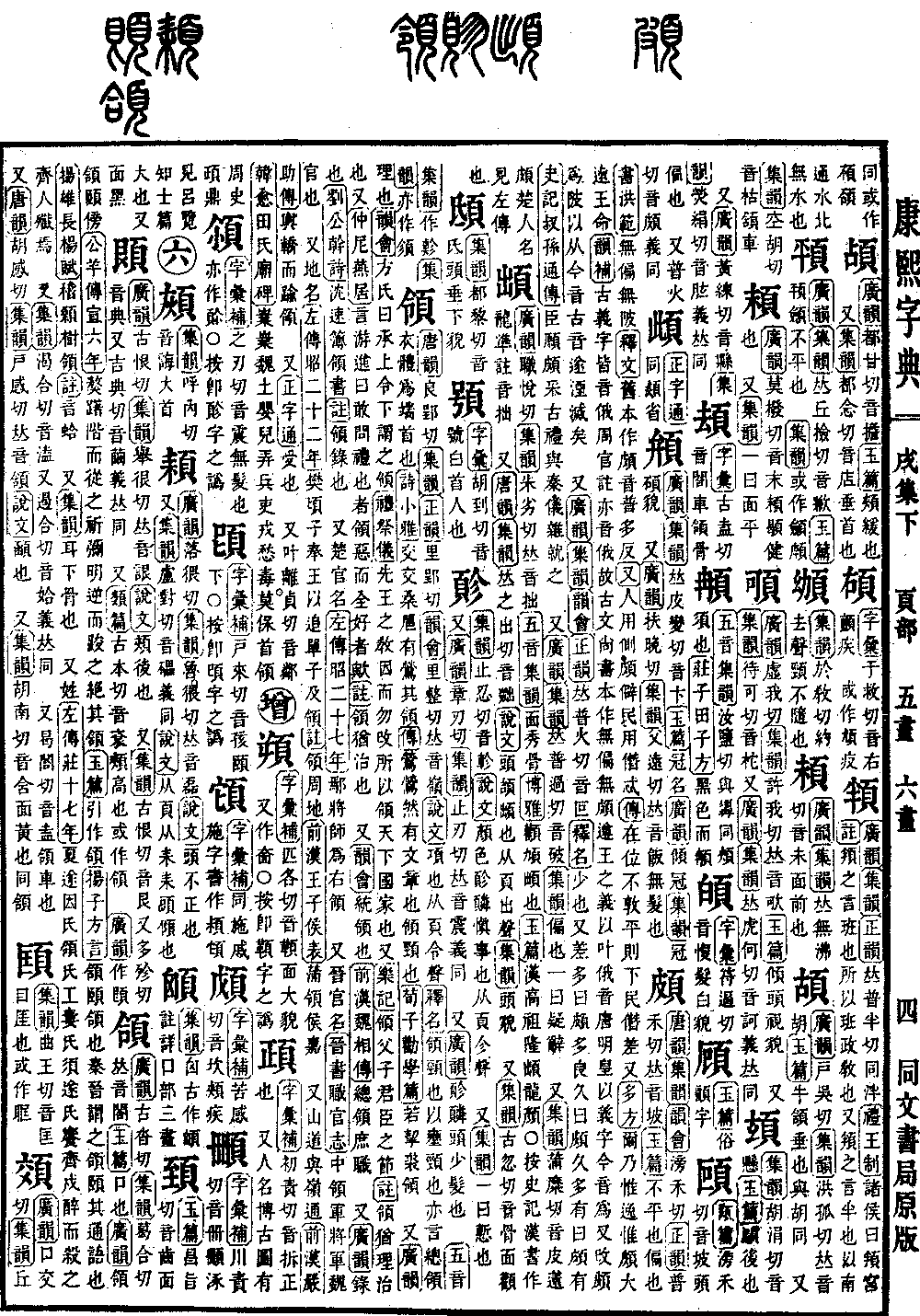
Xu Collection, Lower Volume
Radical: Page (yè)
頜; Kangxi Stroke Count: 15; Page 1402
Pronounced gǔ hé qiè in Guangyun, and gé hé qiè in Jiyun, same pronunciation as "gé".
In Yùpiān, it refers to the mouth.
In Guangyun, it refers to the jaw and chin, specifically the sides of the lower jaw.
"The mastiff jumped onto the steps and chased him. Qi Míngmíng went to meet it and kicked it with his foot, breaking its lower jaw." — Gōngyáng Zhuàn, Year 6 of Duke Xuán. In Yùpiān, it is written as "頜" when cited.
In Fāngyán, it refers to the chin and jaw, both indicating the jaw area. In the Qin and Jin regions, it is called "頜," while "yí" is the common term.
"When kowtowing, the chin is raised." — Yángxiong, Chángyáng Fù.
Note: Pronounced the same as "gé".
Also, in Jiyun, it refers to the bone below the ear.
Also used as a surname.
"In the summer, the Yīn clan, Hé clan, Gōnglóu clan, and Xūsùi clan of the state of Suí feasted the Qi garrison soldiers, got them drunk, and killed them. The Qi people were all annihilated." — Zuǒzhuàn, Year 17 of Duke Zhuāng.
Also, in Jiyun, pronounced kě hé qiè, same pronunciation as "kè". Also pronounced è hé qiè, same pronunciation as "è". The meaning is the same.
Also, pronounced hé hé qiè, same pronunciation as "hé". Refers to the lower jawbone.
Also, in Tángyùn, pronounced hú gǎn qiè, and in Jiyun, pronounced hù gǎn qiè, same pronunciation as "hàn".
In Shuōwén Jiězì, it refers to the chin.
Also, in Jiyun, pronounced hú nán qiè, same pronunciation as "hán". Refers to a sallow complexion. Same as the character "hàn".