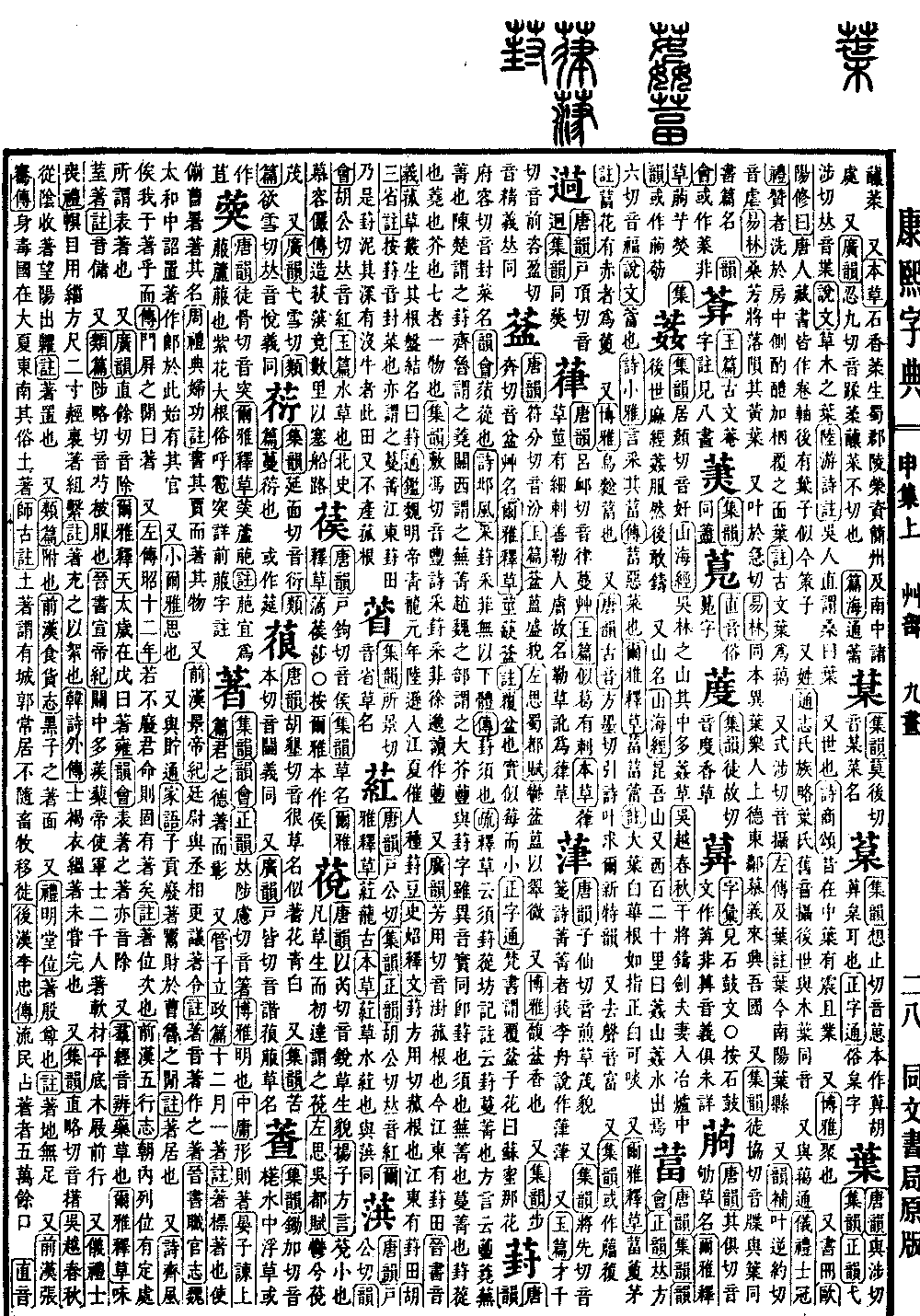
Shen Collection, Upper Volume
Radical: Grass (cǎo)
Kangxi Strokes: 15
Page 1044, Entry 01
Pronounced zhu.
From Collected Rhymes (Jiyun), Rhyme Club (Yunhui), and Correct Rhymes (Zhengyun): combined sounds, pronounced zhu.
From Broad Elegance (Boya): bright, manifest.
From Doctrine of the Mean (Zhongyong): when formed, it manifests.
From Master Yan's Spring and Autumn Annals (Yanzi Chunqiu), Advice Part 1: The ruler's virtue is manifest and brilliant.
Also, from Guanzi, Establishing Government: the twelfth month is once fixed. Annotation: Fixed means marked or displayed, causing the assistants to record and post their names.
From Rites of Zhou (Zhouli), Canon of Women's Work: record the price and mark the goods.
Also, from History of the Former Han (Hanshu), Annals of Emperor Jing: the Commandant of Justice and the Chancellor changed the deliberations and enacted the statutes. Annotation: Zhù is pronounced as the zhu in writing/authorship.
From History of the Jin (Jinshu), Treatise on Official Positions: in the Taihe era of the Wei, an edict established the Official Historian (zhùzuò láng); this was the beginning of that office.
Also, from Little Erya: to think.
Also, used interchangeably with store (zhù). From Family Sayings of Confucius (Kongzi Jiayu): Zigong abandoned trade and sold goods between Cao and Lu. Annotation: Zhù means to dwell.
Also, from Book of Odes (Shijing), Odes of Qi: waiting for me at the gate screen. Commentary: The space between the door and the screen is called zhù.
Also, from Zuo Tradition (Zuozhuan), Twelfth Year of Duke Zhao: if the ruler's command is not abolished, then there is a fixed position. Annotation: Zhù means rank or order.
From History of the Former Han (Hanshu), Treatise on the Five Elements: within the court, ranks have fixed places, which is what is called manifest positions.
Also, from Broad Rhymes (Guangyun): pronounced chu.
From Erya, Explaining the Heavens: the year of Jupiter in the wù position is called zhùyōng.
From Rhyme Club (Yunhui): the zhù in manifest position is also pronounced chu.
Also, from Discrimination of Sounds in the Classics (Qunjing Yinbian): a medicinal herb.
From Erya, Explaining the Grasses: flavor, chi-zhu. Annotation: Pronounced chǔ.
Also, from Classified Chapters (Leipian): pronounced sháo. To wear clothing.
From History of the Jin (Jinshu), Annals of Sima Yi: there were many thorns in Guanzhong, so the Emperor ordered two thousand soldiers to wear soft-soled wooden clogs to walk in front.
Also, from Book of Etiquette and Ceremonial (Yili), Rites of Mourning: for the face cloth, use black silk, one foot two inches square, lined and stuffed with silk wadding. Annotation: Zhù means to stuff with wadding.
From Han School External Traditions (Hanshi Waizhuan): the scholar wears hempen clothes and quilted garments, never complete.
Also, from Collected Rhymes (Jiyun): pronounced zhuo.
From Annals of Wu and Yue (Wuyue Chunqiu): accumulate stores during the darkness, and sell when the sun appears. Annotation: Zhù means to place.
Also, from Classified Chapters (Leipian): to attach.
From History of the Former Han (Hanshu), Biography of Jia Yi: a black spot appearing on the face.
Also, from Book of Rites (Liji), Bright Hall Positions: zhù, the sacrificial vessel of the Yin dynasty. Annotation: Zhù means reaching the ground without feet.
Also, from History of the Former Han (Hanshu), Biography of Zhang Qian: the Shendu kingdom is southeast of Daxia, and their custom is to be settled. Annotation by Yan Shigu: settled (tǔzhù) means having city walls and permanent residence, not moving with livestock.
From History of the Later Han (Houhanshu), Biography of Li Zhong: fifty thousand refugees registered as settled residents.
From Direct Pronunciation (Zhiyin): vulgarly written as zháo.
Textual correction: History of the Former Han, Treatise on Food and Money mentions a black spot on the face. Note: There is no such phrase in the Treatise on Food and Money; it has been corrected to the Biography of Jia Yi.