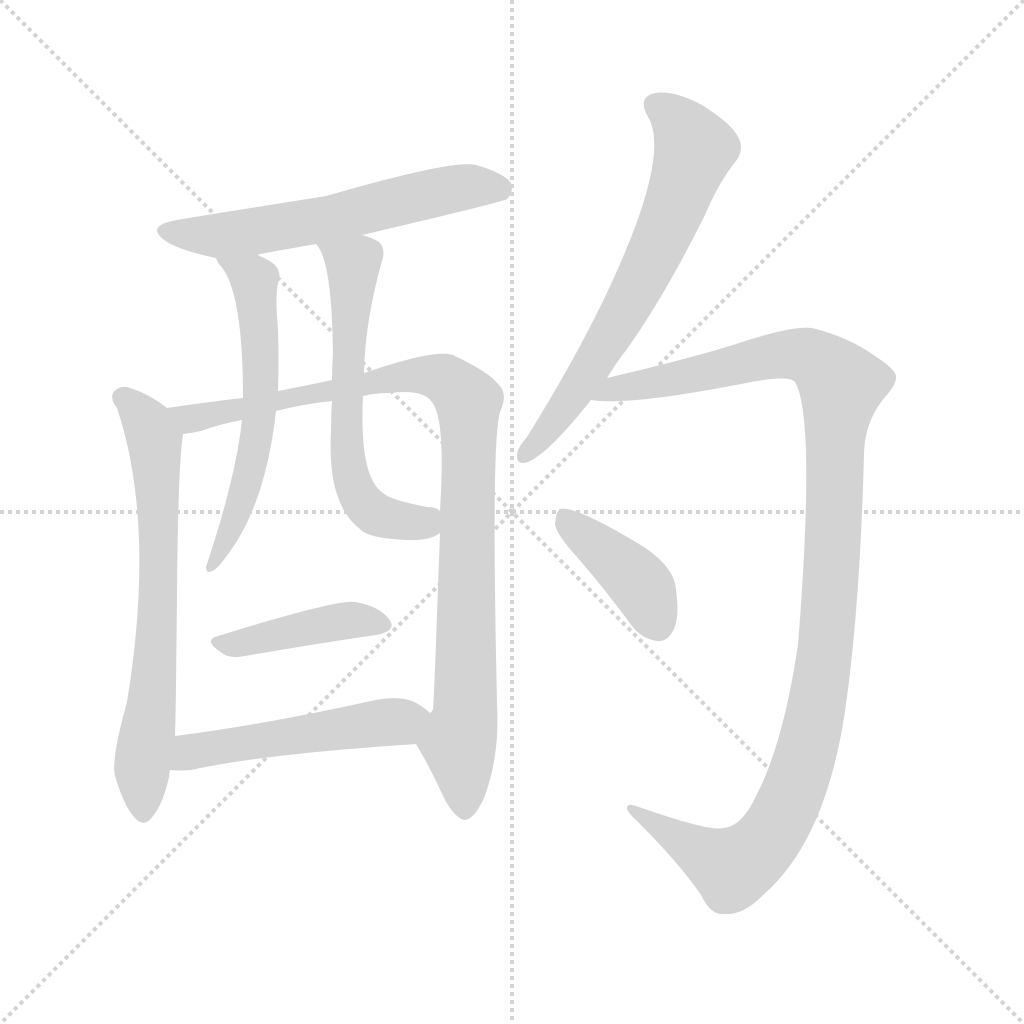
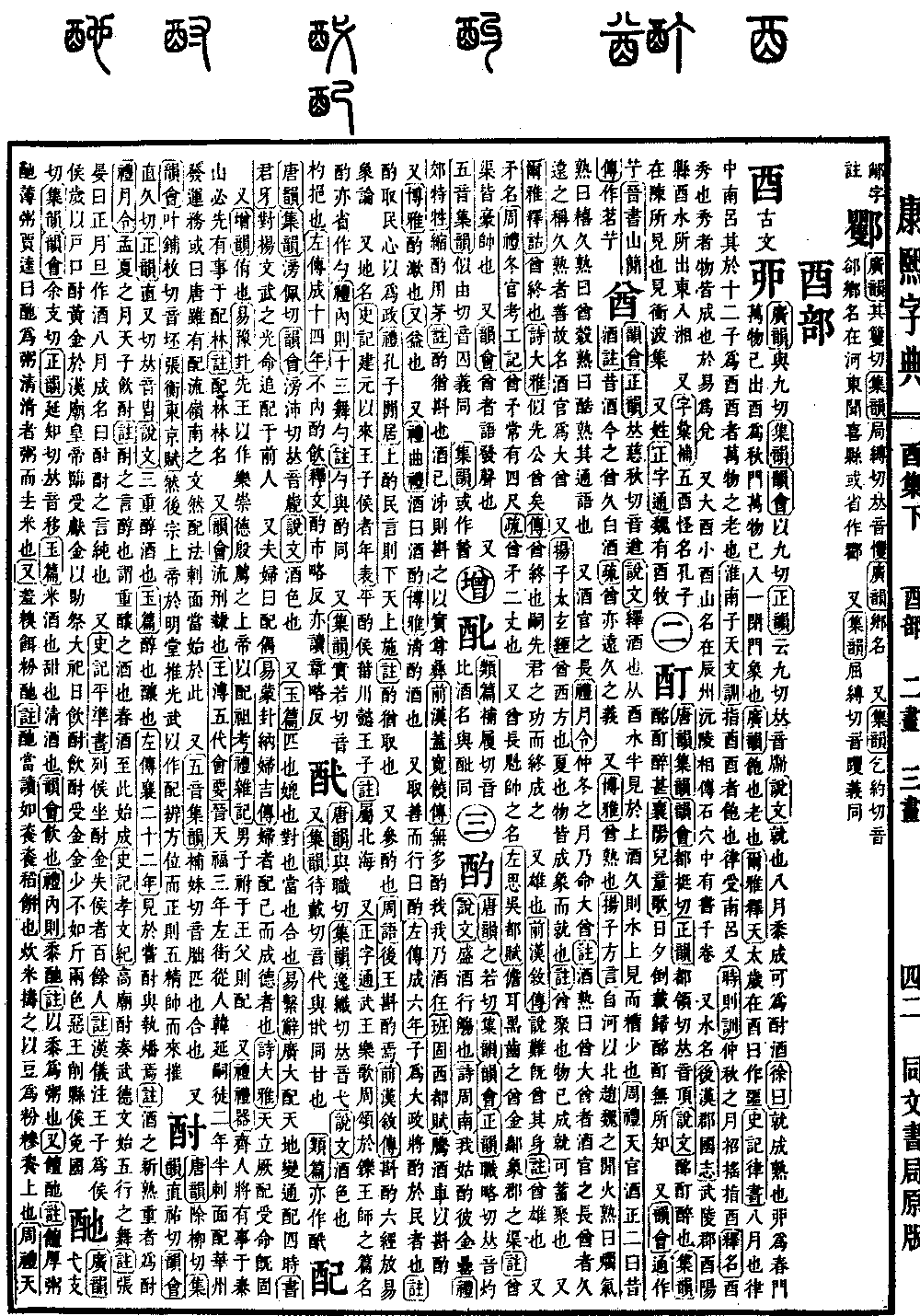
You Collection, Lower Volume
Radical: Wine (yǒu)
Kangxi Strokes: 10
Page 1280, Entry 07
Tang Dynasty Rhyme (Tangyun) states: pronounced zhuó.
Collected Rhymes (Jiyun), Rhyme Compendium (Yunhui), and Correct Rhymes (Zhengyun) state: pronounced zhuó.
Explanation of Characters (Shuowen): To pour wine and pass the cup.
Book of Odes (Shijing): I will pour from that golden vessel.
Book of Rites (Liji): Using bundled reeds for straining while pouring. Commentary states: To pour is to decant. Once the wine is strained, it is decanted to fill the ritual bronze vessels.
History of the Former Han Dynasty (Qianhan): Do not pour too much for me, for I become wild when I drink.
Ban Gu's Western Capital Rhapsody (Xidu Fu): Galloping the wine cart to pour and serve.
Broad Elegance (Boya): To pour also means to rinse.
Broad Elegance (Boya): It also means to add.
Book of Rites (Liji): Refined wine is called clear pouring.
Broad Elegance (Boya): Clear pouring refers to wine.
To select what is good and implement it is called pouring.
Zuo Tradition (Zuo Zhuan): You are in charge of major government affairs; you should draw from the people. Commentary states: To draw from means to solicit the hearts of the people to administer government.
Book of Rites (Liji): When the superior draws from the words of the people, the lower subjects will receive blessings from heaven. Commentary states: To draw from means to take.
It also means to weigh and consider.
Discourses of the States (Zhouyu): Then the king weighs and considers it.
History of the Former Han Dynasty (Qianhan): Deliberating upon the Six Classics, following the imagery of the Book of Changes.
It is also a place name.
Records of the Grand Historian (Shiji): The Marquis of Pingzhuo, son of the Prince of Zichuan Yi. Commentary states: The records assign it to Beihai.
Orthography Manual (Zhengzitong): The title of a musical piece in the Zhou Songs section of the Book of Odes (Shijing), praising the king's army.
The character is also written in the simplified form (sháo).
Book of Rites (Liji): At thirteen, one performs the Shao dance. Commentary states: Shao is the same as pouring.
Collected Rhymes (Jiyun) states: pronounced sháo. To ladle out.
Zuo Tradition (Zuo Zhuan): Do not privately pour and drink.
Explication of Texts (Shiwen): Pronounced zhuó, also pronounced zhuó.
Textual Revisions:
Book of Rites (Liji), Songs of the Rites: Listed as wine pouring; corrected to clear pouring according to original text.
Book of Rites (Liji), Confucius at Leisure: The citation actually appears in the Record of Customs (Fangji); now corrected to Record of Customs.
Discourses of the States (Zhouyu): Included the missing character before the word for king.
Records of the Grand Historian (Shiji): Included the missing character for records before the mention of Beihai.