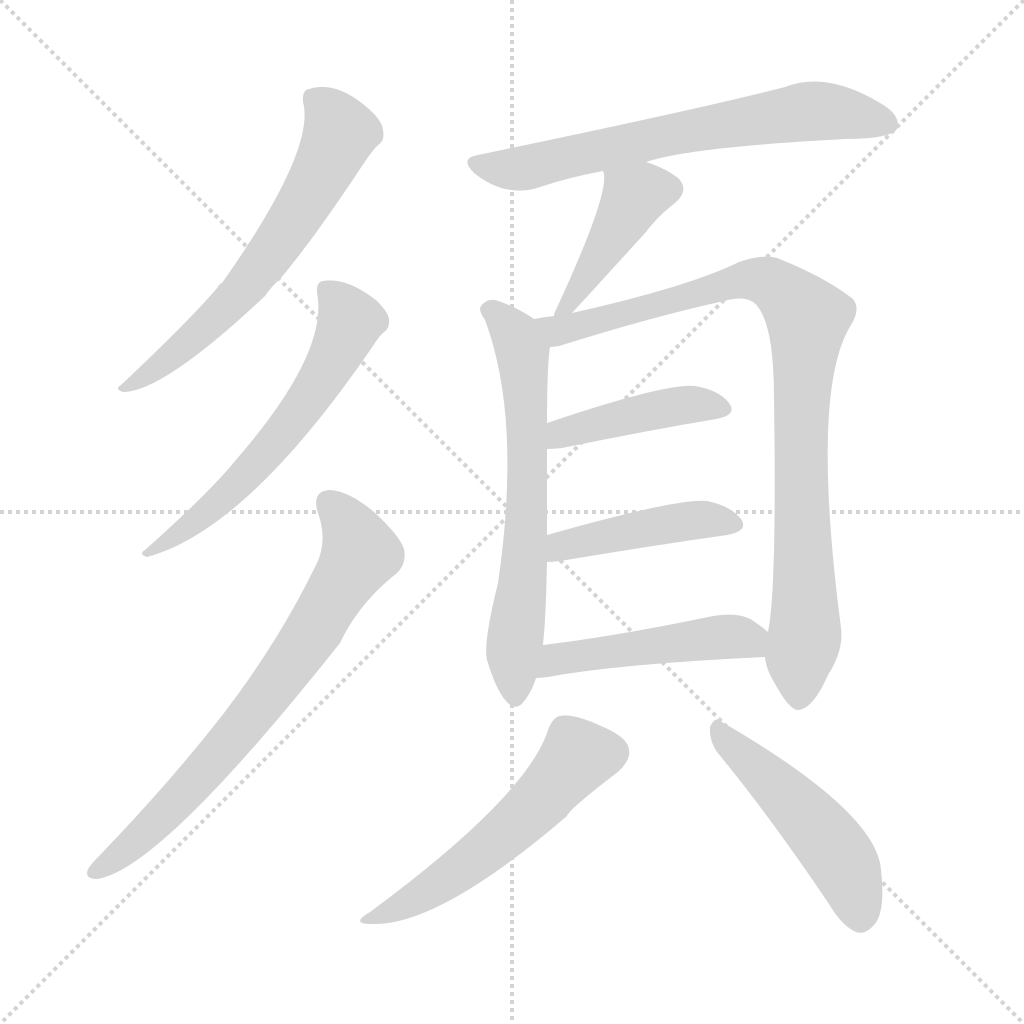
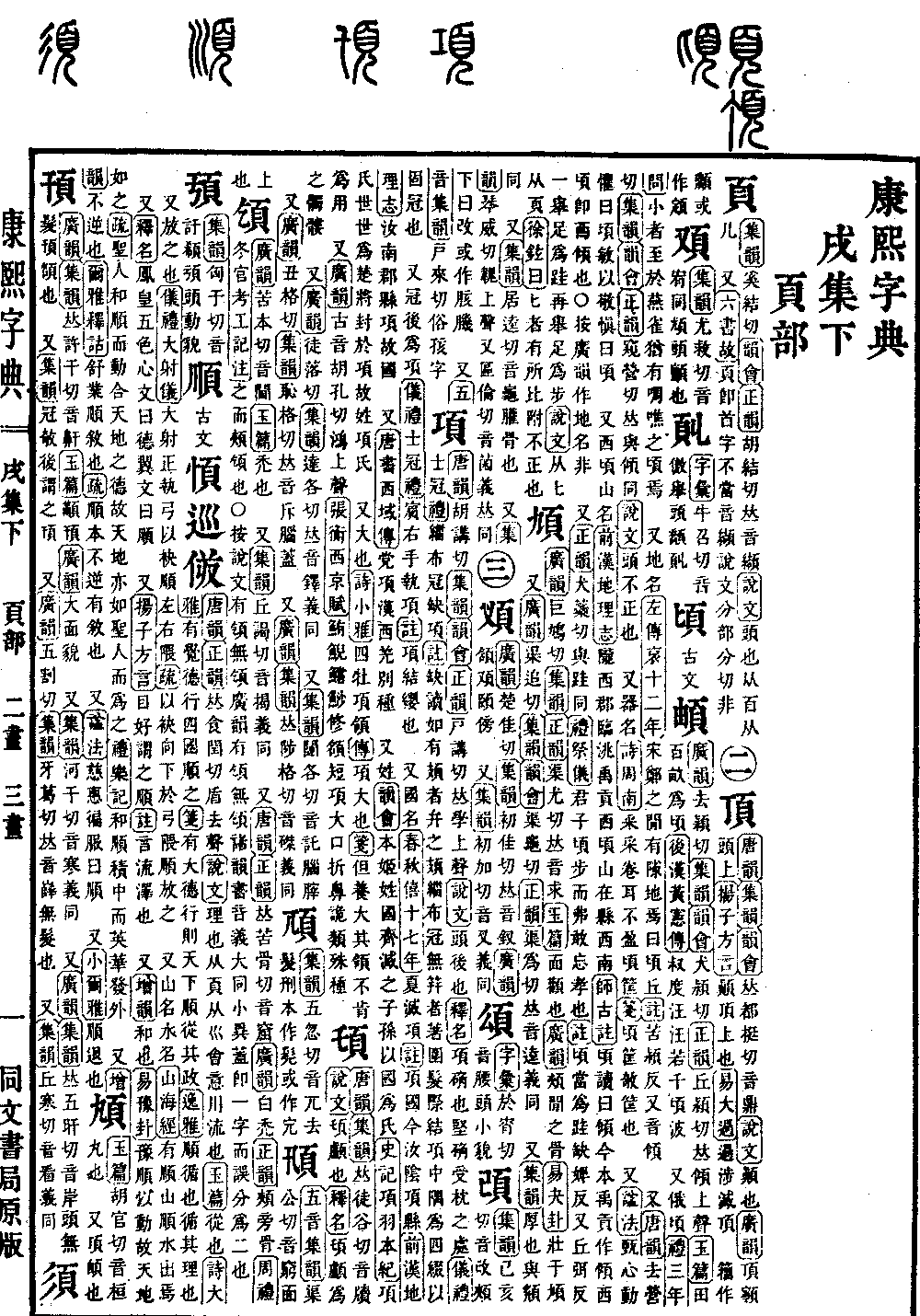
Xu Collection, Lower Volume
Radical: Head (yè)
Kangxi Strokes: 12
Page 1399, Entry 23
Pronounced xu.
Shuowen Jiezi (Explanation of Writing and Analysis of Characters): Hair on the face.
Book of Changes (Yijing), Hexagram Bi: Adorning one’s beard (or facial hair).
Commentary: That which is called a beard is what attaches to the upper part.
Sub-commentary: The beard attaches to the upper part of the face.
Shiming (Explanation of Names): Under the chin is called xu. Xu means shu (elegant or flourishing).
A variant form is written as (xu). The vulgar form is written as (xu).
Also means to wait.
Book of Changes (Yijing), Hexagram Guimei: The maiden waiting for marriage.
Book of Odes (Shijing), Beifeng: Others cross, but I do not; I am waiting for my friend.
Also interchangeable with the character (xu).
Zuo Zhuan (Chronicle of Zuo), 12th year of Duke Cheng: The sun is already setting; my ruler is waiting.
Erya (Approaching Nearness), Interpretation of Words: Xu means to wait.
Also means property or to use. Interchangeable with (xu).
Erya (Approaching Nearness), Interpretation of Beasts: For beasts it is called xin, for men it is called qiao, for fish it is called xu, and for birds it is called ju.
Sub-commentary: These all refer to states where qi is exhausted and the body is weary, which is what is required, hence the title regarding xu.
Also si-xu, equivalent to xu-yu (a short moment).
Book of Rites (Liji), Record of Music: Propriety and music cannot be absent for even a single moment.
Also means slow or sluggish.
Zuo Zhuan (Chronicle of Zuo), 2nd year of Duke Cheng: If you do not wait a little, the masses will be exhausted.
Book of the Later Han (Hou Hanshu), Biography of Prince Xiao of Qinghe: Also, wait for a little while.
Commentary: In the Dongguan Ji, "wait a while" is written as "stay a while."
Also Xu Nu, a star name.
Records of the Grand Historian (Shiji), Treatise on the Celestial Offices, Commentary on Wu Nu: The orthodox meaning states: Xu Nu consists of four stars. Also known as Wu Nu, the celestial minor treasury. Xu Nu is a term for a lowly female servant, one who performs the duties of a woman.
Also a state name.
Spring and Autumn Annals (Chunqiu), 22nd year of Duke Xi: The Duke attacked Zhu and took Xuju.
Gongyang Zhuan (Gongyang Commentary) writes it as Xuqu.
Book of the Former Han (Hanshu), Treatise on Geography: Xuchang County in Dong Commandery, formerly the state of Xuju.
Also, Zuo Zhuan (Chronicle of Zuo), 4th year of Duke Ding: Distributed the drums of Mixu to Tang Shu.
Records of the Grand Historian (Shiji), Annals of Zhou: King Wen attacked Mixu.
Commentary: The Mixu clan, a state of the Ji surname. It is the current Yinmi County in Anding.
Also a city name.
Book of Odes (Shijing), Beifeng: Thinking of Xu and Cao.
Commentary: Xu and Cao are cities in the state of Wei.
Also Book of the Later Han (Hou Hanshu), Treatise on Commanderies and States: In Nanyang Commandery, there is the Shunyang Xu settlement.
Also a vegetable name.
Erya (Approaching Nearness), Interpretation of Grasses: Xu, fen-wu.
Sub-commentary: In the Book of Odes, "gathering the turnip, gathering the wild turnip." The commentary states that the fen is the xu. Earlier scholars identified it with fen-cong. Sun Yan said: Xu is another name for fen-cong.
Also a grass name.
Erya (Approaching Nearness), Interpretation of Grasses: Tai is fu-xu.
Sub-commentary: Tai is another name for fu-xu. It is sedge grass.
Also a bird name.
Erya (Approaching Nearness), Interpretation of Birds: Ti is xu-lui.
Sub-commentary: Ti is another name for xu-lui.
Also a weapon.
Ming: Xu-dun, originally from Shu. Xu refers to that which is held.
Also Yang Xiong's Fangyan (Regional Dialects): Xu means tattered or ruined. In Southern Chu, when a person's clothing is poor and ugly, it is called xu-jie.
Also a surname.
Zuo Zhuan (Chronicle of Zuo), 17th year of Duke Zhuang: There is the Xusui clan.
Strategies of the Warring States (Zhanguo Ce): The Wei grandee Xu Jia.
Also a personal name.
Zuo Zhuan (Chronicle of Zuo), 24th year of Duke Xi: Tou Xu, the attendant of the Duke of Jin, who guarded the treasury.
Also Zuo Si, Rhapsody on the Capital of Wu (Wu Du Fu): Flag fish-xu.
Commentary: Using fish whiskers as the staff of a flag.
Also Pronounced ban. It means sorted or arranged.
Book of Rites (Liji), Yuzhao: For the tablet, the grandee uses bamboo patterned with fish whiskers.
Explanation of Characters: Cui says: It uses patterned bamboo and fish scales. The Hidden Meaning says: It decorates the edge of patterned bamboo with fish whiskers. Xu is pronounced ban.
Also rhymes with qiu, pronounced xiu.
Xi Fu Gong's Lament: Alas, if this is so, what else is there to stay for? Caressing the divine dragon, I grasp its whiskers.
Lu Yun, Nine Laments: Life passes with its years exhausted; dwelling in silent words, what more is required? I will lightly ascend to travel afar, looking off into the distant celestial path and roaming high.
Commentary: Xu means to seek.
Xu's commentary on the Shuowen: This originally refers to the beard and whiskers. Ye means head; shan means hair decoration. It was borrowed to mean "to require." The vulgar script adds the water radical, which is incorrect. Master Mao says: Xu and (xu) are different. (Xu), pronounced fire and wai, means rotten.