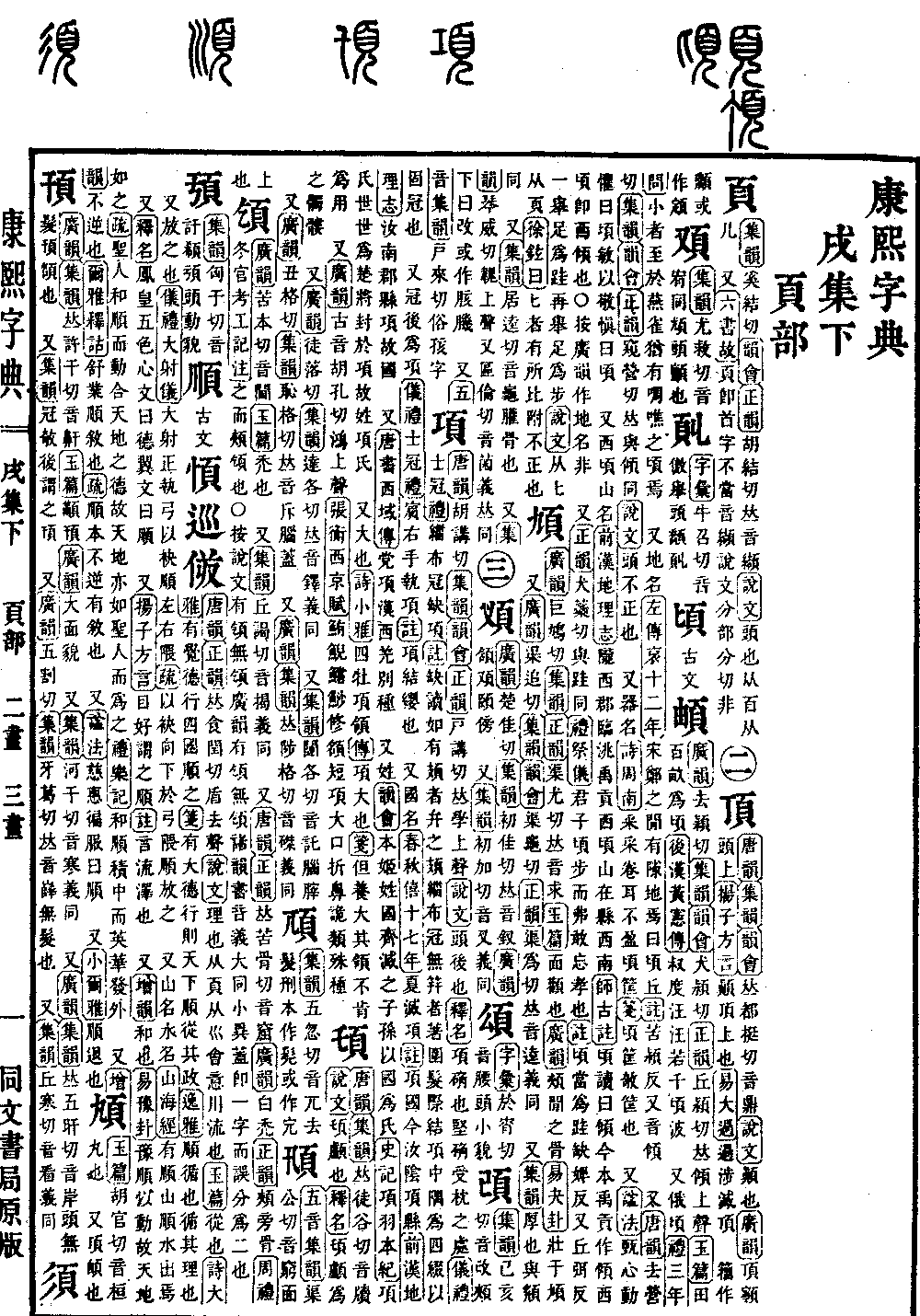
Xu Collection, Lower Volume
Radical: Leaf (yè)
Kangxi Strokes: 11
Page 1399, Entry 05
Ancient form: di. Pronounced qing (falling tone). Pronounced qing (falling tone). Pronounced qing (falling tone). Pronounced qing (rising tone).
Yu Pian: A field of one hundred mu is called a qing.
History of the Later Han Dynasty (Hou Hanshu), Biography of Huang Xian: Shu Du was as vast as waves stretching for a thousand qing.
Also, a brief moment.
Book of Rites (Liji), Three Years Mourning: Even small creatures like swallows and sparrows experience a moment of chirping.
Also, a place name.
Zuo Commentary (Zuozhuan), Twelfth Year of Duke Ai: Between the states of Song and Zheng there is a place called Qingqiu.
Pronunciation: Pronounced ku (rising tone) and ying, also pronounced qing.
Also, according to Tang Yun: Pronounced qing (level tone). According to Jiyun, Yunhui, and Zhengyun: Pronounced kui (level tone) and ying. Same as qing (to lean).
Shuowen Jiezi: The head is not straight.
Also, a type of container.
Book of Odes (Shijing), Zhou Nan: Gathering the cocklebur, not filling the shallow basket. Han Poetry (Han Shi) says: It is a basket.
Also, posthumous title laws: One who is cautious and fearful is called qing. One who is alert and respectful is called qing.
Also, Xiqing, a mountain name.
History of the Former Han Dynasty (Qian Hanshu), Treatise on Geography: Longxi Commandery, Lintao; the Yu Gong mentions Mount Xiqing located west of the county.
Shigu Commentary: Qing is read as qing (to lean). In current editions of the Yu Gong, it is written as qing. Xiqing is the same as Xiqing (to lean). Note: Guangyun treats this as a place name, which is incorrect.
Also, according to Zhengyun: Pronounced quan (rising tone) and rui (rising tone). Same as kui (half-step).
Book of Rites (Liji), Meaning of Sacrifices (Jiyi): The superior man, in a half-step, does not dare to forget filial piety.
Commentary: Qing should be kui. One lift of the foot is a kui. Two lifts of the foot make a bu (step).
Shuowen Jiezi: Composed of the radicals for spoon and leaf.
Xu Xuan says: The spoon radical implies something compared or attached, not straight.
Textual Revisions:
Zuo Commentary, Twelfth Year of Duke Ai: Between the states of Song and Zheng there is a place called Qingqiu.
Commentary: Pronounced ku (rising tone) and ying. Note: This pronunciation information is not part of the commentary; the word commentary has been changed to pronunciation.
Book of Odes, Zhou Nan: Gathering the cocklebur, not filling the shallow basket.
Annotation: Shallow basket is a basket. Note: The original annotation does not contain this phrase. It has been corrected based on the citation of Han Poetry in the Shiewen.
History of the Former Han Dynasty, Treatise on Geography: Longxi Commandery, Lintao; the Yu Gong mentions Mount Xiqing located west of the county. Note: The original text contained an error regarding the location, which has been omitted.
Book of Rites, Meaning of Sacrifices: The superior man, in a half-step, does not dare to forget filial piety. Note: Corrected from the original text's title, Meaning of Rituals, to Meaning of Sacrifices.