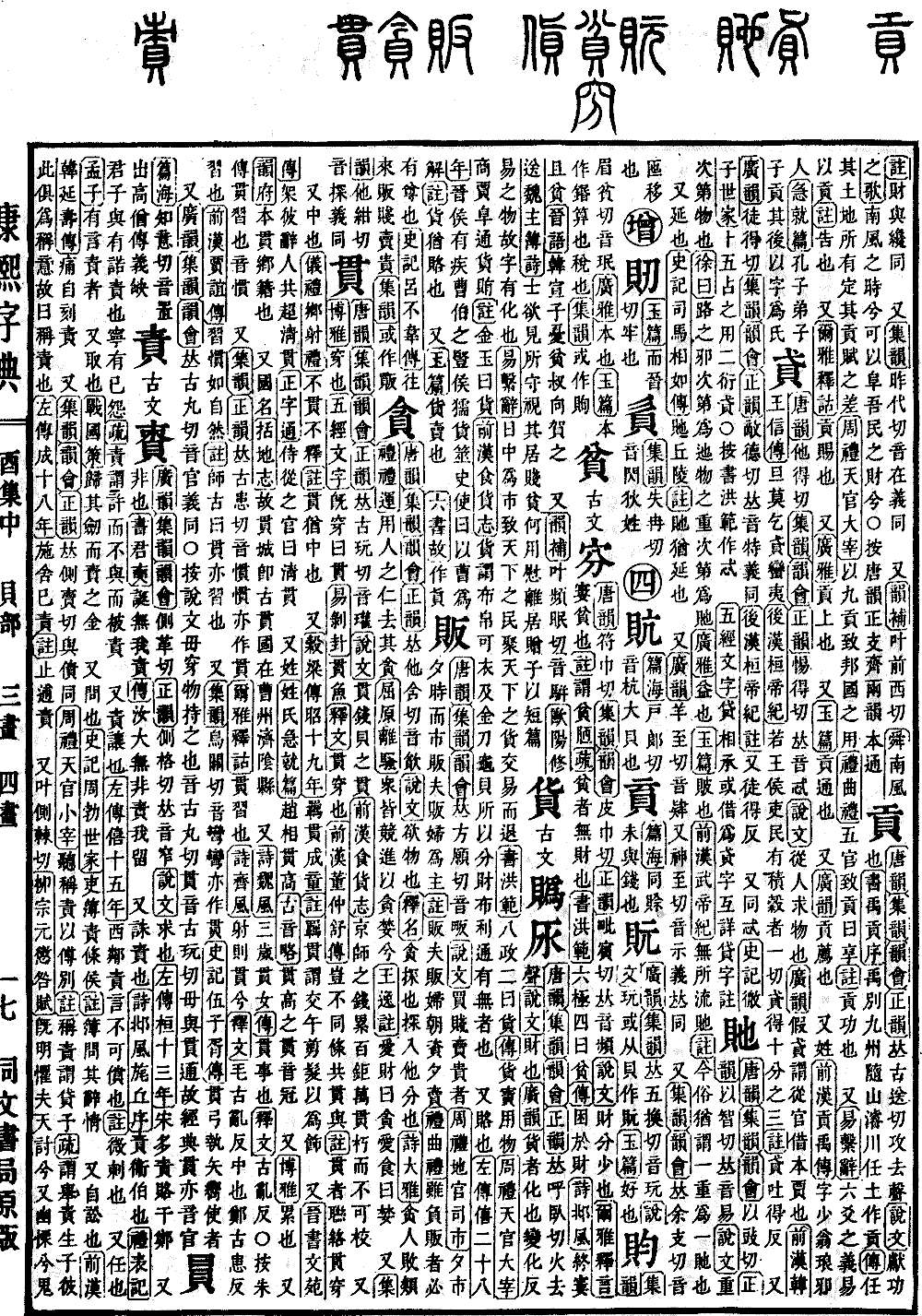
You Collection, Middle Volume
Radical: Shell (bèi)
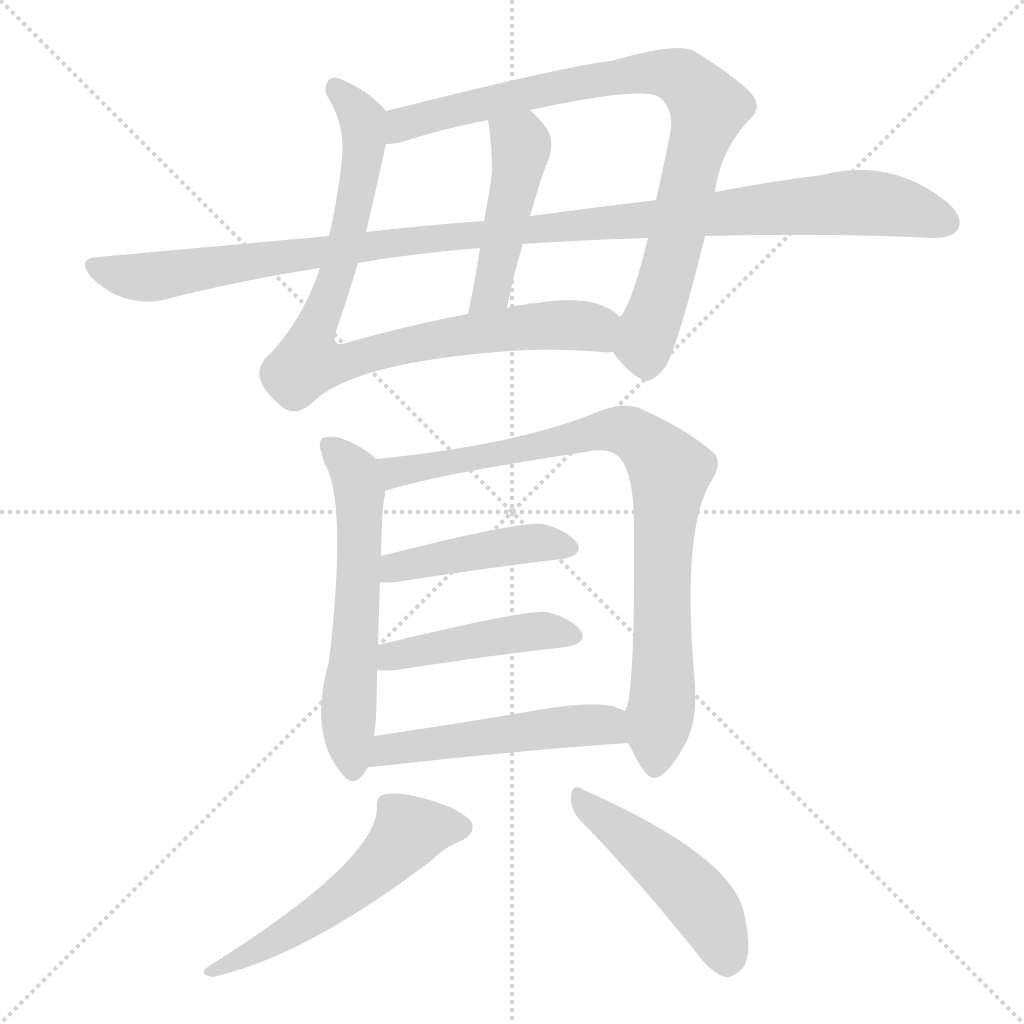
Character: Guan
Kangxi strokes: 11
Page 1205, Entry 17
Tang Rhymes (Tangyun), Collection Rhymes (Jiyun), Rhyme Meetings (Yunhui), Correct Rhymes (Zhengyun): Pronounced guan (falling tone).
Shuowen Jiezi: Guan means a string of shell money.
History of the Former Han (Qian Hanshu), Treatise on Food and Money: In the capital, the strings of cash reached tens of millions, and the strings rotted so that they could not be counted.
Also: Broad Elegance (Boya), to pierce through.
Five Classics Text (Wujing Wenzi): Once pierced, it is called guan.
Book of Changes (Yijing), Bo Hexagram: Stringing fish.
Explanation of Text (Shiwen): Guan means to pierce.
History of the Former Han (Qian Hanshu), Biography of Dong Zhongshu: Are they not of the same branch and the same string?
Commentary: Guan means to connect and thread through.
Also: To hit the mark.
Book of Etiquette and Ceremonial (Yili), Village Archery Rites: If one does not hit the mark, one does not release the arrow.
Commentary: Guan is equivalent to hitting the mark.
Also: Guliang Commentary (Guliang Zhuan), 19th Year of Duke Zhao: Youthful topknots.
Commentary: Ji-guan refers to hair tied in intersecting knots as an ornament.
Also: Book of Jin (Jinshu), Biographies of Men of Letters: Standing above those writers, together surpassing the pure ranks.
Correct Character Guide (Zhengzitong): Serving officials are called pure ranks.
Also: A surname.
Quick Study of Surnames (Xingshi Jijiu Pian): The Zhao minister Guan Gao.
Outline of Ancient Sounds (Guyin Lue): The guan in Guan Gao is pronounced guan (level tone).
Also: Broad Elegance (Boya), to accumulate.
Also: Rhyme Treasury (Yunfu), original registration, referring to one’s native place.
Also: Name of a state.
Geography of the Wide World (Kuodizhi): The former Guan City was the ancient state of Guan, located in Jiyin County, Cao Prefecture.
Also: Book of Odes (Shijing), Odes of Wei: For three years, I have served you.
Commentary: Guan means to serve.
Explanation of Text (Shiwen): Pronounced luan (rising tone).
Note by Zhu Xi: Guan means to be accustomed to; pronounced guan (falling tone).
Also: Collection Rhymes (Jiyun), Correct Rhymes (Zhengyun): Pronounced guan (falling tone). Guan is also written as guan.
Erya, Explanation of Words (Shigu): Guan means to be accustomed to.
Book of Odes (Shijing), Odes of Qi: To shoot is to be accustomed to it.
Explanation of Text (Shiwen): Mao says pronounced luan (rising tone), meaning to hit the mark. Zheng says pronounced guan (falling tone), meaning to be accustomed to.
History of the Former Han (Qian Hanshu), Biography of Jia Yi: Habits become as if they were natural.
Commentary: Yan Shigu says: Guan also means to be accustomed to.
Also: Collection Rhymes (Jiyun): Pronounced wan (level tone). Wan is also written as guan.
Records of the Grand Historian (Shiji), Biography of Wu Zixu: Drawing the bow and holding the arrows, they aimed at the envoy.
Also: Broad Rhymes (Guangyun), Collection Rhymes (Jiyun), Rhyme Meetings (Yunhui): Pronounced guan (level tone). The meaning is the same.
Note: In Shuowen Jiezi, the character guan signifies threading objects together and holding them; it is pronounced guan (level tone). Guan and the character for threading are interchangeable, therefore in the classics, guan is also pronounced guan (level tone).