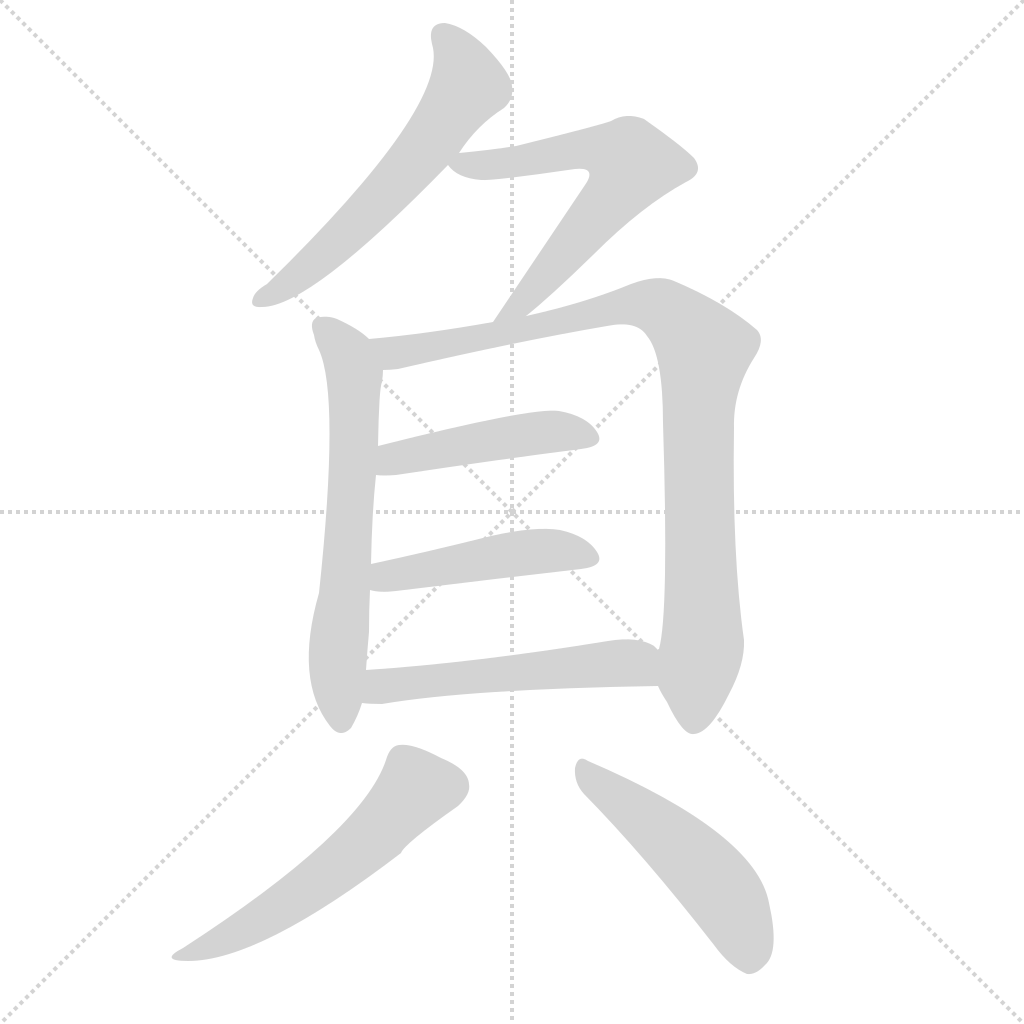
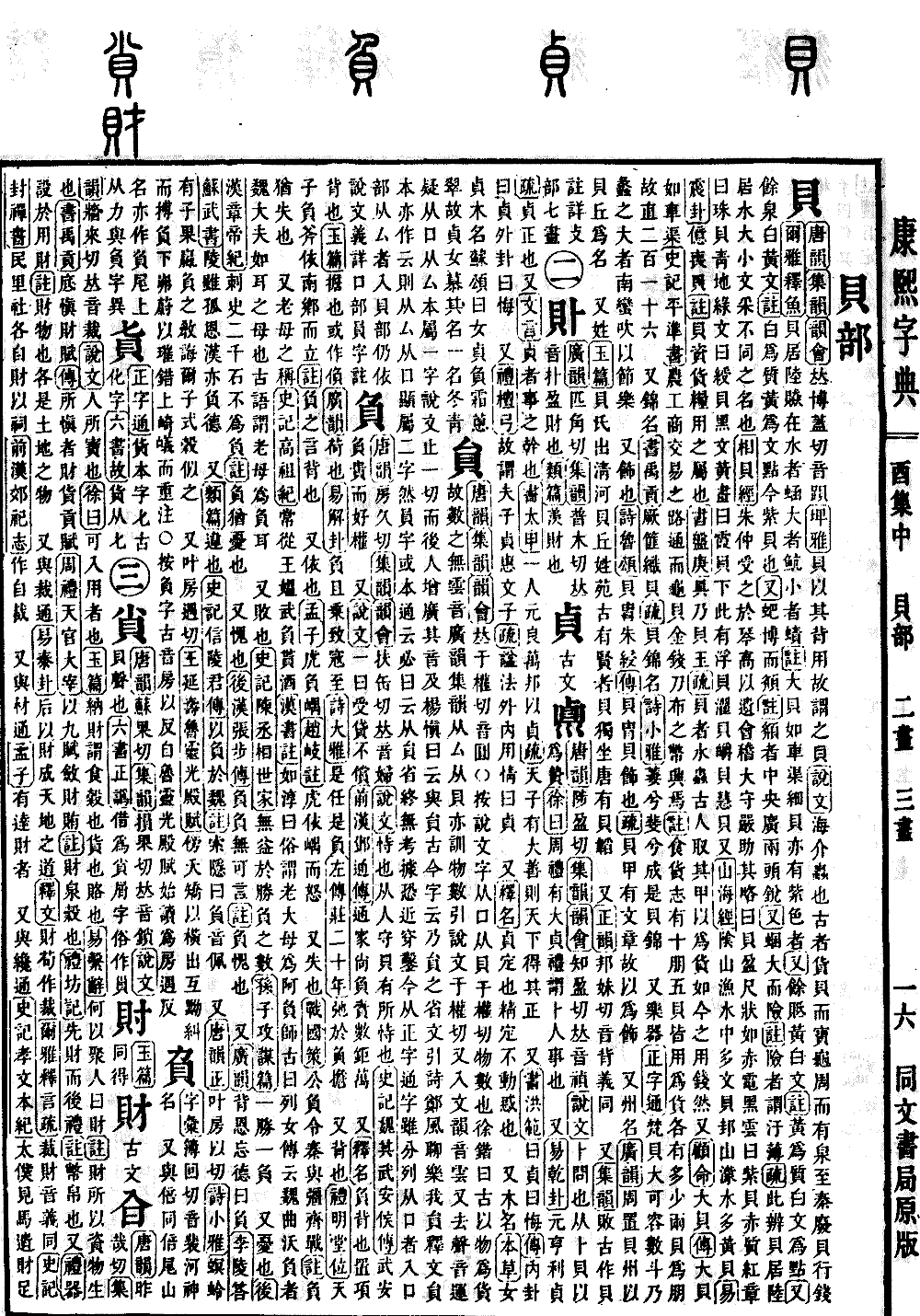
You Collection, Middle Volume
Radical: Shell (bèi)
9
Page 1204, Entry 06
Pronounced fu (falling tone)
According to the Shuo Wen Jie Zi (Explaining Graphs and Analyzing Characters), it means to rely upon. The character is composed of a person guarding a shell, representing something to rely on.
Records of the Grand Historian (Shiji), Biography of Marquis Weiqi and Marquis Wu'an: Marquis Wu'an relied on his noble status and favored schemes.
Also, according to the Shuo Wen Jie Zi, another meaning is to receive a loan and not repay it.
Book of Han (Hanshu), Biography of Deng Tong: Deng Tong's family still owed a massive debt.
Also, according to the Shi Ming (Explanation of Names), to carry on the back. To place something upon the neck and back.
According to the Yu Pian (Jade Chapters), to carry with the shoulders. Sometimes also written in a variant form (fù).
According to the Guang Yun (Broad Rhymes), to bear on the back.
Book of Changes (Yijing), Xie Hexagram: Carrying items while riding in a carriage attracts bandits.
Book of Odes (Shijing), Da Ya: Thus carrying on the shoulder, thus carrying on the back.
Zuo Commentary (Zuozhuan), 20th Year of Duke Zhuang: Relieved from the burden.
Also refers to having one's back turned.
Book of Rites (Liji), Ming Tang Wei: The Son of Heaven stands facing south, with his back to the screen painted with axe patterns.
Commentary: The meaning of this is to turn one's back.
Also refers to to rely on.
Mencius: A tiger relying on a mountain corner.
Zhao Qi Commentary: The tiger relies on the mountain corner to show its rage.
Also refers to to lose.
Strategies of the Warring States (Zhanguo Ce): If you lose the opportunity to have the Qin state engage the powerful Qi state in battle.
Commentary: Loss in this context is like losing.
Also refers to a term of address for elderly women.
Records of the Grand Historian (Shiji), Annals of Gaozu: Often went to the shop of a woman surnamed Wang and an old woman surnamed Wu to buy wine on credit.
Book of Han (Hanshu) Commentary: Ru Chun states: It is customary to call an elderly woman A Fu. Yan Shigu states: The Quwo Fu of the Wei state mentioned in Biographies of Women (Lienü Zhuan) was the mother of the Wei official Ru Er. Ancient language refers to an old mother as Fu.
Also refers to defeat.
Records of the Grand Historian (Shiji), Biographies of the Prime Ministers: It does not affect the inevitable outcome of victory or defeat.
Sun Tzu, Art of War: One side wins, the other side loses.
Also refers to worry.
Book of the Later Han (Hou Hanshu), Annals of Emperor Zhang: The governors and officials earning two thousand shi of grain have no worries.
Commentary: In this context, it is synonymous with worry.
Also refers to shame.
Book of the Later Han (Hou Hanshu), Biography of Zhang Bu: Shameful, shameful, there is nothing more to say.
Commentary: In this context, it is synonymous with shame.
Also according to the Guang Yun (Broad Rhymes), to abandon virtue or forget kindness is called Fu.
Li Ling, Letter to Su Wu: Although I, Li Ling, have failed in my duty and grace, the Han dynasty has also abandoned its virtue.
Also according to the Lei Pian (Classified Chapters), to violate or go against.
Records of the Grand Historian (Shiji), Biography of Lord Xinling: Thereby failing the Wei state.
Commentary: The Suoyin states: Pronounced pei.
Also, according to the Tang Yun Zheng (Corrected Tang Rhymes), it rhymes with the sound pronounced fi (rising tone).
Book of Odes (Shijing), Xiao Ya: The mud dauber wasp has its larvae, and the sphex wasp comes to carry them away. Nurture your descendants, and the good path will be continued.
Also rhymes with the sound pronounced fu (falling tone).
Wang Yanshou, Rhapsody on the Lingguang Hall (Lingguang Dian Fu): The sides are bent and extend horizontally, interlaced and coiled, supporting one another. The lower sections are dense and colorful, the upper sections are high and steep, cascading downwards.
Note: The character Fu was anciently pronounced as the rhyme of Fang and Yi. Starting from the Rhapsody on the Lingguang Hall, it began to be pronounced as the rhyme of Fang and Yu.