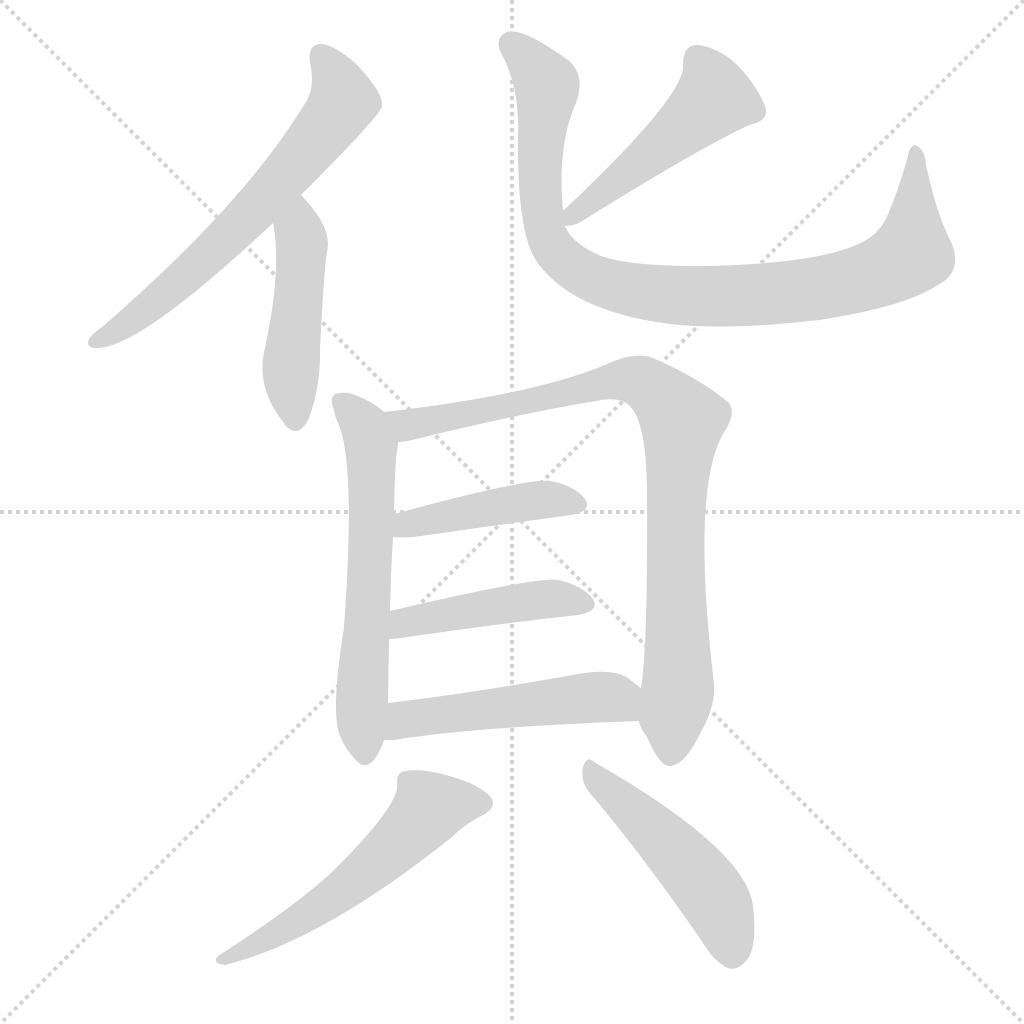
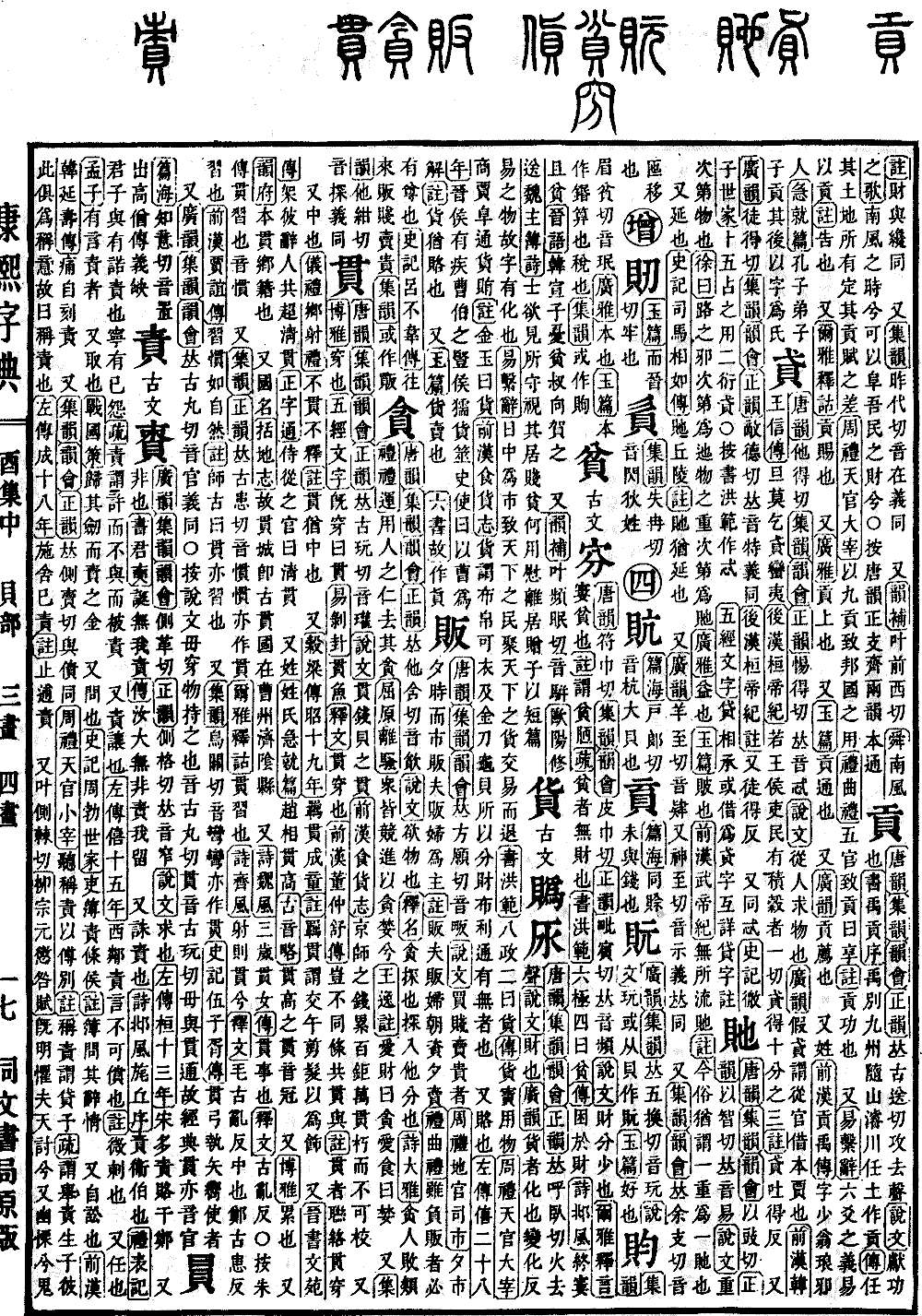
You Collection, Middle Volume. Radical: Shell (bèi).
Total strokes: 11. Page 1205, Entry 12.
Ancient script. According to Tang Rhymes (Tangyun), Collection of Rhymes (Jiyun), Rhyme Compilation (Yunhui), and Orthodox Rhymes (Zhengyun), it is pronounced huo (falling tone).
According to Explaining Graphs and Analyzing Characters (Shuowen), it means wealth.
According to Extensive Rhymes (Guangyun), the term for commodity implies transformation, as it is an object that changes hands or is exchanged, hence the character contains the element for transformation.
Book of Changes (Yijing), Commentary on the Appended Statements: At midday, markets were held to attract the people of the world, gathering the world's commodities, exchanging goods, and then departing.
Book of Documents (Shangshu), The Great Plan: Among the eight categories of government, the second is commodities. Commentary: Commodities refer to precious and useful items.
Rites of Zhou (Zhouli), Offices of Heaven, Grand Administrator: Merchants facilitate the flow of commodities and wealth. Commentary: Gold and jade are called commodities.
History of the Former Han (Qianhanshu), Treatise on Food and Commodities: Commodities refer to cloth and silk that can be worn, as well as metal currency, tortoise shells, and cowries, which are used to distribute wealth, disseminate profit, and circulate items of necessity.
It also means to bribe.
Zuo Commentary (Zuo Zhuan), 28th Year of Duke Xi: The Marquis of Jin was ill; the servant of the Earl of Cao, Hou Ru, bribed the divination official, telling him to say: Take Cao as the explanation. Commentary: Here, the term implies bribery.
According to Jade Compilation (Yupian), it also means to sell.
According to Six Writings (Liushugu), it is written in a variant form.