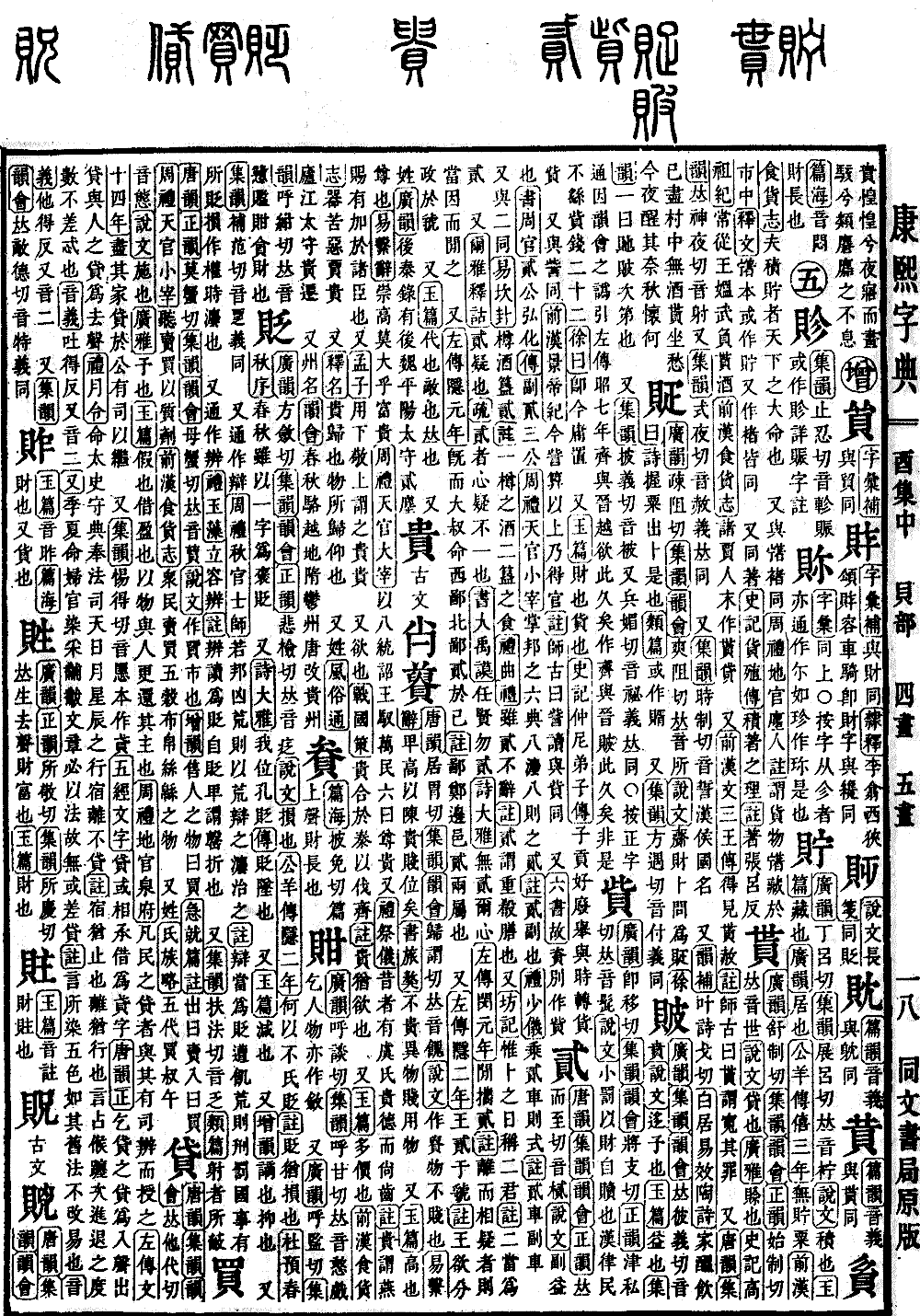
You Collection, Middle Volume
Radical: Cowrie (bèi)
Entry: gui
Kangxi strokes: 12
Page 1206, Entry 15
Ancient text. Tang Rhymes (Tangyun) states: pronounced kui (falling tone). Collected Rhymes (Jiyun) and Rhyme Compendium (Yunhui) state: pronounced kui (falling tone). According to Explaining Graphs and Analyzing Characters (Shuowen Jiezi), it is written as a variant form, referring to objects that are not inexpensive.
Book of Changes (Yijing), Commentary on the Appended Statements: High and low status are determined by noble and base positions.
Book of Documents (Shangshu), Travels of the Master of the Dog: Do not prize rare items; do not undervalue useful items.
Also, Jade Chapters (Yupian) defines it as high and honorable.
Book of Changes (Yijing), Commentary on the Appended Statements: There is nothing more honorable than wealth and nobility.
Rites of Zhou (Zhouli), Offices of Heaven, Grand Administrator: Using eight unifiers to guide the king in governing the myriad people, the sixth is honorable and noble status.
Also, Record of Sacrificial Rites (Jisiyi): In the past, the Yu dynasty valued virtue and respected seniority. Commentary: Nobility refers to banquets and rewards bestowed upon ministers.
Also, Mencius (Mengzi): Treating those above with respect is called valuing the noble.
Also, to desire. Strategies of the Warring States (Zhanguoce): Desired to align with Qin to attack Qi. Commentary: Valuing here is the same as desiring.
Also, Jade Chapters (Yupian): A high price. History of the Former Han (Qianhan), Treatise on Food and Money: Tools were poorly made yet expensive.
Also, Explanation of Names (Shiming): Valuing means returning; it is that to which things return and look up to.
Also, a surname. Comprehensive Customs (Fengsutong): Lujiang Governor Gui Qian.
Also, a prefecture name. Rhyme Compendium (Yunhui): Land of the Luoyue during the Spring and Autumn period, Yuzhou during the Sui dynasty, renamed Guizhou during the Tang dynasty.