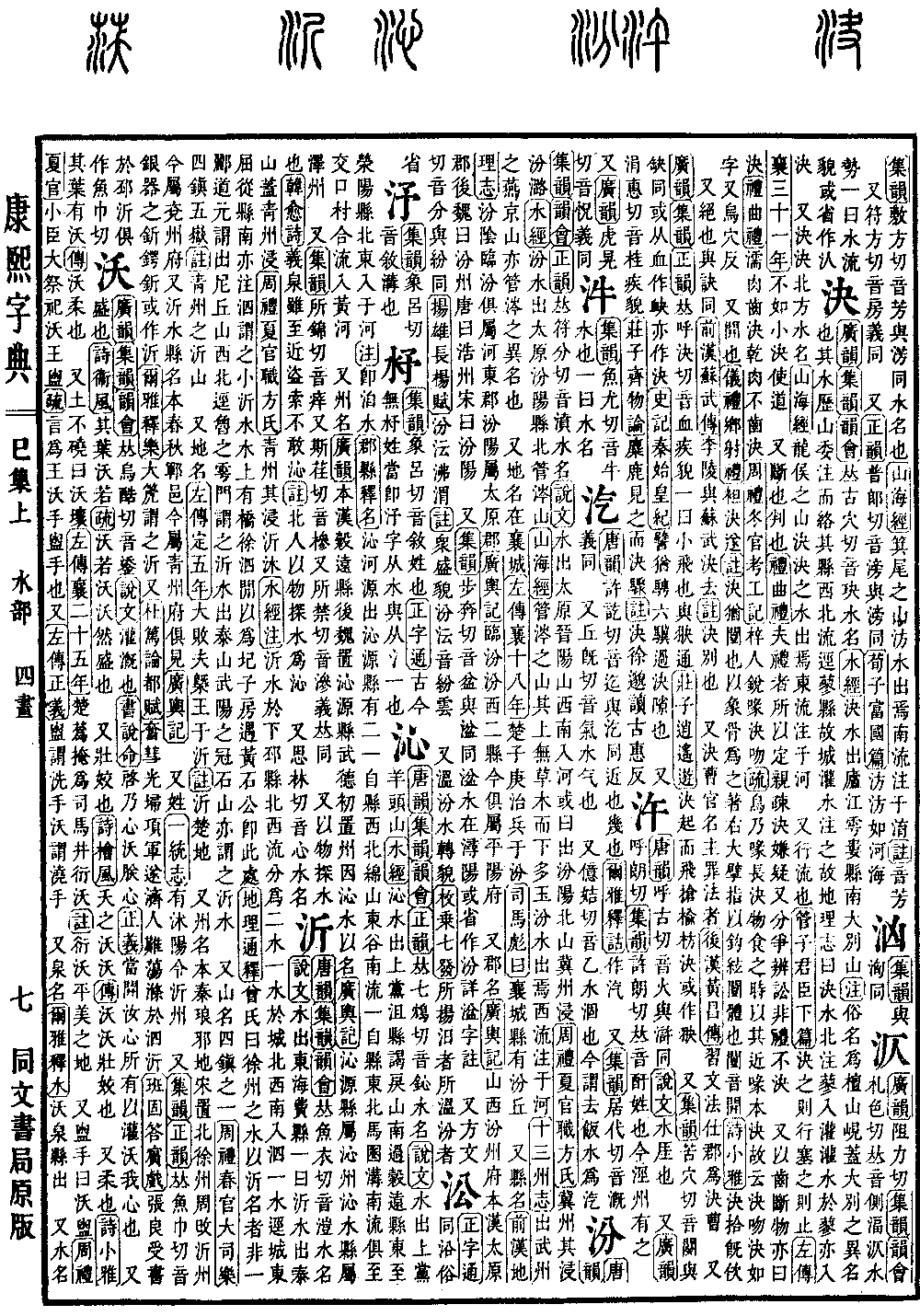
Si Collection, Upper Volume
Radical: Water (shuǐ)
沁
Kangxi Dictionary strokes: 8
Page 609, Entry 11
According to the Tang Rhyme (Tangyun), the Collected Rhymes (Jiyun), the Rhyme Compendium (Yunhui), and the Correct Rhymes (Zhengyun), it is pronounced xin.
The name of a river. According to the Explaining Graphs and Analyzing Characters (Shuowen), the river originates at Mount Yangtou in Shangdang. According to the Classic of Water (Shuijing), the Qin River originates at Mount Yeli in Ju County, Shangdang, passes south through Guyuan County, flows east to the north of Xingyang County, and then flows east into the Yellow River. The commentary notes that this is the Ji River. According to the Interpretations of Names of Commanderies and Counties (Junxian Shiming), the source of the Qin River is in Qinyuan County; there are two sources, one flowing south from the eastern valley of Mount Mian northwest of the county, and the other flowing south from Maquangou northeast of the county; they meet at Jiaokou Village and flow into the Yellow River.
Also the name of a prefecture. According to the Expanded Rhymes (Guangyun), it was originally Guyuan County during the Han dynasty, renamed Qinyuan County during the Northern Wei dynasty, and established as a prefecture in the early Wude era, named after the Qin River. According to the Expanded Geography Records (Guangyuji), Qinyuan County belongs to Qin Prefecture, and Qinshui County belongs to Ze Prefecture.
Additionally, according to the Collected Rhymes (Jiyun), it is pronounced shen, also pronounced sen, and also pronounced shen. The meaning is the same.
Also, to probe water with an object. In a poem by Han Yu, it is written: Although the righteous spring is very close, the thief dares not probe it. The commentary notes: People of the north use the word for probing water with an object.
Also pronounced xin. The name of a river.