Wu Collection, Middle Volume
Radical: White (bái)
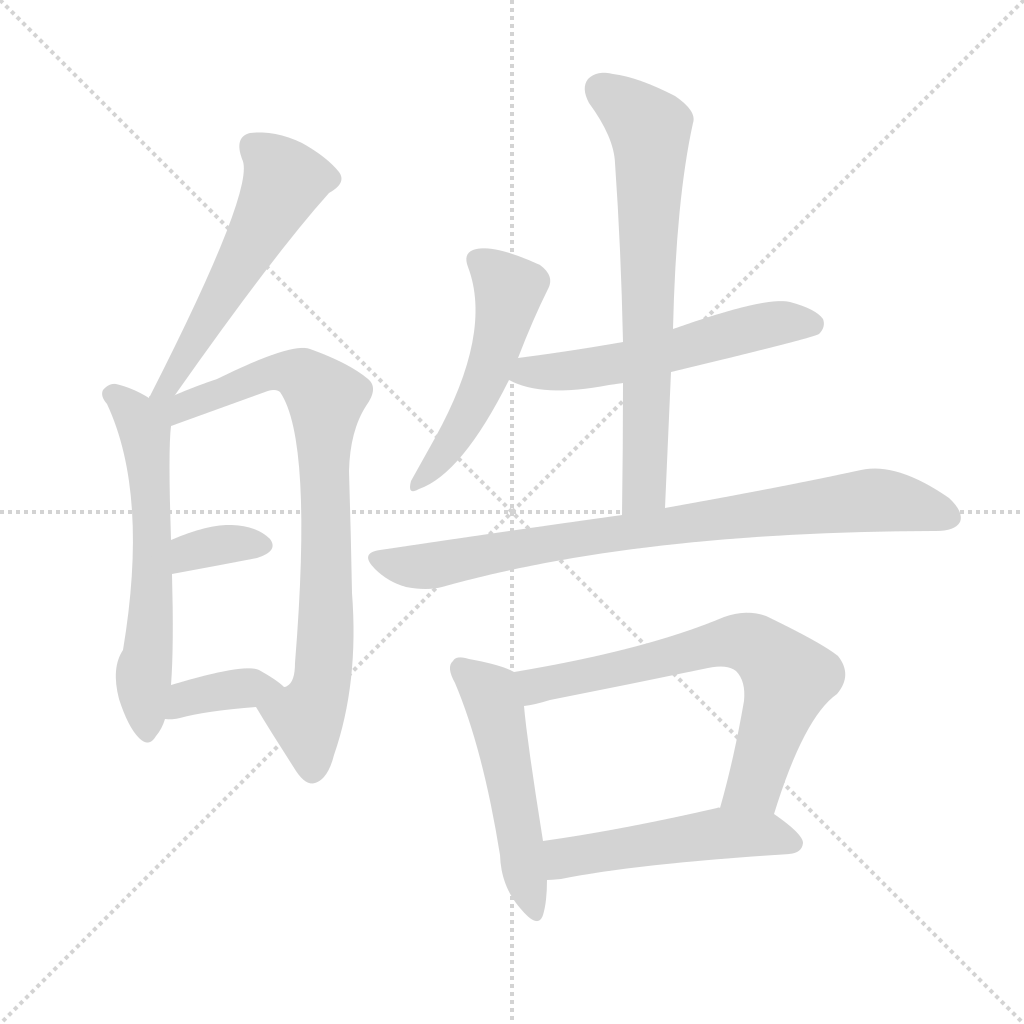
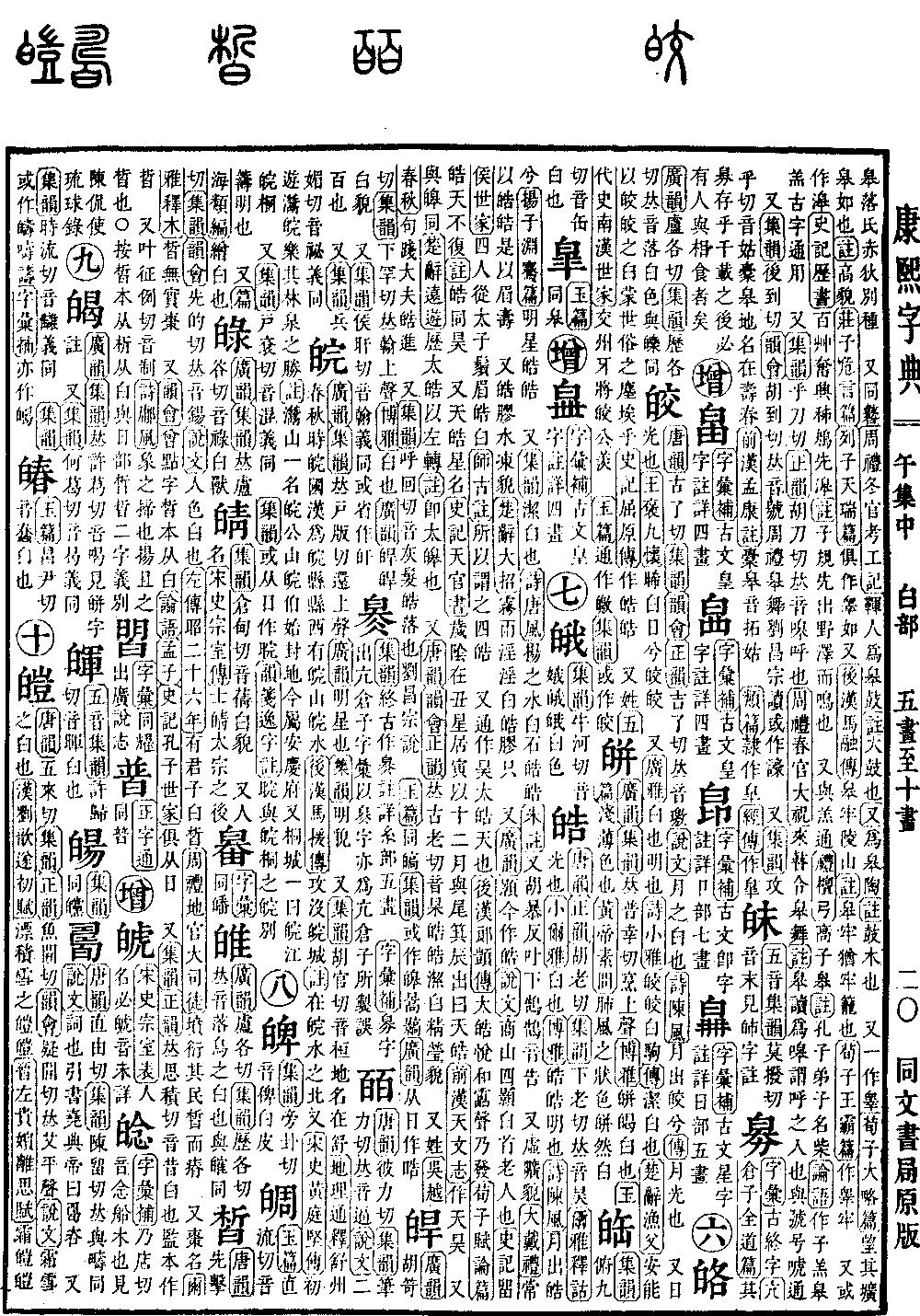
Hao
Kangxi strokes: 12
Page 788, Entry 14
Pronounced hao (falling tone).
Book of Erya (Erya), Explanation of Names: Brightness.
Book of Little Erya (Xiao Erya): White.
Book of Bolya (Boya): Hao-hao means bright.
Book of Odes (Shijing), Odes of Chen: The moon comes out, white and bright.
Book of Yangzi (Yangzi), Yuanqian Chapter: The morning star is bright.
Also, Book of Collected Rhymes (Jiyun): Pure white.
Book of Odes (Shijing), Odes of Tang: The waters of the Yang, the white stones are bright.
Commentary by Zhu Xi (Zhu Zhu): Also pronounced bao (falling tone), rhyming with gu. Gu is pronounced gao.
Also, the appearance of being empty and vast.
Book of Rites of Dai (Da Dai Liji): Constantly remaining vast and clear, thereby attaining longevity.
Also, hao-jiao, the appearance of water freezing.
Book of Chu Elegies (Chuci), Great Summons: The mist and rain are pervasive, the white frost is thick.
Also, Book of Broad Rhymes (Guangyun): Hao (颢), now written as hao.
Book of Analytical Dictionary of Characters (Shuowen Jiezi): The four white-headed sages of Mount Shang are elderly men with white hair.
Records of the Grand Historian (Shiji), Biography of the Marquis of Liu: The four men followed the Crown Prince, their whiskers and eyebrows were white.
Commentary by Yan Shigu (Shigu Zhu): This is why they are called the Four Hao.
Also interchangeably used as hao (昊). Taihao refers to the heavens.
Book of the Later Han (Hou Hanshu), Biography of Lang Hao: Taihao is pleased and harmonious, and the sound of thunder is emitted.
Book of Xunzi (Xunzi), Chapter on Rhapsodies: The vast heavens do not turn back.
Commentary: Hao is the same as hao (昊).
Also, Tianhao, a star name.
Records of the Grand Historian (Shiji), Treatise on the Celestial Offices: When the year's influence is in the chou position, the star dwells in the yin position, and in the twelfth month, it rises at dawn with the tail and winnowing basket constellations; this is called Tianhao.
Book of the Former Han (Qian Hanshu), Treatise on Astronomy: Written as Tianhao (昊).
Also the same as hao (皞).
Book of Chu Elegies (Chuci), Distant Wandering: Passing Taihao and turning left.
Commentary: This refers to Taihao (皞).
Also pronounced gao (rising tone). Hao-hao describes a pure white, crystalline appearance.
Also a surname.
Annals of Wu and Yue (Wuyue Chunqiu): The minister Hao Jin of Goujian.
Also, Book of Collected Rhymes (Jiyun): Pronounced hui. Describing hair falling out. According to Liu Changzong.
Book of Character Compendium (Yupian): The same as hao (皜).
Book of Collected Rhymes (Jiyun): Sometimes written as hao (皞) or hao (暠).
Book of Broad Rhymes (Guangyun): Written with the sun radical as hao (晧).
Editorial Notes:
Book of Xunzi (Xunzi), Chapter on Rhapsodies: Adjusted to match the original text by omitting the word chapter.
Records of the Grand Historian (Shiji), Treatise on the Celestial Offices: Adjusted to change the original text from rise to rise at dawn.