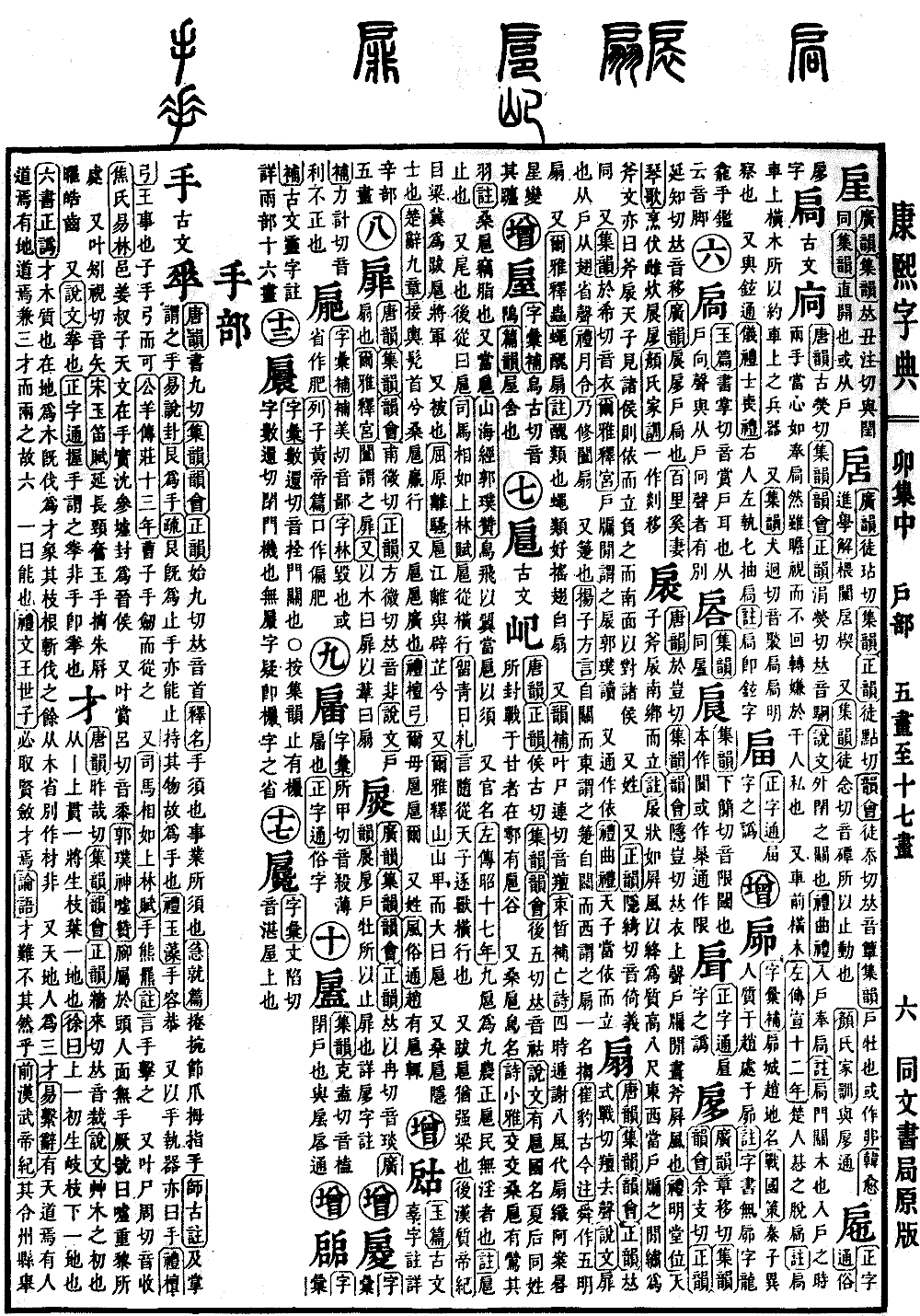
Mao Collection, Middle Volume
Radical: Hand (shǒu)
才
Kangxi strokes: 4
Page 416, Entry 30
Pronounced zai. According to Tangyun, Jiyun, Yunhui, and Zhengyun, it is pronounced cai, with the same sound as the character for cut (cái).
Explaining the character (Shuowen Jiezi): It describes the appearance of grass and trees just beginning to grow. The character shape consists of a line (gǔn) with a single horizontal stroke piercing through it, representing the imminent growth of branches and leaves; the horizontal stroke represents the earth.
Xu Kai notes: The horizontal stroke at the top represents the initial branching, while the lower stroke represents the ground.
Six Scripts Corrected (Liushu Zheng'e) explains: The character represents the physical substance of a tree. When growing on the ground it is called wood (mù), and once cut down it is called material (cái); the shape symbolizes the remains of the trunk and roots after being cut. It is a contracted form of the character for wood (mù). Writing it as the material variant (cái) is incorrect.
It also refers to the three powers (sān cái) of Heaven, Earth, and Man.
Classic of Changes (Yijing), Appended Remarks (Xici): There is the Way of Heaven, the Way of Man, and the Way of Earth. By combining these three powers and doubling them, the six lines (yáo) are formed.
It also refers to talent.
Book of Rites (Liji), Hereditary Successor of King Wen (Wenwang Shizi): One must select the virtuous and gather talented individuals.
Analects (Lunyu): Is it not the case that talented people are hard to find?
History of the Former Han (Qian Hanshu), Annals of Emperor Wu (Wudi Ji): An edict ordered provinces and counties to recommend excellent and outstanding talent.
Book of Tang (Tangshu), Treatise on Officials (Baiguan Zhi): Selection of talent was based on four criteria: appearance, speech, calligraphy, and judgment.
Shao Yaofu notes: It is only after facing major events that one realizes how difficult it is to find talented people. Talent is a virtuous quality bestowed by Heaven; those who study use it to fulfill their own capabilities.
It also refers to nature and ability.
Book of Odes (Shijing), Eulogies of Lu (Lusong): Their thoughts are infinite, how excellent are these horses.
Mao Commentary (Maozhuan) explains this as having great strength and talent.
Mencius (Mengzi): It is not that the nature bestowed by Heaven is so different.
Reflections on Things at Hand (Jinsilu): One's original nature comes from Heaven, while one's talent comes from the vital force (qi); if the vital force is pure, the talent is pure, and if the vital force is murky, the talent is murky.
It is also a surname. For example, Cai Kuan, a Minister during the Ming dynasty.
According to Jiyun, it is interchangeable with the character for material (cái).
Explaining the character (Shuowen Jiezi): The character for material (cái) refers to a wooden post standing upright in the water. The character consists of wood with a phonetic component.
Xu Kai notes: Wood that is strong and straight is useful, which is why people go into the mountains to select wood for building. The meaning of a person possessing talent is derived from this.
According to Zhengyun, it is interchangeable with the character for just now (cái). In ancient times, the current character was used for the character meaning just now or beginning.
Book of Jin (Jinshu), Biography of Xie Hun: Being young and wealthy, he interfered in the affairs of others' families.
It is also interchangeable with the character for decide (cái).
Strategies of the Warring States (Zhanguoce): Only request the King to make the decision.
It is also interchangeable with the character for wealth (cái).
History of the Former Han (Qian Hanshu), Biography of Yang Xiong (Yang Xiong Zhuan): There were enough goods and wealth to supply the ancestral temple.
According to Jiyun, it is pronounced zai, the same as the character for beginning (zāi). It also means to begin.
Commentary on the Erya (Erya Shigu Shu): In ancient texts, the character for beginning (zāi) was written as this character. Because the sounds are similar, it was borrowed to represent the meaning of beginning.
It is also pronounced zai (rising tone), with the same meaning.
It is also phonetically matched to qiu (level tone).
Jia's Forest of Changes (Jia Shi Yilin): Ji Zi has great talent, sparing me from worry.