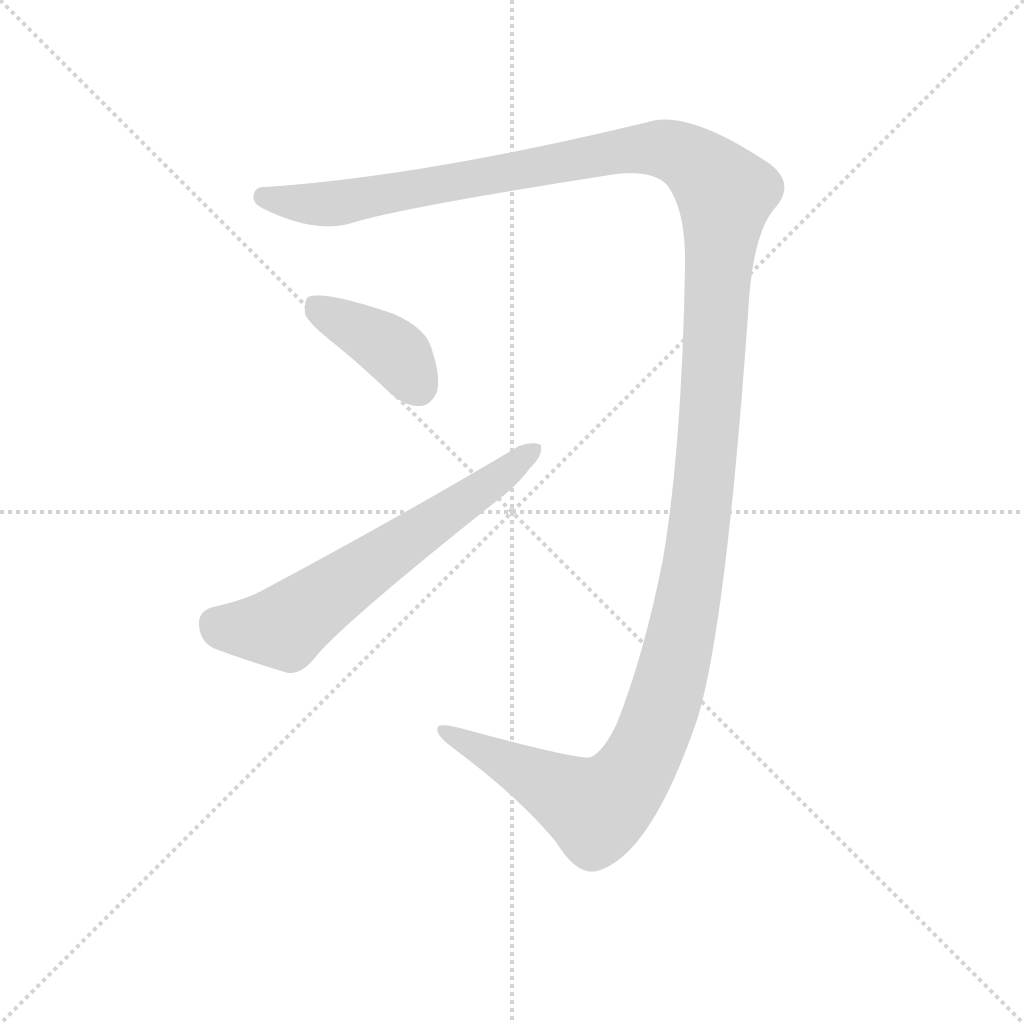
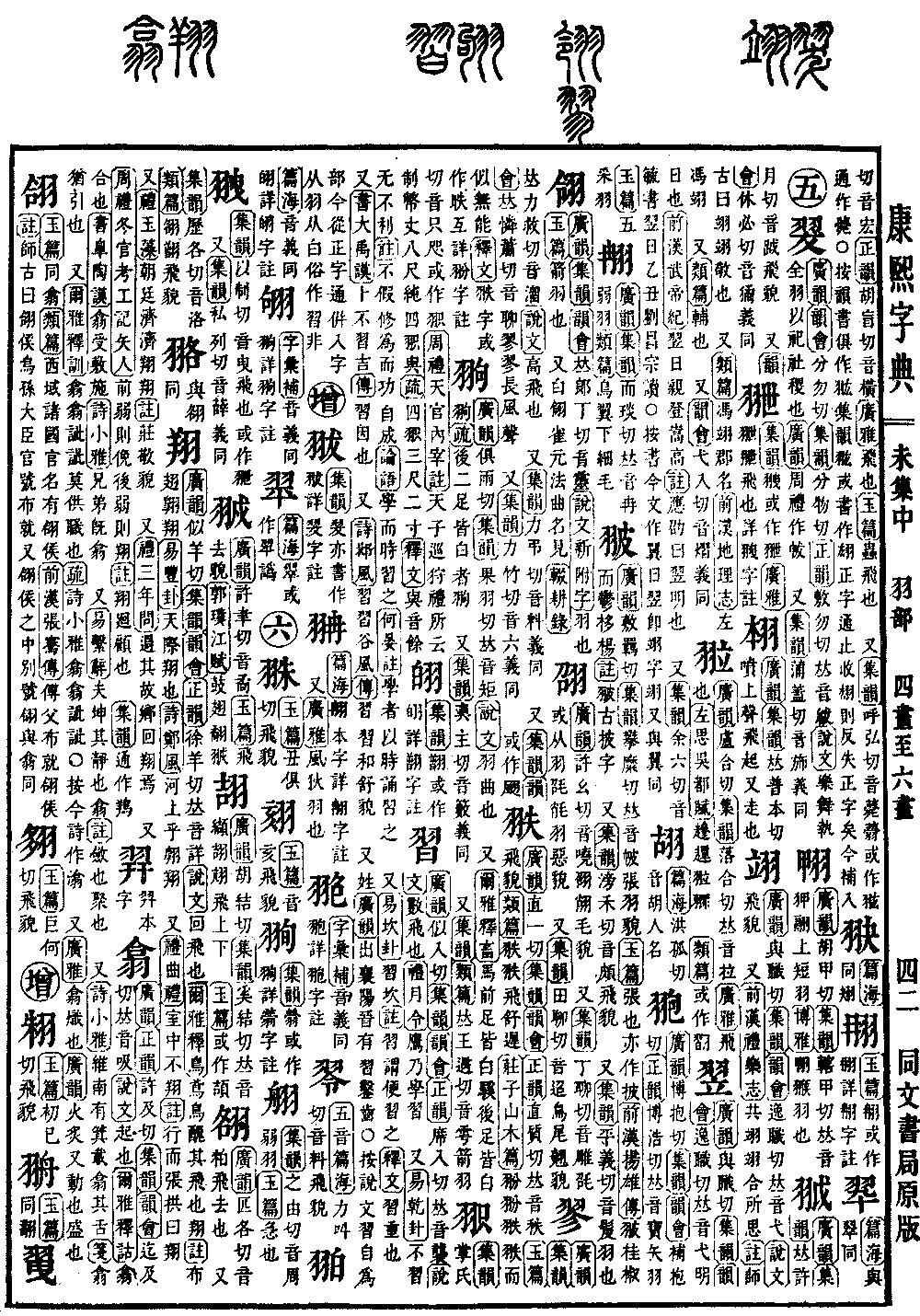
Wei Collection, Middle Volume. Radical: Feather (yǔ). Xi. Kangxi Strokes: 11. Page 956.
Pronounced with the initial si and the rime ru (si ru qie) — Guangyun. Pronounced with the initial xi and the rime ru (xi ru qie) — Jiyun, Yunhui, and Zhengyun. Sound is xi.
To fly repeatedly — Shuowen Jiezi (Shuowen). The hawks then learn and practice flying — Book of Rites (Liji).
Also, not practicing, yet nothing is unfavorable — Book of Changes (Yijing). Note: Without relying on cultivation or effort, the merit is achieved naturally.
To learn and practice it at the appropriate times — Analects (Lunyu). Note by He Yan: Learners recite and practice it at the appropriate times.
Also, repeated Kan — Book of Changes. Note: Xi means to become accustomed to or proficient in. Textual explanation: Xi means repeated.
Also, officials do not repeat auspicious divinations — Book of Documents (Shangshu). Commentary: Xi means to follow or repeat.
Also, gently, gently blows the valley wind — Book of Odes (Shijing). Commentary: Xixi describes a harmonious and relaxed appearance.
Also a surname — Guangyun. Originates from Xiangyang. There was Xi Zuochi in the Jin dynasty.
According to the Shuowen, the character was originally its own radical. It is now merged here following the Correct Character Mastery (Zhengzitong). The character is composed of the radical for feather (yu) and the radical for white (bai). The common form written as xi is incorrect.
Correction: Regarding the quote Not practicing, yet nothing is unfavorable in the Book of Changes, Hexagram Qian, it has been carefully corrected to Hexagram Kun according to the original book.