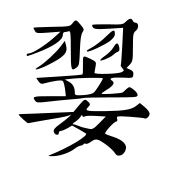
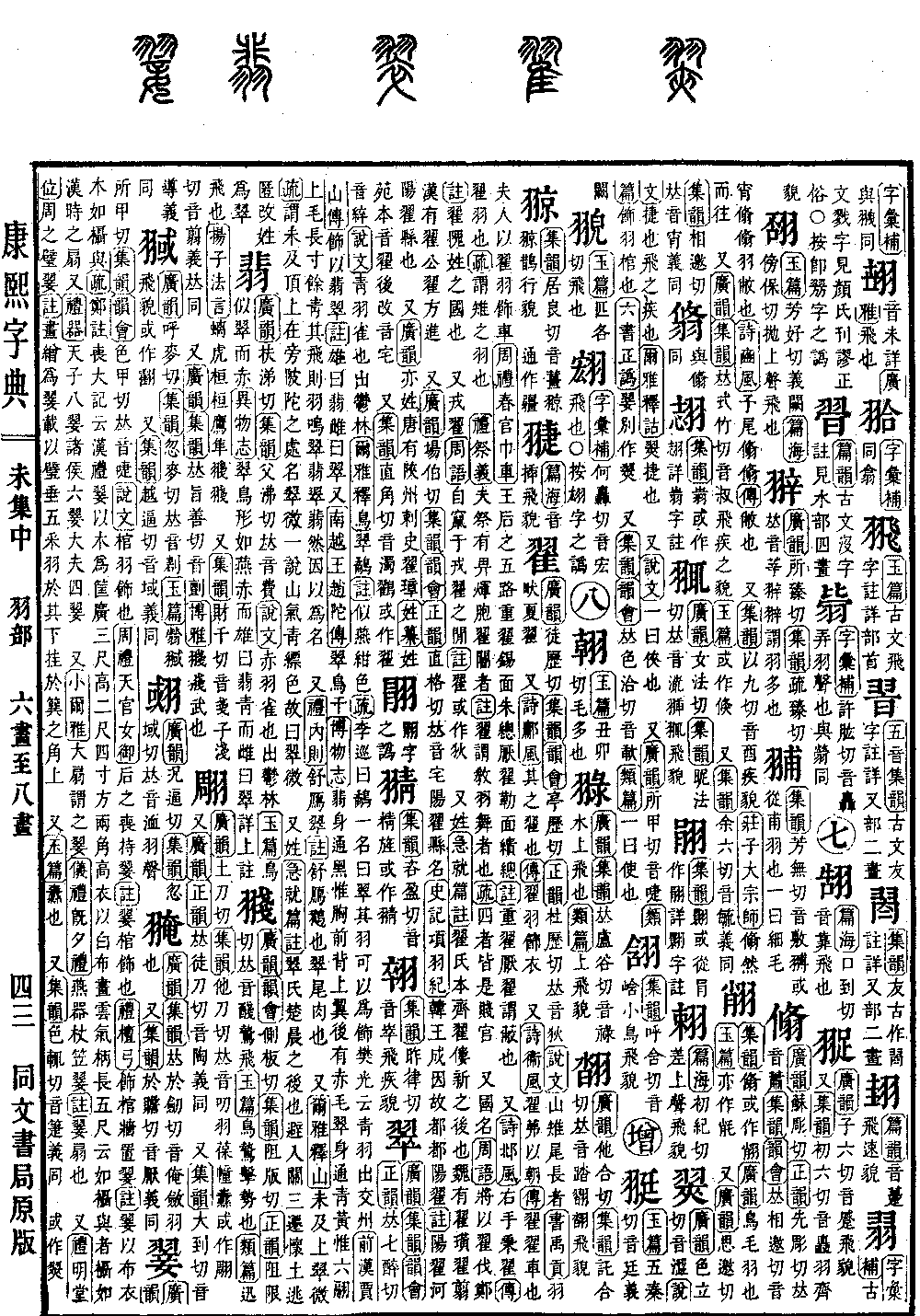
Wei Collection, Middle Volume
Radical: Feather (yǔ)
Kangxi Strokes: 14
Page 957, Entry 43
Pronounced sha.
According to the Explaining Graphs and Analyzing Characters (Shuowen Jiezi), it refers to feather decorations on a coffin.
In the Rites of Zhou (Zhouli), Heaven Official, Female Attendants: The queen's funeral involves holding the sha. Commentary: Sha refers to coffin decorations.
In the Book of Rites (Liji), Tan Gong: Decorate the coffin walls and place the sha. Commentary: The sha is made of cloth covering wood, resembling a fan.
The Sub-commentary states: Zheng's commentary cites the Record of Mortuary Rites (Sangdaji), which says that according to Han dynasty rituals, the sha is made of wood as a frame, three feet wide and two feet four inches high, with two square corners, covered with white cloth, painted with clouds, and having a handle five feet long. The mention of it being like a fan refers to the fans of the Han dynasty.
Also mentioned in Rites of Ceremonial Vessels (Liqi): The Son of Heaven uses eight sha, feudal lords use six sha, and high officials use four sha.
Also, in the Little Er-ya (Xiao Erya): Large fans are called sha.
In the Book of Etiquette and Ceremonial (Yili), Rites for the Morning After the Burial (Jixi Li): Vessels, staffs, hats, and sha. Commentary: The sha is a fan.
Also, in the Book of Rites (Liji), The Position of the Mingtang: The jade sha of the Zhou dynasty. Commentary: Painted silk is used to make the sha, adorned with jade discs, with five-colored feathers hanging beneath, suspended from the corners of the rack.
Also, according to the Jade Compendium (Yupian), it is the same.
Also, in the Collected Rhymes (Jiyun), pronounced she. The meaning is the same. Sometimes also written in a variant form (shà).