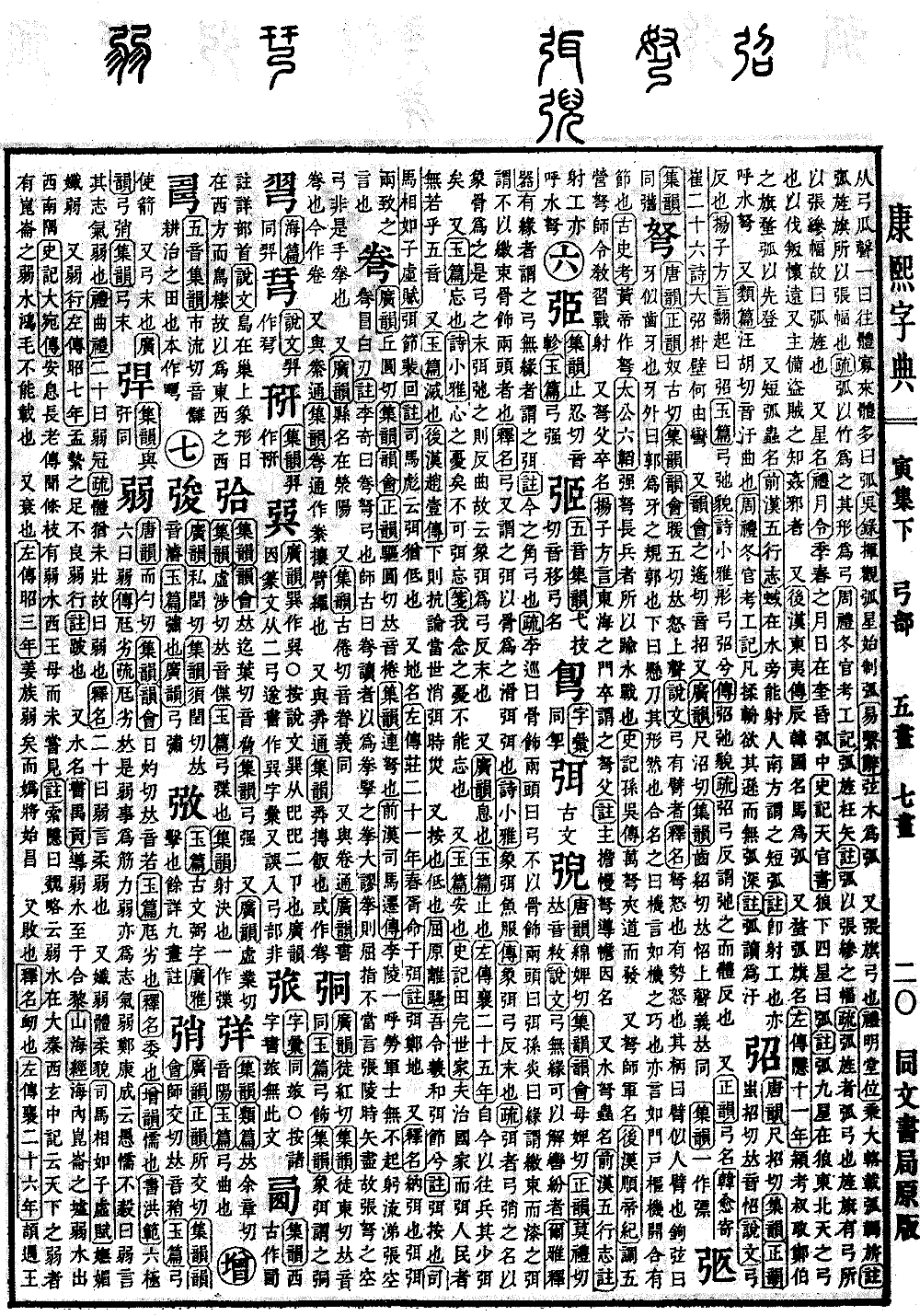
Yin Collection, Lower Volume
Radical: Bow (gōng)
Page 358, Entry 24
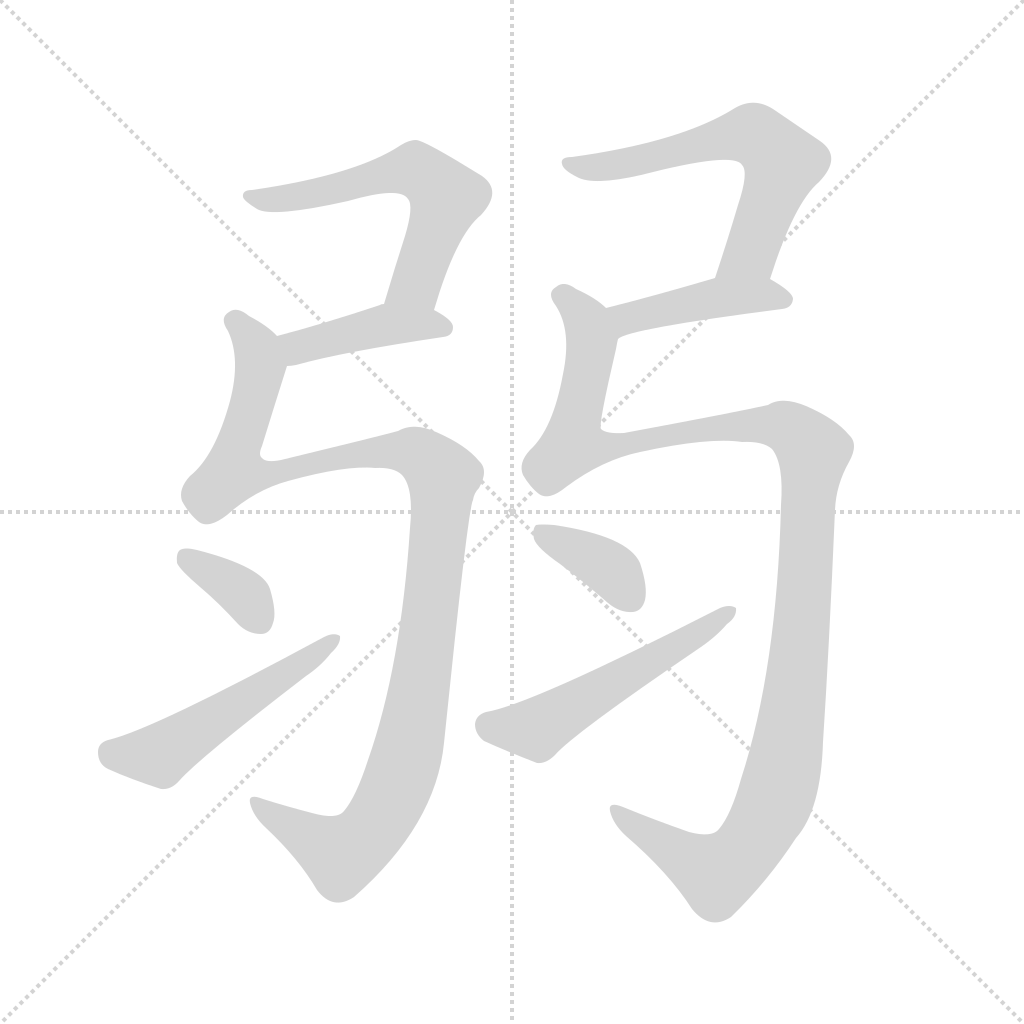
Pronounced ruo (rising tone).
In Yu Pian (Comprehensive Collection), it refers to a frail body or low ability.
In Shi Ming (Explanations of Names), it carries the meaning of being soft and yielding, or dependent.
In Zeng Yun (Expanded Rhymes), it refers to a timid or cowardly character.
In Book of Documents (Shangshu), specifically the Great Plan (Hongfan) chapter, it refers to the sixth of the six types of extreme misfortune. The commentary explains this as being frail and inferior. The sub-commentary states that frailty and inferiority are manifestations of weakness, referring to both a lack of physical strength and a lack of firm will or spirit. Zheng Kangcheng stated: Being foolish and timid, lacking determination, is called ruo, referring to a weakness of will and spirit.
In Book of Rites (Liji), specifically the Qu Li chapter, a man reaching the age of twenty is referred to as having reached the "weak capping" (ruo guan) stage. The sub-commentary explains that the body is not yet strong, hence it is called weak. Shi Ming explains that twenty years old is called weak because one is still in a stage of physical tenderness.
There is also the term xianruo, referring to a body that is slender and delicate. In Sima Xiangru’s Zixu Fu (Rhapsody on Sir Fantasy), it describes a posture that is charming and a body that is slender and delicate.
There is also the term ruoxing. In Zuo Tradition (Zuo Zhuan), seventh year of Duke Zhao, it is noted that Meng Zhi had a crippled foot and could not walk well, which is called ruoxing. The note explains this as having a lame gait.
It also refers to the name of a river. In Book of Documents (Shangshu), specifically the Tribute of Yu (Yu Gong) chapter, it mentions the channeling of the Ruo River until it reaches the Heli Mountains. In Classic of Mountains and Seas (Shanhaijing), it is said that within the seas, the Kunlun Mountains are the region where the Ruo River originates from its southwestern corner. In Records of the Grand Historian (Shiji), specifically the Biography of Dayuan, the elders of the Parthian Empire (Anxi) told of the Ruo River and the Queen Mother of the West in the Tiaozi state, though no one had seen them. The Suoyin commentary notes that the Wei Lue (Brief History of the Wei) records the Ruo River to the west of the Da Qin (Roman Empire). The Zhong Ji (Records of the Middle) states that the softest thing in the world is the water of the Kunlun Mountains, which is so light that even a goose feather cannot float upon it.
It also carries the meaning of decline or decay. In Zuo Tradition (Zuo Zhuan), third year of Duke Zhao, it states that the influence of the Jiang clan has declined, while the Gui clan is about to flourish.
It also carries the meaning of failure or defeat. In Shi Ming, it is defined as being thwarted or defeated. In Zuo Tradition (Zuo Zhuan), twenty-sixth year of Duke Xiang, Xie encountered the Prince and was defeated by him. The note explains that here, ruo means to be defeated, implying being captured by the Prince.
It also carries the meaning of loss. In Zuo Tradition (Zuo Zhuan), third year of Duke Zhao, it refers to the loss of a person.
There is also the term Fanruo, which is the name of a bow. It is also written in a variant form (fanruo). In Zuo Tradition (Zuo Zhuan), fourth year of Duke Ding, it refers to the Fanruo bow of the Fengfu. The note explains that Fanruo is the name of a great bow. In Kong Congzi (Masters' Anthology of Confucius), specifically the Gongsun Long chapter, it mentions the King of Chu drawing the Fanruo bow. In Sima Xiangru’s Zixu Fu, it mentions bending the Fanruo bow. The note by Wen Ying says that Fanruo is the name of a fine bow belonging to the Xia Dynasty.
In Explaining Graphs and Analyzing Characters (Shuowen Jiezi), the original form is recorded in its seal script.