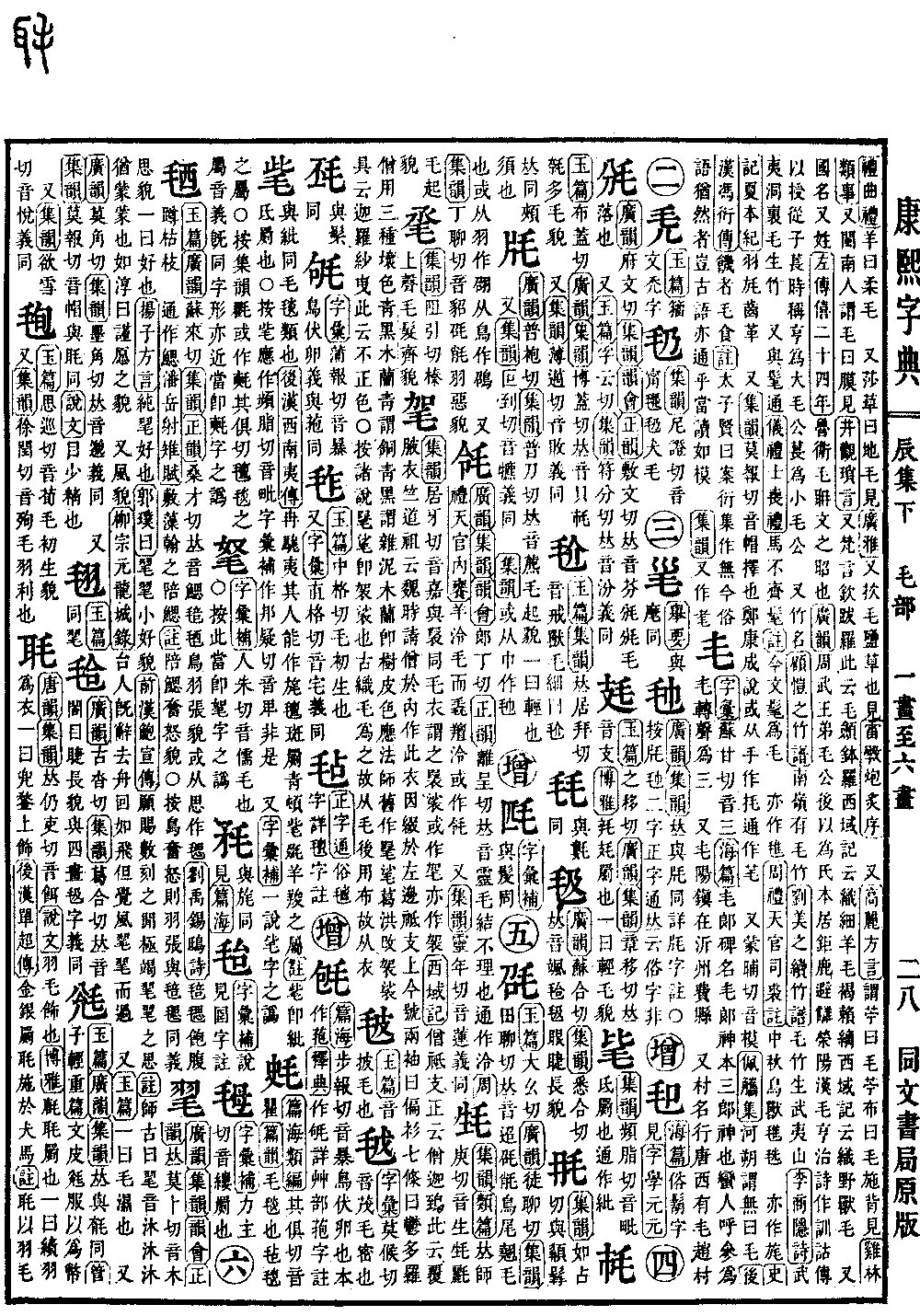
Chen Collection, Lower Volume
Radical: Fur (máo)
Kangxi Strokes: 10
Page 592, Entry 36
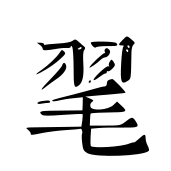
According to the Expanded Dictionary of Sounds (Guangyun), the Collection of Rhymes (Jiyun), the Collection of Rhymes and Explanations (Yunhui), and the Correct Rhymes (Zhengyun), it is pronounced mu. It describes the appearance of being deep in thought. Another interpretation suggests it means beautiful.
In the Dialects (Fangyan) by Yang Xiong, it states: "pure mu" means good. Guo Pu says: "mu mu" refers to the appearance of being small and beautiful.
In the History of the Former Han (Qianhan shu), in the biography of Bao Xuan, it states: "I wish to be granted a few moments of leisure to fully exhaust my sincere thoughts." The commentary by Yan Shigu says: mu is pronounced mu (descending tone); mu mu is like the appearance of being obscure. Ru Chun says: it refers to the appearance of being respectful and sincere.
It also refers to the appearance of the wind. In the Records of Longcheng (Longcheng lu) by Liu Zongyuan, it states: "After the people of the platform departed, the boat returned as if flying; one only sensed the wind passing by in a soft, continuous manner."
According to the Jade Chapters (Yupian), another interpretation is that it refers to the appearance of fur being wet.
According to the Expanded Dictionary of Sounds (Guangyun) and the Collection of Rhymes (Jiyun), it is pronounced miao. The meaning is the same.
According to the Collection of Rhymes (Jiyun), it is pronounced mao. It is the same as the character mao. According to the Explaining Graphs and Analyzing Characters (Shuowen jiezi), it refers to eyes lacking luster.