Zi Collection, Page Position: Lower
Radical: Private (sī)
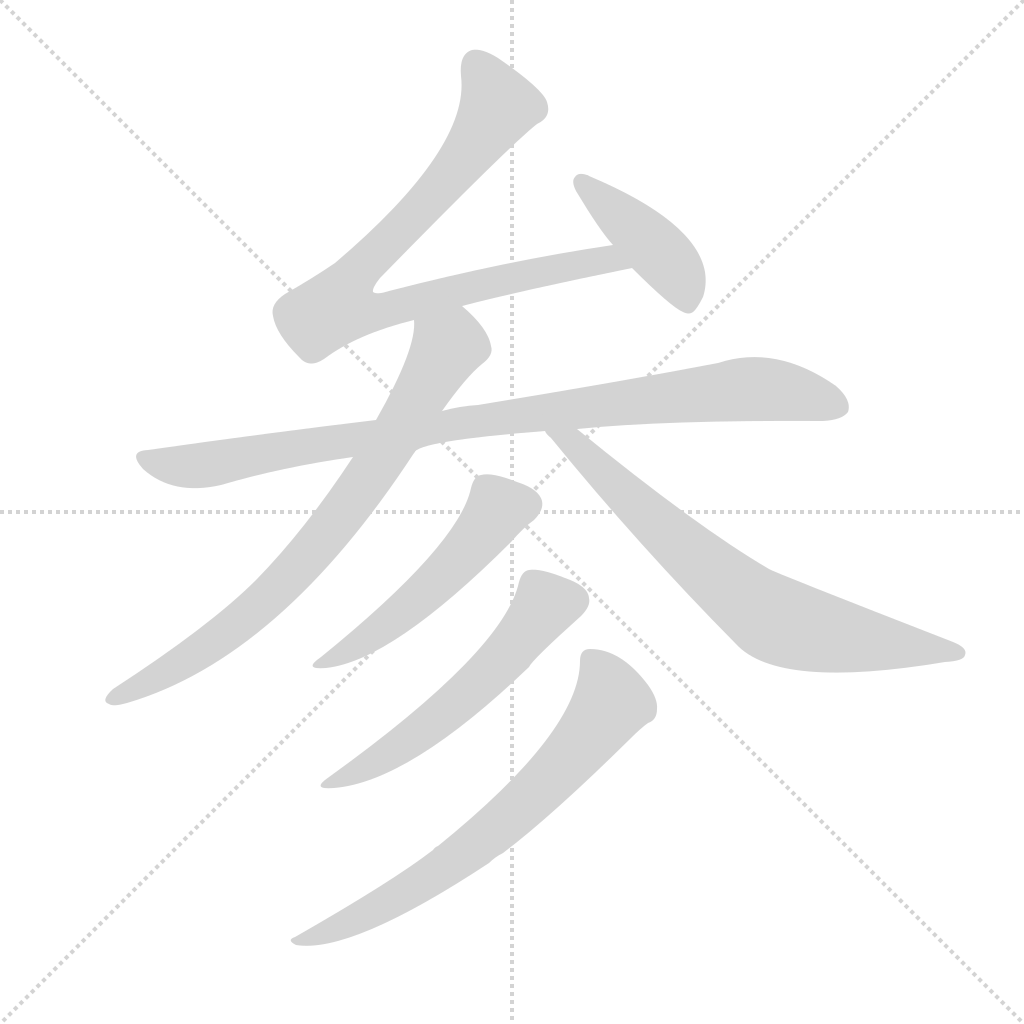
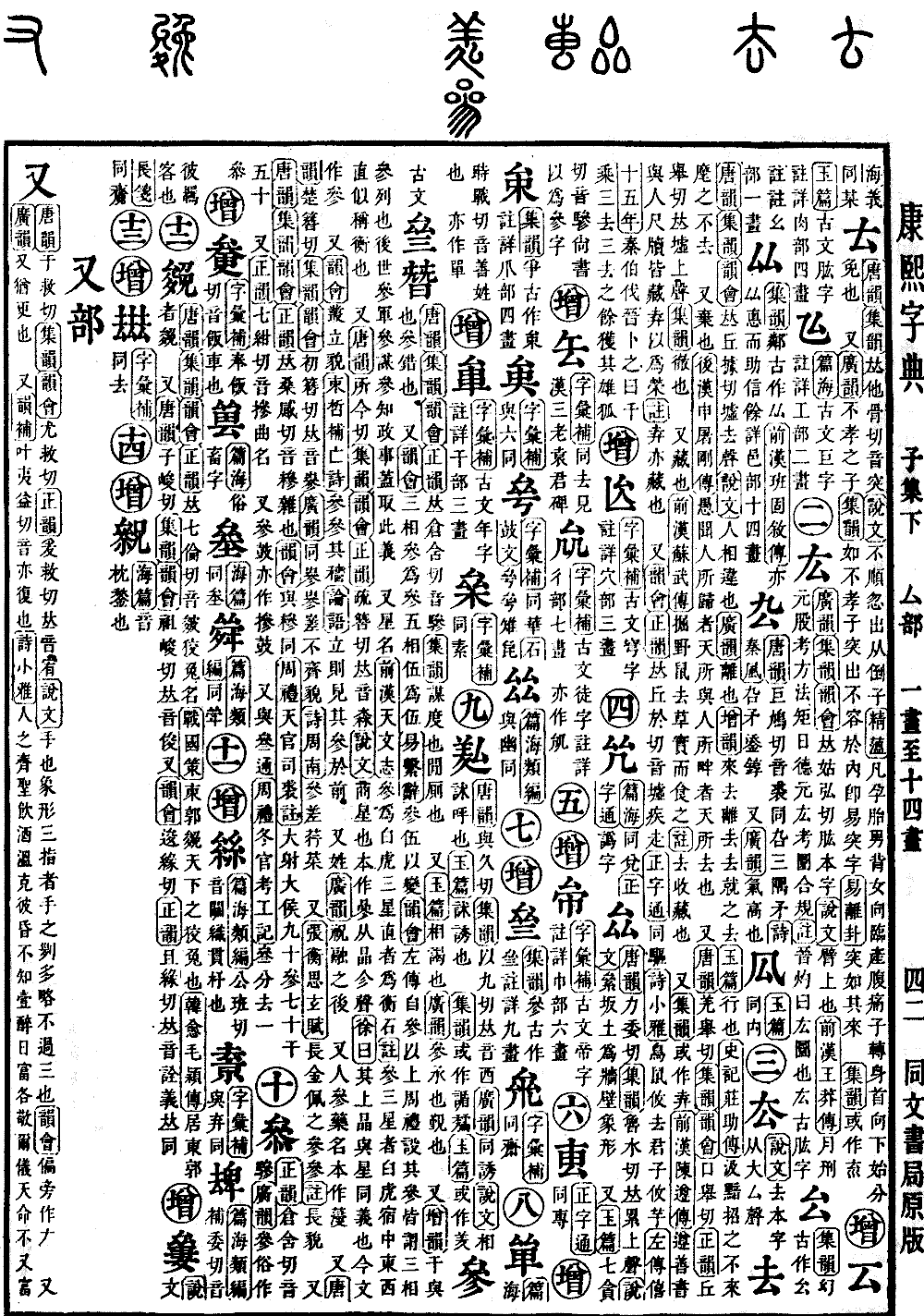
Entry: 參
Kangxi Stroke Count: 11
Page 164, Entry 21
Ancient form: 朁
Tang Dynasty Rhymes (Tangyun), Collected Rhymes (Jiyun), Dictionary of Rhymes (Yunhui), and Standard Rhymes (Zhengyun) define this as pronounced can. Jiyun states it means to plan or measure, and to intervene or interleave. Yu Pian states it means to visit one another. Guangyun states it means to receive or to have an audience with. Zengyun states it means to participate or interfere, and to be staggered or mixed. Yunhui states that when three items are compared, it is called can, and when five are matched, it is called wu. Book of Changes (Yijing), Commentary on the Appended Statements (Xici) states: By comparing and alternating them, changes are produced. Yunhui notes that in the Zuo Commentary (Zuo Zhuan), from can upwards is referred to, and in the Rites of Zhou (Zhouli), the establishment of its can refers to the arrangement of three things in a row. Later generations used terms such as advisor (canjun), consultant (canmou), and assistant administrator (canzhi zhengshi) based on this meaning.
Also the name of a constellation. History of the Former Han Dynasty (Qianhan Shu), Treatise on Astronomy (Tianwen Zhi) states: Can refers to the three stars of the White Tiger; those that are straight constitute the Hengshi. Annotation: The three stars of Can are in the White Tiger mansion; their straight alignment from east to west resembles a balance beam.
Tangyun, Jiyun, Yunhui, and Zhengyun define this as pronounced sen. Shuo Wen Jie Zi states it is the Shang constellation. Originally written as can, using the phonetic component jing. Xu states the jing component on top shares the same meaning as stars. Modern writing uses can.
Yunhui defines it as the appearance of things standing together in a cluster. Shu Xi, Supplementary Poems (Buwang Shi) states: The crops stand tall in clusters. Analects of Confucius (Lunyu) states: When standing, one sees them appearing clustered before one.
A surname. Guangyun identifies it as a descendant of Zhurong.
Ginseng, a medicinal herb. Originally written as can.
Tangyun, Jiyun, Yunhui, and Zhengyun define this as pronounced cen. Guangyun notes it is synonymous with cen. Cenci refers to an uneven or irregular appearance. Book of Odes (Shijing), Zhou South (Zhou Nan) section: Uneven are the water mallows. Zhang Heng, Thought Rhapsody (Si Fu) states: Lengthening my pendants, appearing long and trailing. Annotation: Describes length.
Tangyun, Jiyun, Yunhui, and Zhengyun define this as pronounced san. Means to mix. Yunhui notes it is synonymous with san. Rites of Zhou (Zhouli), Office of Heaven (Tianguan), Supervisor of Furs (Siqiu) annotation: In great archery, the great target is 90, the can is 70, and the small target is 50.
Zhengyun defines this as pronounced can. The name of a musical piece. Also can drum, also written as can drum.
Also used interchangeably with the number three. Rites of Zhou (Zhouli), Winter Office, Artificers' Record (Kaogong Ji) states: Divide and remove one.
Textual corrections: In History of the Former Han Dynasty, Treatise on Astronomy, the phrase concerning the three stars of the White Tiger, the original text was corrected to include the word is. In Zhang Heng, Rhapsody on Thinking (Sixuan Fu), the phrase concerning long pendants was corrected from metal pendants to my pendants. Wang Hongyuan's note states the word xuan in Zhang Heng's Rhapsody on Thinking was avoided due to naming taboos.