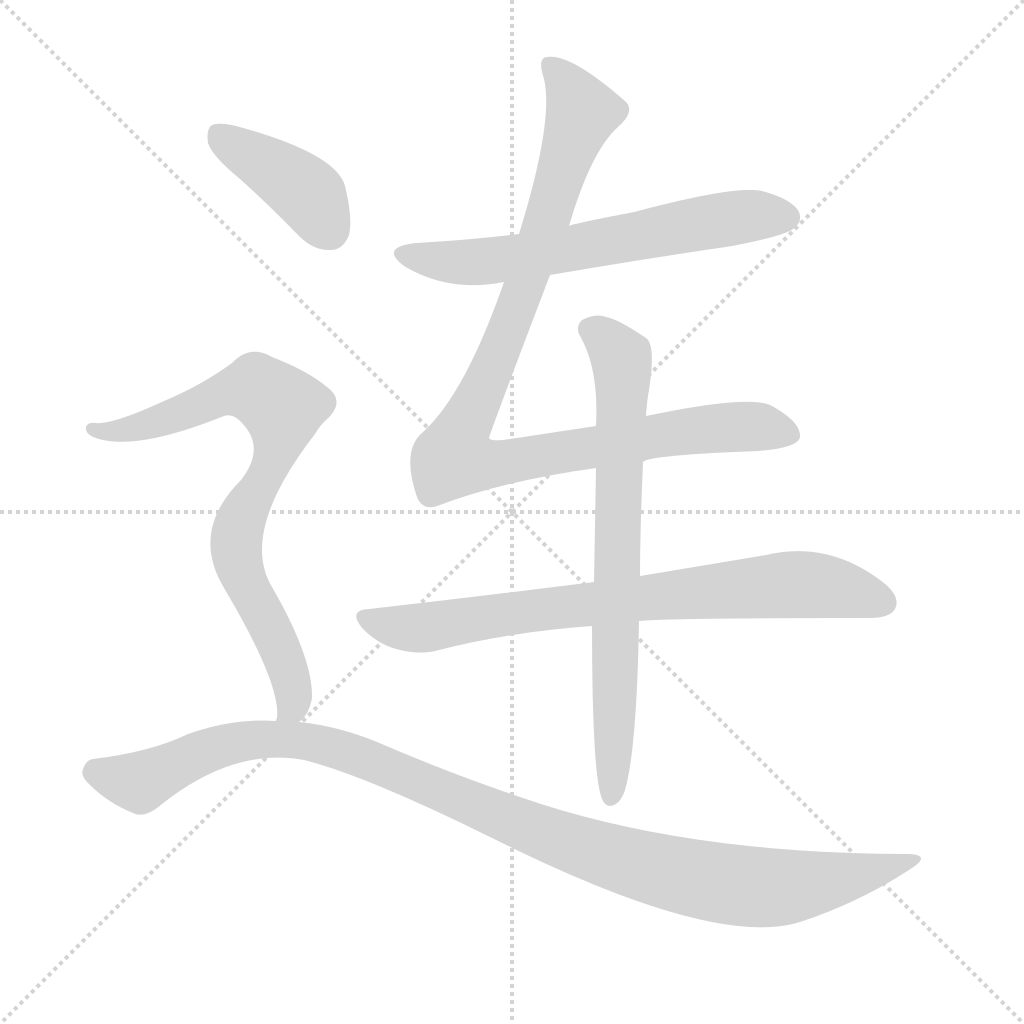
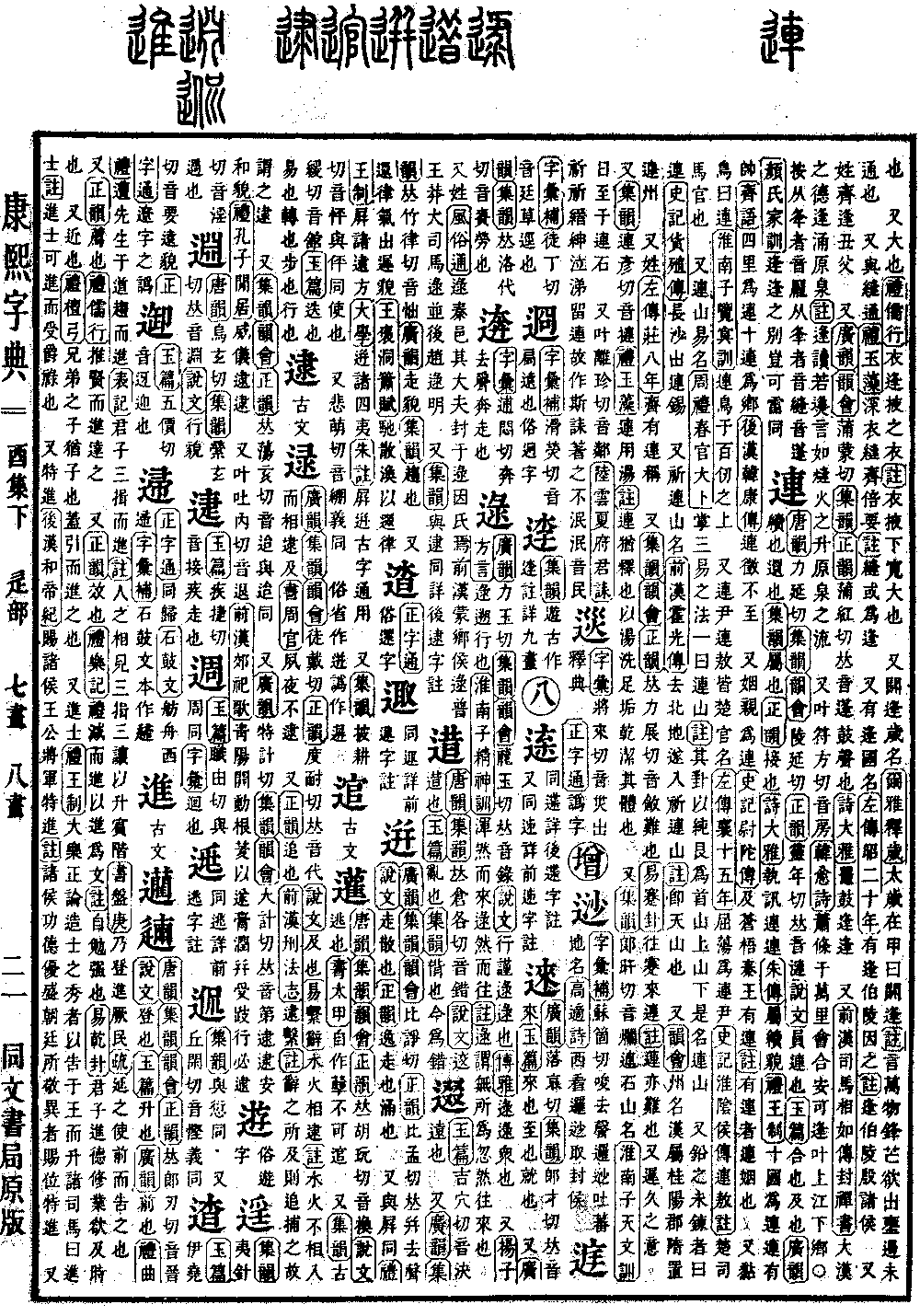
You Collection, Lower Volume
Radical: Walk (chuò)
Kangxi Strokes: 14
Page 1259, Entry 06
Pronounced lian
As defined in the Analytical Dictionary of Chinese Characters (Shuowen Jiezi), the meaning is connected in a circular manner.
In the Jade Chapters (Yupian), it means to join or to reach.
In the Broad Rhymes (Guangyun), it means to continue or to return.
In the Collection of Rhymes (Jiyun), it means to belong to.
In the Correct Rhymes (Zhengyun), it means to connect.
In the Book of Odes (Shijing), Great Odes section: "Capturing captives one after another." The commentary by Zhu Xi explains this as the appearance of continuous succession.
In the Book of Rites (Liji), Royal Regulations section: "Ten states form a lian (a group), and each lian has a commander."
In the Discourses of Qi (Qiyu): "Four neighborhoods form a lian, ten lian form a village."
In the Book of the Later Han, Biography of Han Kang: "Repeatedly summoned but did not arrive."
Also refers to marriage relations.
In the Records of the Grand Historian (Shiji), Biography of Wei Tuo: "And the Qin King of Cangwu had a connection (lian)." The commentary explains that having a lian means having a marital connection.
Also, to catch birds with sticky substances is called lian.
In the Huainanzi, Investigation of Instruction (Lanxun): "Snaring birds at a height of one hundred ren."
Also, lianyin and lianao were titles of officials in the State of Chu.
In the Zuo Commentary (Zuozhuan), 15th year of Duke Xiang: "Qu Dang served as lianyin."
In the Records of the Grand Historian, Biography of the Marquis of Huaiyin, commentary on lianao: "This was a military official position in Chu."
Also, Lianshan, the name of a classic of change.
In the Rites of Zhou (Zhouli), Spring Offices, Grand Diviner: "In charge of the methods of the three Books of Change, the first is called Lianshan." The commentary states: "Its hexagrams begin with pure Gen (Mountain), with mountain above and mountain below, hence it is called Lianshan."
Also, unrefined lead is called lian.
In the Records of the Grand Historian, Biographies of the Money-makers: "Changsha produces lian and tin."
Also, Qilian, the name of a mountain.
In the History of the Former Han, Biography of Huo Qubing: "Departing from Beidi, he arrived at Qilian Mountain." The commentary notes: "This is the Tianshan mountain range."
Also, according to the Collection of Rhymes, it is the name of a prefecture. During the Han dynasty, it belonged to Guiyang Commandery; during the Sui dynasty, Lian Prefecture was established.
Also a surname.
In the Zuo Commentary, 8th year of Duke Zhuang: "In Qi there was Lian Cheng."
Pronounced lian (falling tone).
Meaning difficult.
In the Book of Changes (Yijing), Difficulty hexagram: "Going leads to difficulty, coming leads to lian." The commentary states: "Lian also means difficulty." It also conveys the sense of being slow or prolonged.
Pronounced lian (third tone).
In the Book of Rites, Jade Altar (Yuzao) section: "Lian with hot water." The commentary explains: "Lian is the same as rinsing." It means to use hot water to wash away dirt from the feet and dry the body until clean.
Pronounced lan.
Lianshi is the name of a mountain.
In the Huainanzi, Treatise on Celestial Patterns (Tianwenxun): "The sun arrives at Lianshi."
Also rhymes with lin.
In Lu Yun's Eulogy for Prefect Xia: "The officials stand in rows with sorrow, weeping and lingering (liulian). Therefore I compose this eulogy, so that it may be recorded and not forgotten." Note: min rhymes with min.