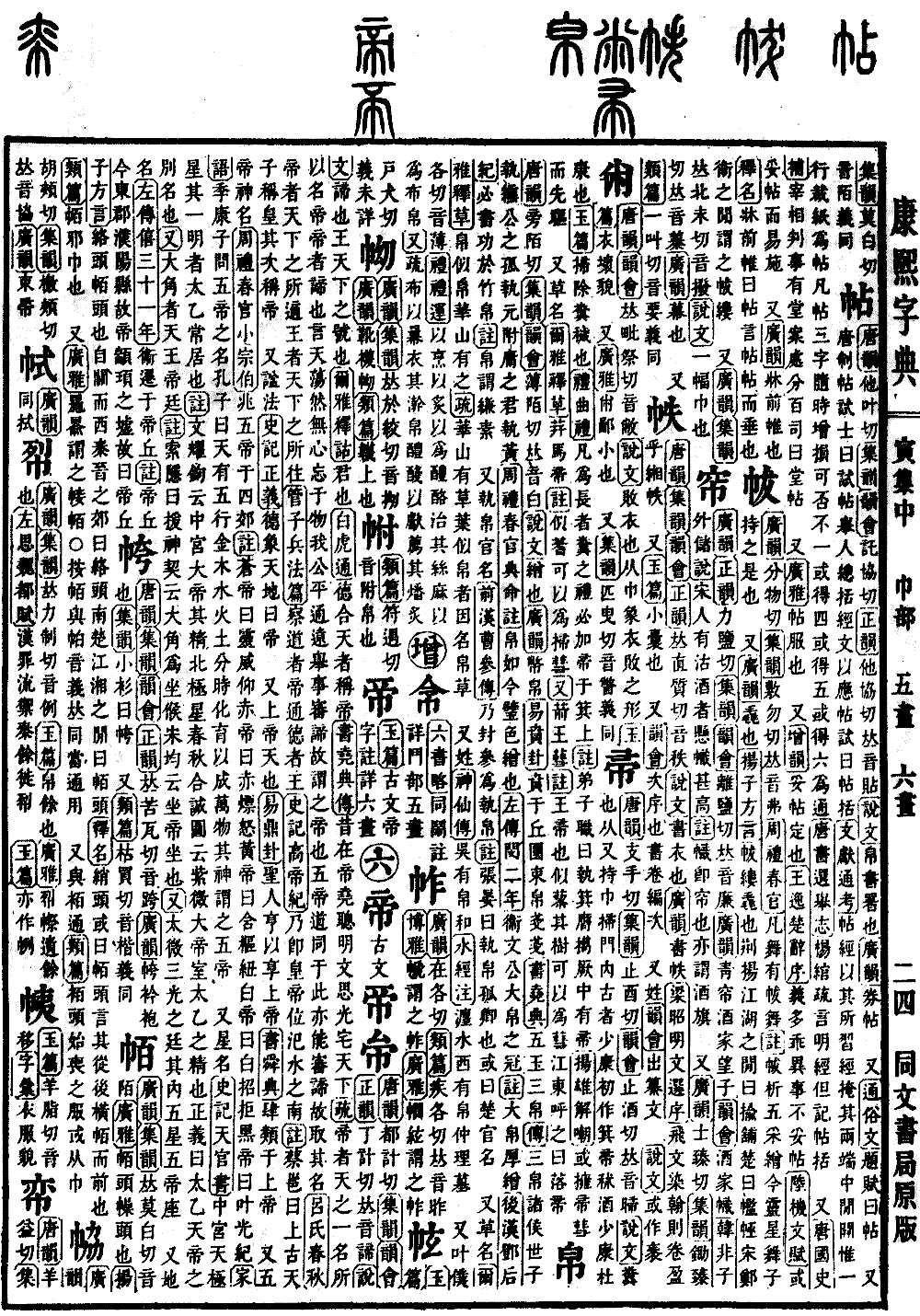
Yin Collection, Middle Volume
Radical: Towel (jīn)
Kangxi Strokes: 19
Page 330, Entry 03
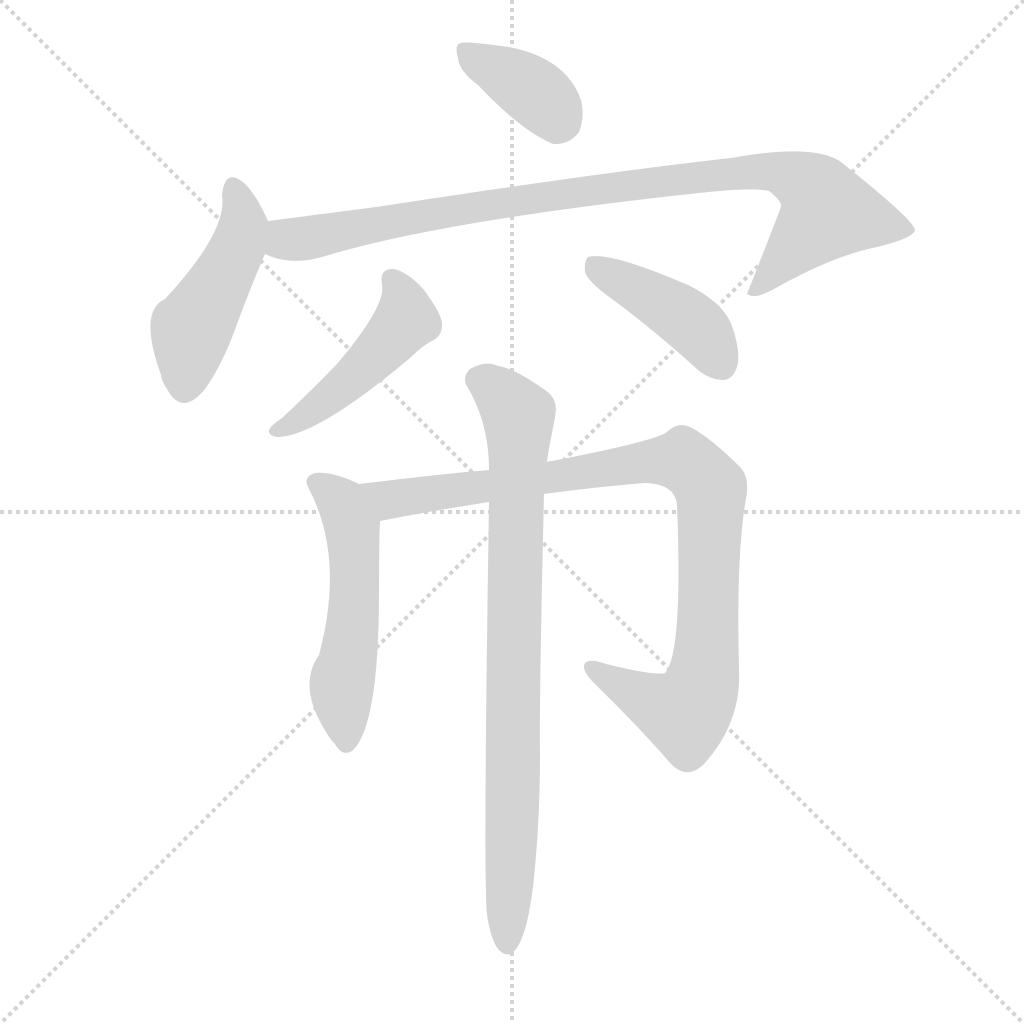
Pronounced lian. According to the Expanded Rhymes (Guangyun) and Orthodox Rhymes (Zhengyun), and also the Rhyme Collection (Jiyun) and Rhyme Assembly (Yunhui), it denotes the green banner hung as a sign for a wine shop. According to the Rhyme Assembly, it is a banner for a wine shop. According to the Han Feizi: "A man from Song who sold wine hung his banner very high." The commentary notes that the banner is the same as the curtain, also known as a wine flag.
Also pronounced zhen. According to the Expanded Rhymes and Rhyme Collection, it denotes a screen or curtain.
Also pronounced yao. According to the Classified Chapters (Leipian), the meaning is the same.
Pronounced lian. Made by weaving bamboo into a screen or partition. According to the Explanation of Names (Shiming), a curtain (lian) is named for modesty (lian), serving as a screen to conceal oneself. According to the Apocrypha of the Book of Rites (Liwei), the Son of Heaven uses an outer screen, feudal lords use an inner screen, great officers use a curtain, and scholars use a hanging cloth. According to the Preface to the Biographies of Wang and Gong in the History of the Former Han Dynasty (Qianhan Shu), Yan Junping practiced divination in the Chengdu market; when he had earned enough for his daily needs, he would close his shop, lower the curtain, and teach the Classic of the Way and Virtue (Laozi).
According to the Rhyme Assembly, it also refers to a type of bamboo sheath.