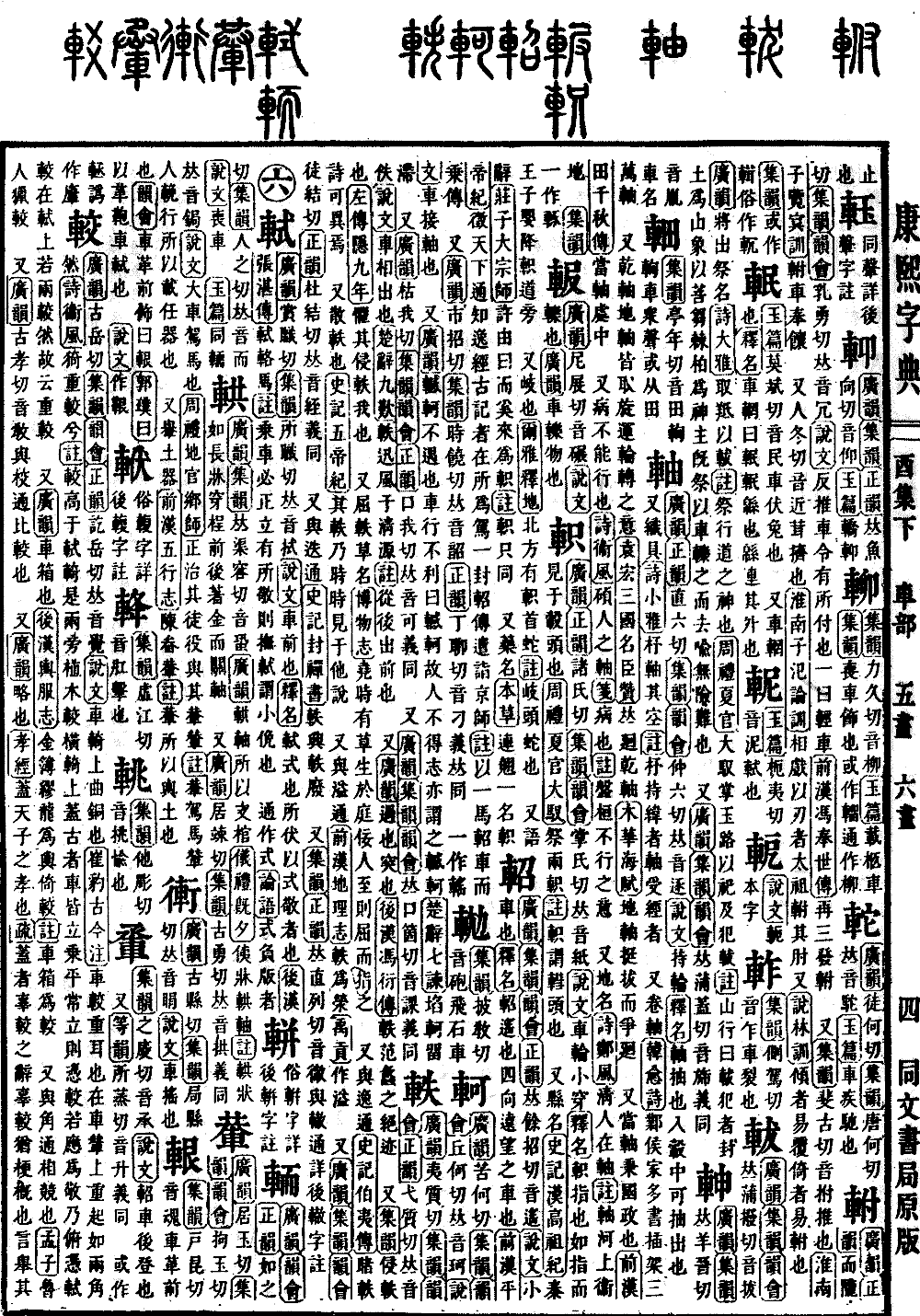
You Collection, Lower Volume
Radical: Carriage (chē)
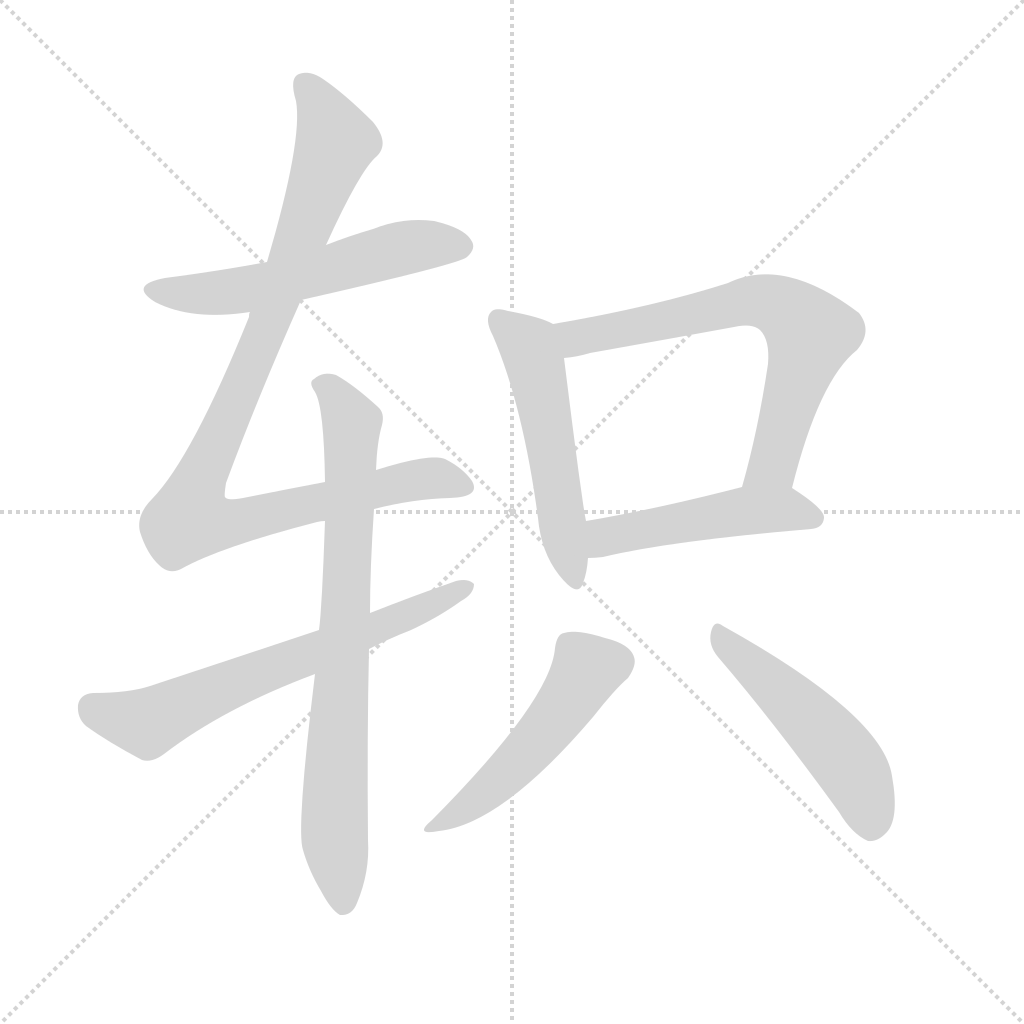
Zhi
Kangxi stroke count: 12
Page 1242, Entry 01
Pronounced zhi (rising tone).
As defined in the Analytical Dictionary of Characters (Shuowen Jiezi), it refers to the small hole in a carriage wheel.
According to the Explanation of Names (Shiming), it is called zhi, meaning a finger, as it resembles a finger visible at the end of the wheel hub.
In the Rites of Zhou (Zhouli), Summer Offices, Great Charioteer section, it mentions offering sacrifices to both zhi. The commentary states that zhi refers to the end of the axle protruding from the hub.
It is also the name of a district. In the Records of the Grand Historian (Shiji), Annals of Gaozu of Han, it notes that Ziying, Prince of Qin, surrendered beside the zhi road.
It also means forked. In the Literary Expositor (Erya), Explanation of Earth, it mentions a northern creature called the zhi-headed snake. The commentary identifies this as a snake with a forked head.
It is also used as a particle. In the Book of Zhuangzi (Zhuangzi), Great and Venerable Teacher, Xu You says: Why have you come here? The commentary notes that zhi and zhi are the same.
It is also the name of a medicine. According to the Materia Medica (Bencao), the plant forsythia is also known as zhi.