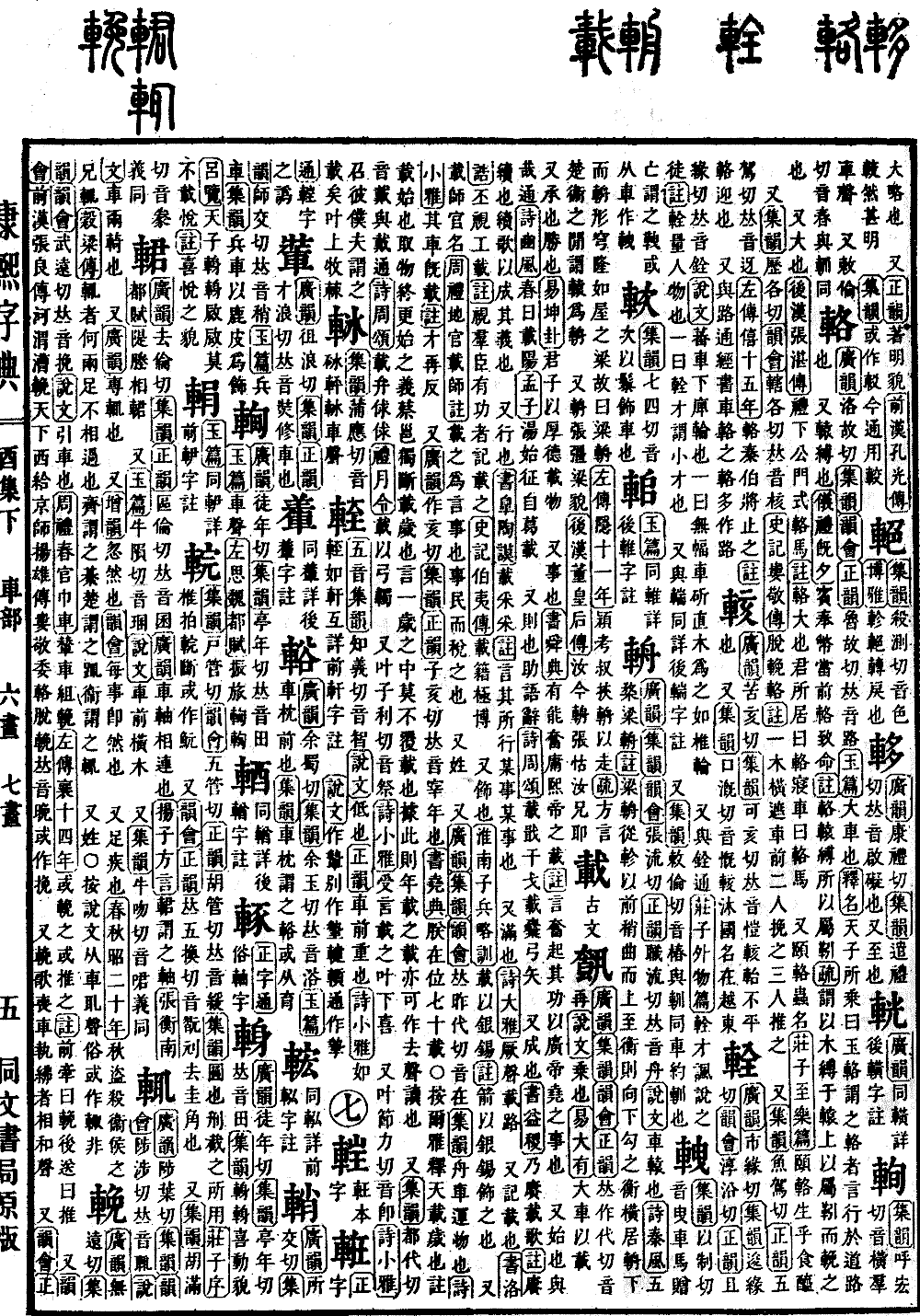
You Collection, Lower Volume
Radical: Carriage (chē)
Zhe
Kangxi strokes: 14
Page 1243, Entry 01
Broad Rhymes (Guangyun): Pronounced zhe (entering tone)
Collected Rhymes (Jiyun), Rhymes Compendium (Yunhui): Pronounced zhe (entering tone)
Explanatory Notes on Characters (Shuowen): The side railings of a carriage.
Broad Rhymes (Guangyun): Arbitrary or acting on one's own initiative.
Expanded Rhymes (Zengyun): Suddenly.
Rhymes Compendium (Yunhui): Every matter is immediately so.
Also: A disease of the feet.
Spring and Autumn Annals (Chunqiu), 20th Year of Duke Zhao: In the autumn, bandits killed Zhe, the elder brother of the Duke of Wei.
Guliang Commentary (Guliang zhuan): What is meant by Zhe? It describes feet that cannot pass one another. In the state of Qi it is called qi, in Chu it is called er, and in Wei it is called zhe.
Also: A surname.
Note: According to Explanatory Notes on Characters (Shuowen), it is formed from the carriage radical with a phonetic component (er). Common usage sometimes writes it as a variant form (zhe), which is incorrect.
Textual Research:
Guliang Commentary (Guliang zhuan): What is meant by Zhe? It describes feet that cannot pass one another. According to the original text, the word can (neng) has been added after the word not (bu).