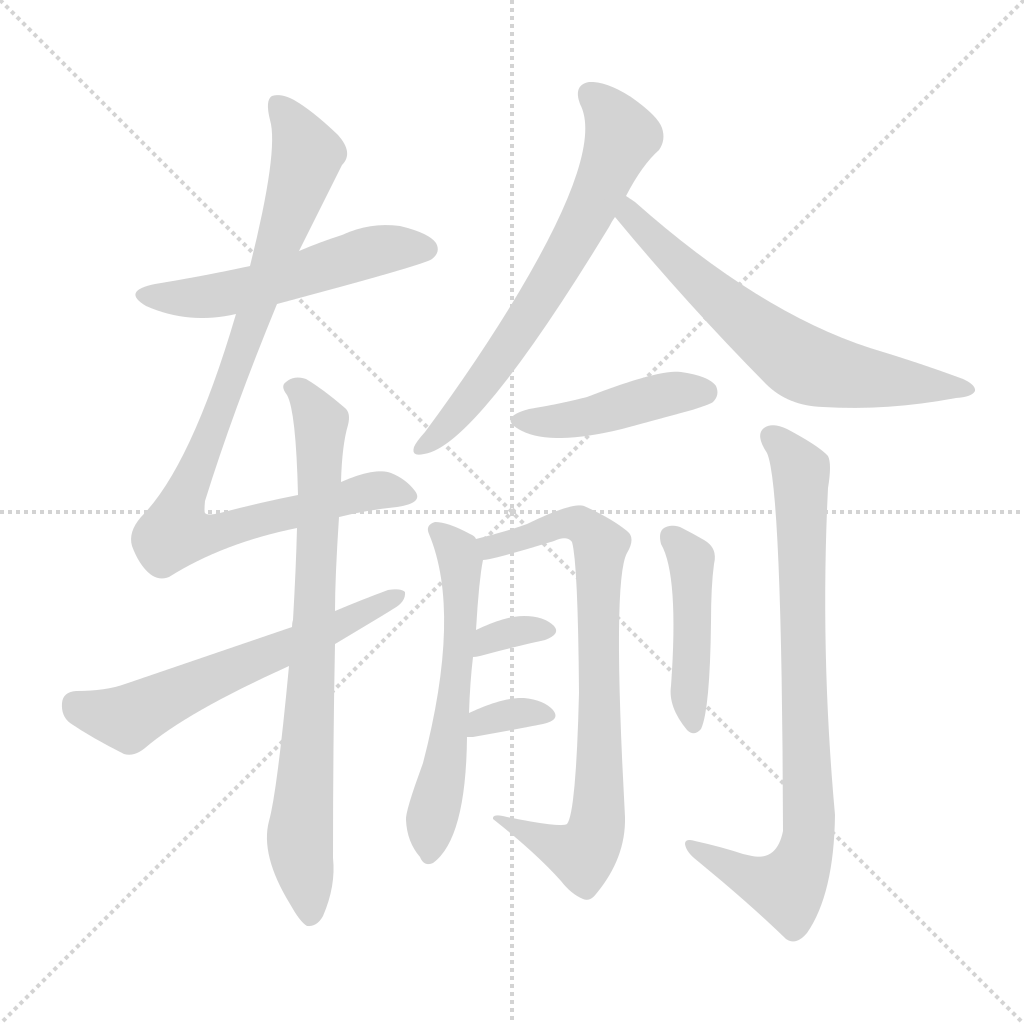
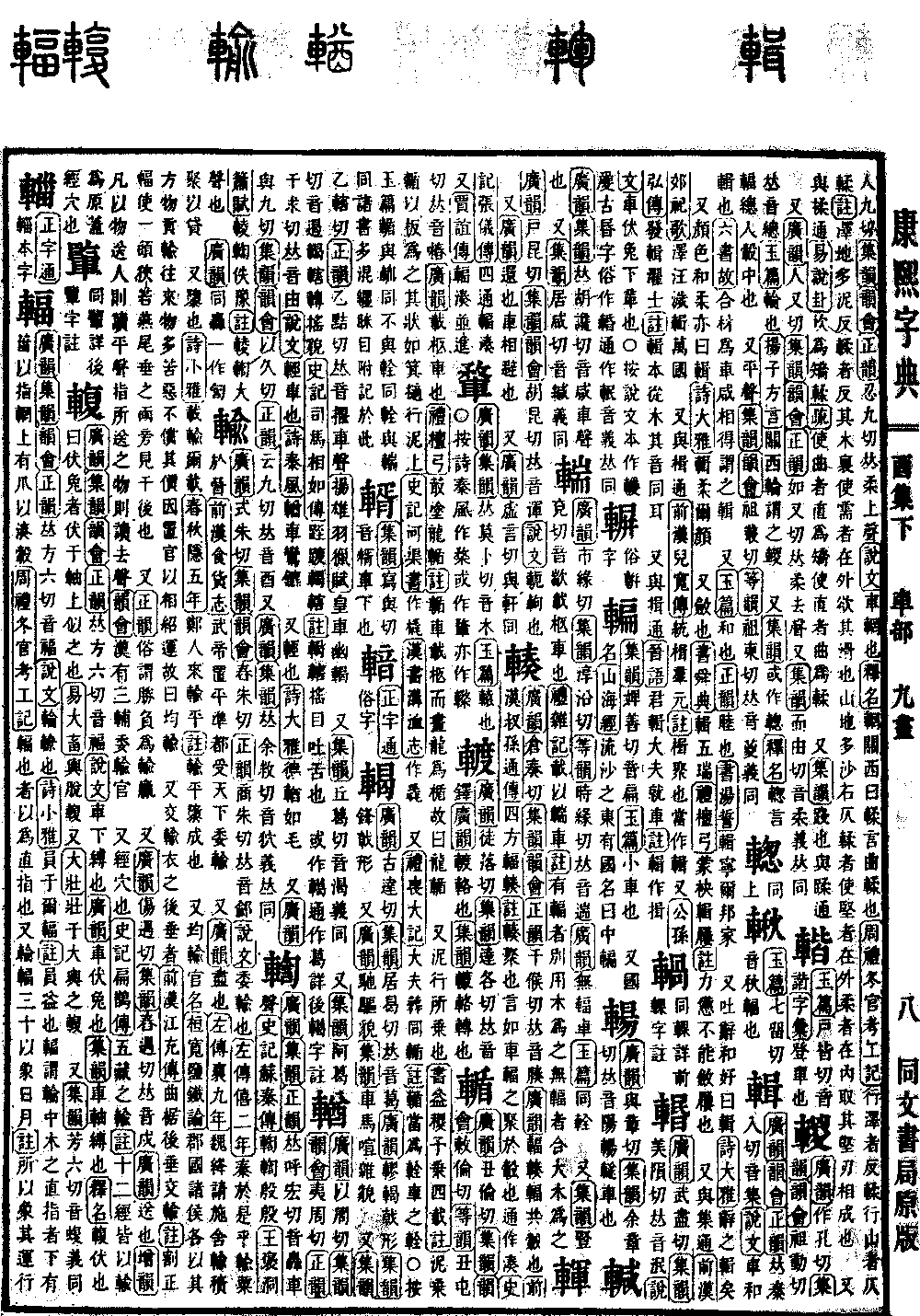
You Collection, Lower Volume
Radical: Carriage (chē)
Kangxi strokes: 16
Page 1246, Entry 01
Pronounced shu.
In the Shuowen Jiezi (Shuowen), it means to transfer or deliver.
Zuo Tradition (Zuo Zhuan), Second Year of Duke Xi: Qin then delivered millet to Jin.
History of the Former Han (Qianhan Shu), Treatise on Food and Money: Emperor Wu established the level-standard system, with the capital receiving the delivered supplies from all under heaven.
Also, it means to exhaust.
Zuo Tradition (Zuo Zhuan), Ninth Year of Duke Xiang: Wei Jiang requested a general amnesty, exhausting the accumulated stores to provide loans.
Also, it means to destroy.
Book of Odes (Shijing), Lesser Odes: To overturn your burdens.
Spring and Autumn Annals (Chunqiu), Fifth Year of Duke Yin: The people of Zheng came to break the peace.
Commentary: To break the peace means to destroy the alliance.
Also, Equalized Delivery, the name of a government office.
Discourse on Salt and Iron (Yantielun) by Huan Kuan: The commanderies, kingdoms, and feudal lords each delivered their local products as tribute; the transport back and forth was often bitter and the goods were of poor quality, not worth their price, so an office was established to coordinate the transport, which was called Equalized Delivery.
Also, crossed hanging parts, referring to the back flap of a garment.
History of the Former Han (Qianhan Shu), Biography of Jiang Chong: A curved hem with crossing flaps hanging behind.
Commentary: Cutting a full width of cloth so that one end is narrow like a swallow tail, hanging it on both sides, visible at the back.
Also, according to the Correct Rhymes (Zhengyun), commonly used to refer to victory and defeat as winning and losing.
Pronounced shu (falling tone).
In the Extensive Dictionary of Rhymes (Guangyun), it means to escort or send.
In the Augmented Rhymes (Zengyun), generally, when using things to send to someone, it is read in the level tone. When referring to the thing that is sent, it is read in the falling tone.
Rhyme Collection (Yunhui): During the Han dynasty, there were officials of the Three Auxiliary regions responsible for deliveries.
Also, acupuncture points.
Records of the Grand Historian (Shiji), Biography of Bian Que: The transport points of the five viscera.
Commentary: The twelve meridians all use the transport points as their source; these are the acupuncture points.