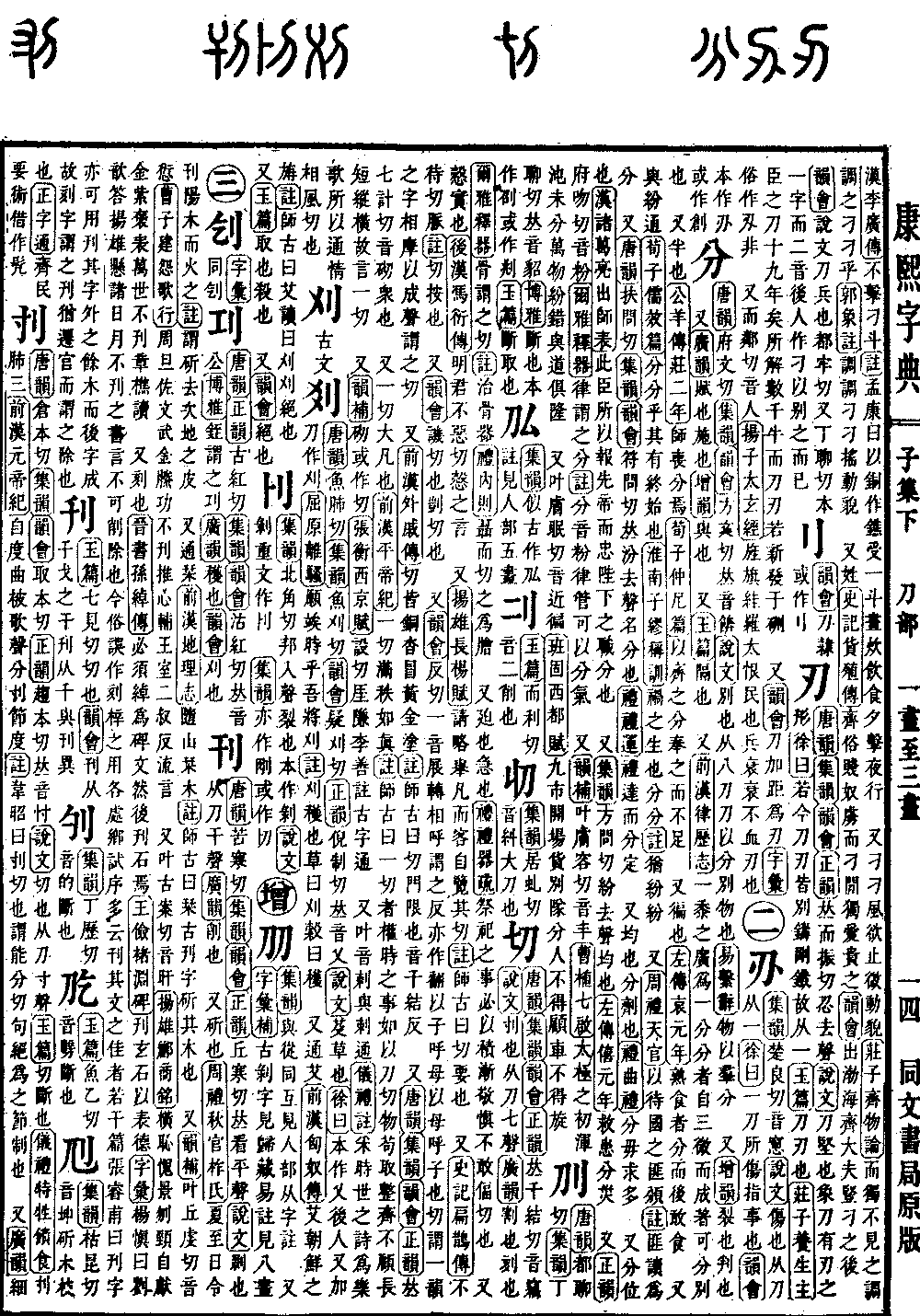
Zi Collection, Page Position: Lower. Radical: Knife (dao). Character: Qie. Kangxi Dictionary Stroke Count: 4 strokes. Page Number: Page 136, Column 9.
Regarding pronunciation:
The Tang Rhymes (Tangyun), Collected Rhymes (Jiyun), Rhyme Association (Yunhui), and Standard Rhymes (Zhengyun) all provide the fanqie pronunciation qian plus jie, sounding similar to the character qie.
Definitions:
1. The original meaning is to cut or carve. Explaining Graphs and Analyzing Characters (Shuowen Jiezi) defines it as cun, meaning to cut. The character form is derived from the Radical: Knife (dao), with the component for the number seven (qi) providing the sound. The Broad Rhymes (Guangyun) defines it as to cut or to carve. Approaching the Refined (Erya) mentions that processing bone is called qie, with commentaries noting it refers to the fashioning of bone implements. The Book of Rites (Liji) records that slicing and then cutting meat into fine strips makes minced meat (kuai).
2. Extended to mean pressing or urgent. A commentary on the Book of Rites states that matters of sacrifice require the gradual accumulation of sincerity and respect, and one must not be hasty or careless.
3. Expresses being sincere and simple. The Book of the Later Han (Hou Hanshu) states that an enlightened ruler does not dislike sincere and honest speech.
4. Refers to the essential points or an outline. In the Rhapsody on the Tall Poplars (Changyang Fu) by Yang Xiong, it says one may briefly list the general points so the guest may see the essentials for themselves, with commentaries stating that qie means the main point.
5. In traditional medicine, it refers to diagnosis by pressing the pulse. The Records of the Grand Historian (Shiji) mentions not waiting to press the pulse, with commentaries explaining that qie means to press the pulse.
6. Refers to satirizing or earnestly admonishing. The Rhyme Association mentions it means to mock or to give earnest advice.
7. Refers to the fanqie phonetic system. The Rhyme Association explains that fanqie is a method of indicating pronunciation by combining the initial of one character with the final of another, also called fan; the blending of two characters to form a sound is called qie.
8. Used interchangeably with the character qi, meaning a threshold. The Book of Han (Hanshu) mentions that thresholds were all covered in copper and coated with gold, with commentaries stating that qie here means threshold, pronounced through the fanqie of qian and jie.
Other pronunciations and usages:
Also pronounced through the fanqie of qi and ji, sounding like the word for threshold (qi), meaning numerous.
The term yiqie means in general or without exception. The Book of Han states that all received full rank as if they were permanent officials, with commentaries explaining that yiqie is like using a knife to cut things, seeking only uniformity without regard for length or orientation, symbolizing a temporary expedient or a generalization.
The Rhyme Supplement (Yunbu) states that the word for threshold is sometimes written as qie. In the Rhapsody on the Western Capital (Xijing Fu) by Zhang Heng, it mentions setting the thresholds on the cliffs, and the commentator Li Shan notes that the two characters were interchangeable in ancient times.
Also used interchangeably with ci, and read with a rhyming pronunciation like ci. A commentary on the Etiquette and Ceremonies (Yili) mentions collecting the poems of the era to create songs for music, used to communicate feelings and to satirize or admonish one another.