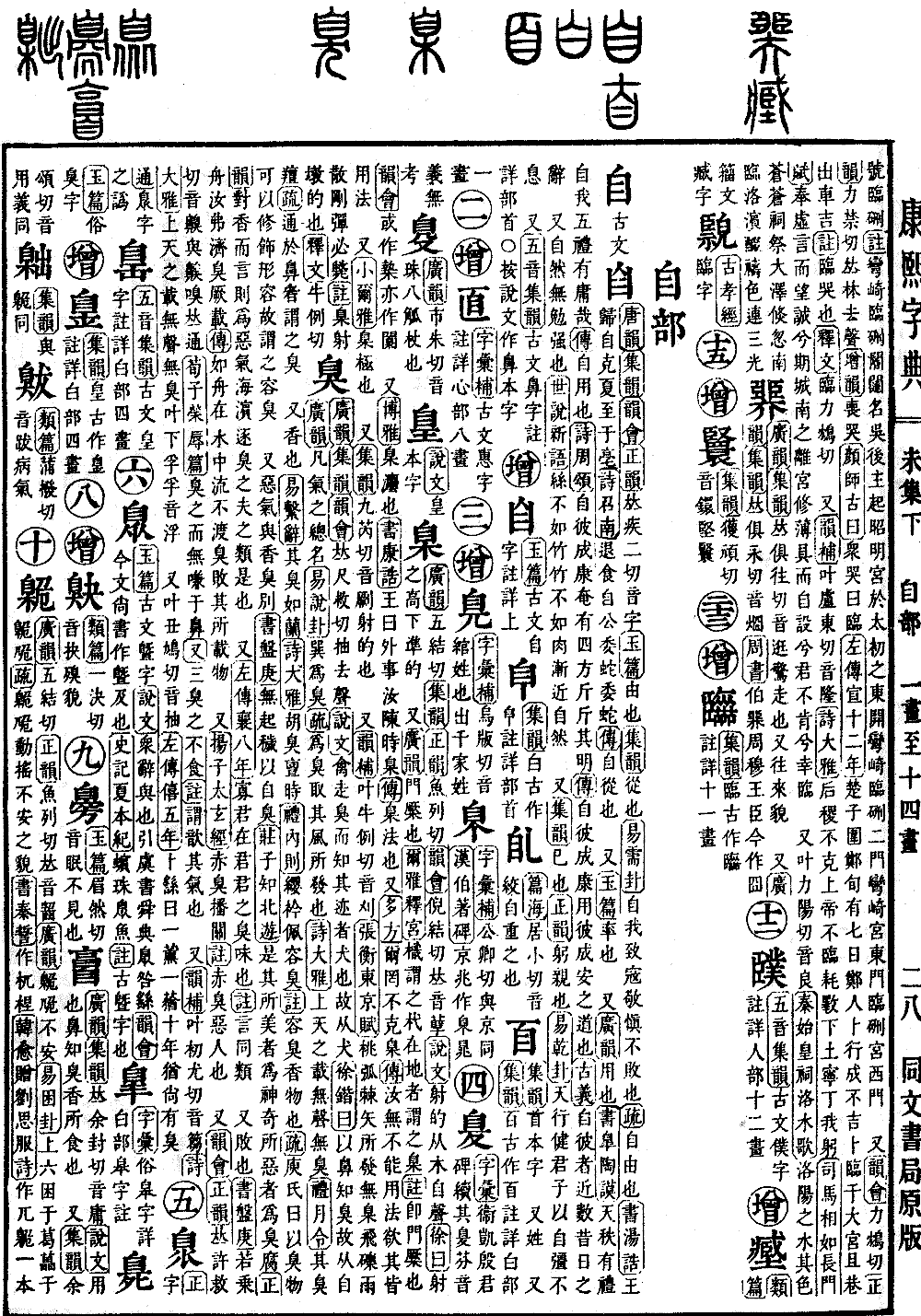
Wei Collection, Lower Volume
Radical: Self (zì)
Kangxi Strokes: 10
Page 1000, Entry 20
Guangyun (Expanded Rhymes), Jiyun (Collected Rhymes), and Yunhui (Collection of Rhymes) state the pronunciation is chou (falling tone).
Shuowen (Explaining Graphs): Animals that run and identify tracks by scent are dogs. Therefore, the character is composed of the dog radical. Xu Kai states: It uses the nose to perceive scents, therefore it is composed of the self radical.
Guangyun: A general term for all scents.
Book of Changes (Yijing), Explanation of the Trigrams: The Xun trigram represents scent. Commentary: It represents scent, taking the meaning that wind can disperse scent.
Book of Odes (Shijing), Daya: The affairs of Heaven have neither sound nor scent.
Book of Rites (Liji), Monthly Ordinances: Its scent is rank. Commentary: That which is perceived through the nose is called chou.
Also refers to fragrance. Book of Changes, Appended Remarks: Its scent is like an orchid. Book of Odes, Daya: The rich fragrance is truly fine. Book of Rites, Inner Teachings: Wearing a sachet at the sash. Commentary: Rong chou refers to fragrant items. Commentary: Master Yu says: Because fragrant items can adorn one's appearance, they are called rong chou.
Also refers to a foul smell, distinct from fragrance. Book of Documents (Shangshu), Pan Geng: Do not raise filth and make yourselves stink. Zhuangzi, Knowledge Wanders North: This is to treat what they consider beautiful as miraculous, and what they loathe as putrid. Zheng Yun (Standard Rhymes): In contrast to fragrance, it is a foul odor, such as those who pursue foul smells by the seaside.
Also, Zuo Zhuan (Chronicle of Zuo), 8th year of Duke Xiang: Our lord, in relation to your lord, is like scents that match. Commentary: It means to be of the same kind.
Also refers to putrefaction. Book of Documents, Pan Geng: Like riding a boat; if you do not cross the river, you will cause the goods on the boat to spoil. Commentary: Like a boat in the middle of the water failing to cross, which causes the goods loaded on the boat to rot and spoil.
Also, Yangzi, Tai Xuan Jing (Great Mystery): The red foul smell spreads through the pass. Commentary: Red foul smell refers to evil people.
Also, Yunhui and Zheng Yun state the pronunciation is xiu (falling tone). It is interchangeable with the characters meaning to smell or sniff. Xunzi, Glory and Disgrace: Smell it without satisfying the nose. Also: Smelled it several times but did not eat it. Commentary: This refers to inhaling its scent.
Also, in rhyme appendices, it rhymes with chu (level tone). Book of Odes, Daya: The affairs of Heaven have neither sound nor scent. It rhymes with the character fu in the following line. Fu is pronounced fu.
Also rhymes with chou (level tone). Zuo Zhuan, 4th year of Duke Xi: The divination says: If fragrant herbs and foul herbs are placed together, even after ten years, there will still be a foul smell.
Correction notes: In Book of Rites, Inner Teachings, the text formerly reading ying jin should be corrected to jin ying. In Zuo Zhuan, 4th year of Duke Xi, the text formerly reading 5th year should be corrected to 4th year, and the phrase you shang should be corrected to shang you.